I'll Be Bach
A computer program is writing great, original works of classical music. Will human composers soon be obsolete?
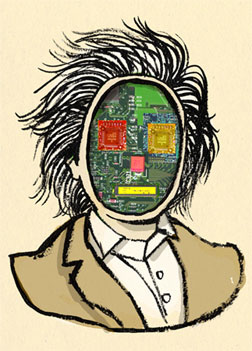
Composer David Cope has a knack for describing music in the least romantic terms possible. Whenever Mozart heard something, Cope says, "He was able to digest it and store it in his database. He could recombine it with other things so that the output would be hardly recognizable." Mozart has been called many things— plagiarist, potty-mouth, politician —but rarely do you hear him accused of being a computer scientist.
There's a reason Cope talks about composing this way: He is the inventor of the world's most musically creative computer program, whose latest album came out a few weeks ago. Cope has been writing software to help him compose music for 30 years, and he long ago reached the point where most people can't tell the difference between real Bach and the Bach-like compositions his computer can produce. Audiences have been moved to tears by melodies created by algorithms. And yet, it's not exactly that Cope has created a computer than can write music like a human. The way he sees it, it's that humans compose like computers.
The current version of Cope's software is named "Emily Howell," and it is the successor to an earlier effort he called "Emmy," an almost-acronym for "Experiments in Musical Intelligence." (Howell is Cope's father's first name and his middle name.) Ms. Howell's ancestry dates back to 1980, when Cope—by then a successful human composer—hit a brick wall while trying to write an opera. Cope, a genuine polymath with an aptitude for computers, had been playing music his entire life and was respected among modern composers, but around his 40th birthday his ideas started to dry up. In desperation, he wrote a computer program to generate random melodies and musical ideas.
The results were predictably unlistenable. But his composer's block persisted, so he kept working on the software. His first breakthrough came when he began to rethink how human beings compose. His software had been starting its work from scratch, but it occurred to Cope that human composers draw on a huge amount of data when they sit down to write a piece of music. "We don't start with a blank slate," he said. "In fact, what we do in our brains is take all the music we've heard in our life, segregate out what we don't like, and try to replicate [the music we like] while making it our own." What separates great composers from the rest of us, he says, is the ability to accurately compile that database, remember it, and manipulate it into new patterns.
Cope built a huge database of existing music, beginning with hundreds of Bach chorales that he tediously coded by hand. (Each note is given five values: pitch, duration, volume, when it appears in the piece, and which voice or instrument is making it.) The software then did essentially the same thing any complex computer model does: It scoured huge amounts of data by breaking them up into manageable chunks—in this case, short passages from the chorales—and looked for patterns. It then altered and recombined bits and pieces into new works that fit the patterns it had found. "It was an analytical problem more than a composing problem," Cope said. Before long, the program could compose mediocre Bach-like works. It was a start.
Chorales were a natural place for a program to start because, like canons and fugues, they operate according to a set of musical rules governing harmony and structure. Unfortunately, Cope had not been commissioned to compose thousands of mediocre chorales—he had an opera to write. So next he set about analyzing more complex works that relied less on a prescribed structure. In addition to short phrases, the software now analyzed the structure of an entire piece; for instance, looking at how themes would repeat at different points. He expanded the database to include Rachmaninoff, Chopin, Barber, Copland, and many others, including his own work. *
By 1987, "Emmy" was sophisticated enough to help Cope finish his long overdue opera, "Cradle Falling." It was a collaborative effort between Cope and his brainchild: The composer would listen to the computer's musical ideas and incorporate the ones he liked into his piece. Working with Emmy, a project he had struggled with for seven years took only two weeks to finish. At the time, he didn't tell anyone about the work's genesis, and its debut in Richmond two years later garnered the best reviews of his career. The Richmond Times Dispatch described one passage as "a supreme dramatic moment, punctuated by the captivating beat of drums."
As the program continued to improve, Cope began playing less and less of a role in the compositions Emmy was producing. Shortly after his opera debuted, he began publishing works under Emmy's name. In 1992, she wrote 1,500 symphonies, 1,000 piano sonatas, and 1,000 string quartets, among other works, which Cope bundled under the modest title "5,000 Works. You can listen to two clips from Emmy's work below. The audio is converted from MIDI files, hence the tinny sound of the piano.
Cope's most recent album, From Darkness, Light, is divided into three works: a collection of three preludes and three fugues, a long overture, and a four-part piano piece called "Shadow Worlds." The title piece opens with a frenetic keyboard-length run like something out of a Liszt sonata. It's followed by a brisk fugue, which sounds like Bach, and a celestial prelude clearly influenced by Rachmaninoff—a simple melody ornamented with brisk arpeggio-like runs. The most compelling track is the fourth, a slower fugue with meandering motif that reminds me a bit of Bach's "Musical Offering." (Listen to clips on the next page.) There isn't an unlistenable track on the album, though it is probably not destined to be a fan favorite for the simple reason that it lacks a coherent, overarching sound or timbre. But it's shockingly good for a computer-assisted composition. (Cope still gives Emily Howell feedback on what he likes and doesn't like, but she's doing most of the heavy lifting these days.)
From Darkness, Light:
Prelude:
Fugue:
Prelude:
Fugue:
Regardless of whether Emily Howell's work is to your taste, it is compelling evidence that Cope is at least partially right about how composing works. While it's not difficult to guess Howell's influences, the fact that they sound like original, creative pieces is a testament to the database model of composing. Still, I suspect most people will find Cope's theory of composing inherently distasteful. We prefer to think of art as an art, not a science. Not only does Cope disagree, he is an extreme relativist about music. In his opinion, all melodies—any rhythmic string of notes—are equally good. The reason we like some better than others is a product of how we've been socialized in a Western musical tradition. The work that Emmy and Emily Howell produce tends to sound pretty Western, but that's the sort of material they were given to work with.
To stump Cope, I presented him with the famous melody to the second movement of Beethoven's C minor Sonata, the "Pathétique." Could a computer really generate such a beautiful string of notes? Surely this was the product of Beethoven's genius. Cope directed me to Mozart's Piano Sonata 14, also in C minor. A nearly identical melody, in the same key, occurs three minutes into the second movement. Of course, pointing out that Beethoven ripped off Mozart doesn't explain where Mozart got the melody. But Cope makes a convincing case that Mozart, in turn, may well have heard something like it and stored it away. In other words, great melodies (to our Western ears) are products of evolution, not creationism. Even if Mozart never heard the precise melody, he surely heard similar riffs that his mind, which was constantly recombining bits and pieces of his database, stuck together to make the final product. Cope has another program, called Sorcerer, that can scan a piece, compare it to various databases, and look for similar passages in earlier works. Positive matches appear more often than you'd like.
I don't expect Emily Howell to ever replace the best human composers. But as a recent Miller-McCune profile of Cope notes, the field of "artificial creativity," an offshoot of AI research, is only just getting on its feet. (Other "AC" researchers are working on programs to paint pictures, write jokes, and tell stories.) Yet even at this early moment in AC research, Emily Howell is already a better composer than 99 percent of the population. Whether she or any other computer can bridge that last 1 percent, making complete works with lasting significance to music, is anyone's guess.
Correction, May 20, 2010: Aaron Copland's name was originally misspelled as "Copeland." (Return to the corrected sentence.)
Like Slate on Facebook. Follow us on Twitter.