TV's New Heroine Battles Terrorists — and Stereotypes
Courtesy of NBC
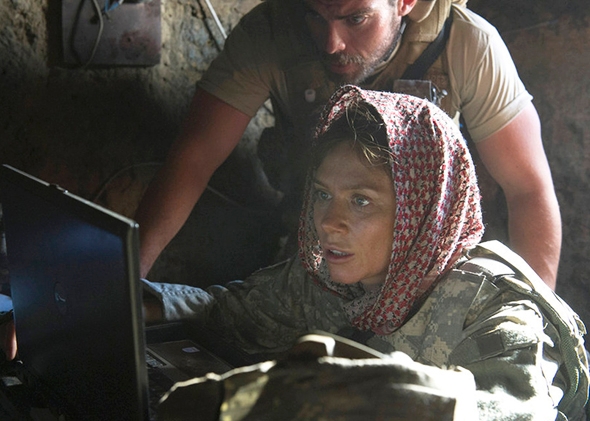
A handful of new shows about our armed forces are headed to television, including NBC’s highly anticipated drama American Odyssey, which stars Anna Friel as a soldier battling jihadists in North Africa. But what accounts for Hollywood’s latest obsession with the U.S. military? Let’s call it: The American Sniper effect.
As summer hurdles towards us like Iron Man in full flight, Hollywood is still basking in the post-coital glow of Sniper, Clint Eastwood’s real-life tale of Chris Kyle, the most lethal sniper in U.S. military history. Starring Bradley Cooper as the titular marksman, Sniper wildly exceeded industry expectations, en route to becoming the highest grossing film of 2014, not to mention its bundle of Oscar nods.
To give you an idea of just how rare a feat Sniper’s dominance is, of the 15 box office leaders last year, Sniper is just one of two that didn’t rely on a pre-established fanbase or the name recognition of a beloved brand or franchise. If there’s a major takeaway from the film’s surprise success, it’s that we finally seem ready for stories about our armed forces, and their exploits in the ongoing war on terror.
That wasn’t always the case. During the height of the conflicts in Iraq and Afghanistan, audiences were reluctant to embrace films like Green Zone and Jarhead, despite their overt criticism of unpopular wars. Even The Hurt Locker, which won the Oscar for Best Picture in 2008, failed to ignite the box office.
In the past few years however, profitable films like Zero Dark Thirty, and Lone Survivor proved that audiences were ready for the post-9/11 war movie, and helped set the table for Sniper’s stunning success.
So what changed?
“Part of the shift in taste may be attributable to the passage of time and the fact that troop levels in both countries are a shadow of their former selves,” writes Bret Lang, a senior film and media reporter at Variety.
The Chicago Tribune’s Michael Phillips has a similar take. “Nobody in the know knew anything about the pent-up demand in the American culture for American Sniper," he writes, "Or just how broadly it would play in every part of the nation, now that we’re nearly 12 years past the origin point of the Iraq invasion.”
Well, now that those “in the know” do know, there’s likely already an assembly line somewhere in Burbank ready to pump out drum-beating, flag-waving war movies by the dozen. Hollywood’s formula for success after all, is the art of repetition. Find something that works, and do it over and over again, until audiences wave the white flag of over-saturation. We’re looking at you, Marvel.
But just because audiences have a renewed hunger for the modern war story, it doesn’t mean they want replicas. In her piece examining the many industry ramifications of Sniper’s success, The Washington Post’s Alyssa Rosenberg argues that Hollywood has a distinct opportunity to diversify the kind of military stories it tells.
“It will be fascinating to see whether the enthusiasm for American Sniper accelerates the number of movies and television shows about active-duty service members, veterans and military families,” writes Rosenberg. “But as the movements to improve the media representations of people of color, women and lesbian, gay, bisexual and transgender (LGBT) people have demonstrated before, quality, nuance and variety matter just as much as quantity. “
Women in particular, have long been marginalized in the war movie genre, and are often relegated to the role of the doting, concerned wife, who can no longer relate to her traumatized husband who’s just returned home from the horrors of combat. When servicewomen are depicted onscreen, it’s usually in some clerical capacity, far removed from dangers of combat, or as the victim of sexual abuse within the military.
“There’s been a real over-emphasis on military women as victims, and an over emphasis on the problem of sexual assault in the military on women,” argues Kayla Williams, a former soldier and the author of I Love My Rifle More than You: Young & Female in the U.S. Army. “Of course it happens, but it happens to both men and women, and focusing on women as victims of sexual assault with the exclusion of all the other challenges that they face and the successes that they’ve been able to accomplish I think is a big mistake.”
That’s what makes shows like American Odyssey so intriguing. The Traffic-like setup features three strangers whose lives are suddenly intertwined by their respective roles in a serpentine military conspiracy that begins to unravel. When Friel’s character, Sgt. Odelle Ballard, uncovers some potentially incriminating documents, Ballard’s team is attacked by a group of black ops contractors, and she finds herself the lone survivor.
It's an unusual position for a female miheroine. While shows like Homeland and State of Affairs, and films like Zero Dark Thirty have given us strong female characters who are actively involved in the war on terror, they've all been members of the U.S. intelligence apparatus. When they're not waging war from a control room, they're trying to convince their male superiors that they're capable of doing the job.
American Odyssey marks one of the rare instances that we’ll get to see a woman in military fatigues involved in high stakes combat situations. Although women soldiers are still not allowed in the infantry, their service has been crucial to some of the most dangerous missions in both Iraq and Afghanistan. "
“All of those situations came about because the combat arms units realized that in muslim countries, where part of the goal is to win the hearts and minds in an insurgency situation, that having women soldiers out there was vitally important because the male soldiers couldn’t connect with female half of the population," adds Williams.
With American Odyssey, NBC hopes to explore what it means to be a woman in the army and the pressures that she feels at home and to her unit.
How audiences will react to this new frontier of storytelling remains to be seen. American Odyssey premieres April 5 on NBC.