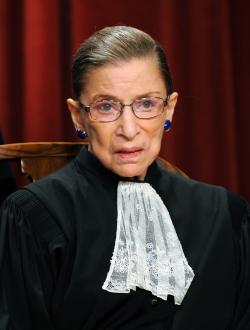
In 18 years on the Supreme Court, Justice Ruth Bader Ginsburg has written more than 200 opinions on a number of important topics, including major opinions on everything from copyright law to abortion rights to employment discrimination. But in the area of campaign finance, she’s authored only one inconsequential two-paragraph concurring opinion—in one of the Supreme Court’s recent cases striking down parts of the McCain-Feingold law—in which she distanced herself from a more far-reaching dissent of Justice Stevens. She’s been a reliable vote to uphold reasonable campaign-finance laws, but this has hardly been her signature issue.
Last week, however, Justice Ginsburg issued a short statement that hinted she is ready to speak out more boldly. She, like many Americans, appears concerned with the rise of super PACs and the disturbing role money is playing in the 2012 campaign season since the Supreme Court’s controversial decision in Citizens United v. FEC. Justice Ginsburg likely won’t have the votes to overturn Citizens United, but she soon will be in a position to expose the disingenuousness at the ruling’s core.
As Dahlia Lithwick recently explained, late last year the Montana Supreme Court thumbed its nose at the Supreme Court’s Citizens United decision. In Citizens United, Justice Anthony Kennedy, writing for a five-justice majority, held that the federal law barring corporations from spending their funds on election ads violated the corporations’ First Amendment rights. The Montana court nonetheless upheld a state ban on corporate campaign spending, finding that Montana’s history of corruption justified the ban.
Everyone expects the Supreme Court to reverse the Montana case, likely on a 5-4 vote. But the big question is how the court will do so. Opponents of the Montana law went for broke before the Supreme Court: In addition to asking the court to put the Montana ruling on hold pending the usual process for seeking Supreme Court review, they asked the court to reverse the Montana court without even hearing any argument. Last Friday, the court agreed to stay the Montana ruling, but the justices did not short-circuit the usual process. The court will accept full briefing on whether or not to hear the case, and then it will decide what to do. Court watcher Tom Goldstein believes a full hearing is fairly likely.
Justice Ginsburg agreed that staying the Montana ruling was the right course, because lower courts are bound to apply Supreme Court precedent even if it is wrong; it is for the Supreme Court to fix its own wrong precedents. But then she added these words in a statement for herself and Justice Stephen Breyer with respect to the stay: “Montana’s experience, and experience elsewhere since this Court’s decision in Citizens United, … make it exceedingly difficult to maintain that independent expenditures by corporations ‘do not give rise to corruption or the appearance of corruption.’ A petition [to hear the case] will give the Court an opportunity to consider whether, in light of the huge sums currently deployed to buy candidates’ allegiance, Citizens United should continue to hold sway.”
In this short statement, Justice Ginsburg quoted from the least defensible part of the Citizens United opinion. As I explained in October, according to the Supreme Court, the only government interests that can justify limits on campaign money against First Amendment challenge are the prevention of corruption or the appearance of corruption. (This interest is what explains the constitutionality of limits on contributions to candidates.) In Citizens United, Justice Kennedy, writing for the court majority, resolved as matter of fiat what had appeared to be a factual question about independent spending and corruption: “We now conclude that independent expenditures, including those made by corporations, do not give rise to corruption or the appearance of corruption.” He further declared that “[t]he appearance of influence or access [coming from unlimited corporate spending] will not cause the electorate to lose faith in our democracy.”
Justice Kennedy presents the issue of corruption and the appearance of corruption as a matter of fact, and the Montana court took Justice Kennedy’s on his words and said, “Ok, let’s take a look at the facts” in Montana. There is a large history of corporate spending corrupting the political process here, so our state’s laws are justified.
With last week’s statement, Justice Ginsburg has signaled that she or one of the other justices opposing the Citizens United case will use the Montana case to expose the fallacy of the Citizens United argument. Although Justice Kennedy indeed stated the issue of corruption and independent spending as one of fact, we know it is a fiction. As former FEC chair and campaign-finance opponent Brad Smith explains: “In fact, Citizens United’s holding that independent expenditures are not ‘corrupting’ is not a statement of fact, but a statement of law. In this respect, it is similar to contractual doctrines that imply consent where consent is truly a fiction; or criminal doctrines that throw out confessions that were freely given, on the grounds that they were not probative because the accused was not properly ‘Mirandized.’”
The explanation reveals a great deal. If a doctor gives emergency CPR to an unconscious person, the doctor cannot be sued later for battery even though the person was touched without consent. Though this principle is sometimes referred to as consent “implied in law,” in reality, it is the law excusing the lack of consent. In other words, a fiction.
Similarly, the statement in Citizens United that independent spending cannot corrupt or undermine the public’s confidence in the electoral process is a fiction which defies common sense. In fact, the greatest danger of super PACs is not that they will influence the outcome of elections, but that contributions to these groups will skew public policy away from the public interest and toward the interest of the new fat cats of campaign finance. The public, too, seems greatly concerned about money this election season.
Citizens United is not even consistent with the court’s own recent actions. In Caperton v. Massey, Justice Kennedy and the four Citizens United dissenters recognized that a $3 million contribution to an independent group supporting the election of a West Virginia Supreme Court justice required that the justice recuse himself from a case involving the contributor supporting his candidacy. The Caperton Court pointed to the “disproportionate” influence of that spending on the race and at least an appearance of impropriety.
It is also in tension with the Supreme Court’s recent decision to uphold the laws barring independent foreign spending in U.S. elections. If such independent spending really “does not give rise to corruption or the appearance of corruption,” as Justice Kennedy wrote in Citizens United, what’s the danger if the Chinese or Iranian government wants to flood tight congressional races with millions of dollars?
If the court were being honest in Citizens United, it would have said something like: We don’t care whether or not independent spending can or cannot corrupt; the First Amendment trumps this risk of corruption, at least when the spending comes from corporations and not foreigners. But the court didn’t say that, because it would have faced even greater criticism than it already has. So it dressed up its value judgment as a factual statement.
Justice Ginsburg seems poised to use the Montana case to expose the false premise at the heart of the Citizens United case. If we are lucky, she’ll convince one of the justices in the Citizens United majority of the error of his ways. At the very least, she will speak truth to power.
