
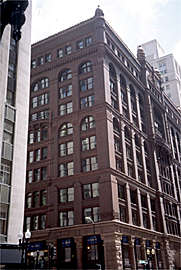
Rookery Building, by Burnham & Root
The commercial skyscraper flourished in Chicago for three reasons. The first was the great fire that flattened the city in 1871--a biggest-ever event that made Chicagoans perversely proud. The fire ignited a cycle of building, demolition, and building. But even more important were the city's exponential population growth in the second half of the 19th century and the physical situation of its central business district. With a bursting population, the city had to build. And with a downtown of just 35 blocks bounded by water on all sides, its core had nowhere to go but up. The early skyscrapers fight against their tallness, emphasizing horizontal rather than the vertical lines. Perhaps the greatest surviving example of these buildings is the Rookery Building (1885). The long ribbons of window hold the building down rather than thrusting it up into the sky. Back then, commercial tenants weren't interested in sweeping views; big windows were to compensate for the dimness of 20-watt light bulbs. The choicest real estate back then was the opulent second floor, a holdover from the pre-elevator days.
Photograph by Rolf Achilles


