Read more of Daniel Engber’s columns on obesity and health care reform.
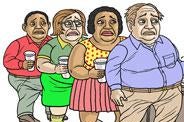
Not long after the attack on Pearl Harbor, in the winter of 1942, physiologist A.J. Carlson made a radical suggestion: If the nation’s largest citizens were charged a fee—say, $20 for each pound of overweight—we might feed the war effort overseas while working to subdue an “injurious luxury” at home. Rationing sugar began a few months later. The limit on consumption—of a cup per week for every American—happens to work out to a very sensible daily allowance by modern standards. The wartime rations were, of course, a matter of national defense, since the alcohol derived from molasses could be used to make explosives. But as Carlson must have known, they were healthy, too.
Sixty-seven years later, the “fat tax” is back on the table. We’re fighting another war—our second-most-expensive ever—and Congress seems on the verge of spending $1 trillion on health care. Once again, a bloated budget may fall on the backs of the bloated public. Some commentators, following Carlson, have lately called for a tax on fat people themselves (cf. the Huffington Post and the New York Times); others, like a team of academics writing in the current issue of the New England Journal of Medicine, propose a hefty surcharge on soft drinks instead. Hamburgers, milk, and eggs might help pay for President Clinton’s proposed reforms. (At the time saturated fats were deemed more harmful than added sugar.)
The notion hasn’t generated much enthusiasm in Congress, but fat taxes are spreading through state legislatures: Four-fifths of the union now takes a cut on the sales of junk food or soda. Pleas for a federal fat tax are getting louder, too. The New York Times recently endorsed a penny-per-ounce soda tax, and Michael Pollan has made a convincing argument for why the insurance industry may soon throw its weight behind the proposal. Even President Obama said he likes the idea in a recent interview with Men’s Health. (For the record, Stephen Colbert is against the measure: “I do not obey big government; I obey my thirst.”)
For all this, the public still has strong reservations about the fat tax. The state-level penalties now in place have turned out to be way too small to make anyone lose weight, and efforts to pass more heavy-handed laws have so far fallen short. But proponents say it’s only a matter of time before taxing junk food feels as natural as taxing cigarettes. The latter has been a tremendous success, they argue, in bringing down rates of smoking and death from lung cancer. In theory, a steep tax on sweetened beverages could do the same for overeating and diabetes.
It may take more than an analogy with tobacco to convince voters. As my colleague William Saletan points out, the first step in policing eating habits is to redefine food as something else. If you want to tax the hell out of soda, you need to make people think that it’s a drug, not a beverage—that downing a Coke is just like puffing on a cigarette. But is soda as bad as tobacco? Let’s ask the neuropundits.
Junk food literally “alters the biological circuitry of our brains,” writes David Kessler in this summer’s best-seller, The End of Overeating. In a previous book, Kessler detailed his role in prosecuting the war on smoking as the head of the FDA; now he’s explaining what makes us fat with all the magisterial jargon of cognitive neuroscience. Eating a chocolate-covered pretzel, he says, activates the brain’s pleasure system—the dopamine reward circuit, to be exact—and changes the “functional connectivity among important brain regions.” Thus, certain foods—the ones concocted by industrial scientists and laden with salt, sugar, and fat—can circumvent our natural inclinations and trigger “action schemata” for mindless eating. Got that? Junk food is engineered to enslave us. Kessler even has a catchphrase to describe these nefarious snacks: They’re hyperpalatable.
Try as we might, we’re nearly powerless to resist these treats. That’s because evolution has us programmed to experience two forms of hunger. The first kicks in when we’re low on energy. As an adaptation, its purpose is simple enough—we eat to stay alive. The second, called hedonic hunger, applies even when we’re full—it’s the urge to eat for pleasure. When food is scarce, hedonic hunger comes in handy, so we can stock up on calories for the hard times ahead. But in a world of cheap food, the same impulse makes us fat.
That’s the problem with junk food. Manufacturers have figured out how to prey on man’s voluptuous nature. Like the cigarette companies, they lace their products with addictive chemicals and cajole us into wanting things we don’t really need. Soda is like a designer drug, layered with seductive elements—sweetness for a burst of dopamine, bubbles to prick the trigeminal nerve.
It’s hard to draw a line, though, between foods that are drugs and foods that are merely delicious. Soda and candy aren’t the only stimuli that “rewire your brain,” of course. Coffee does, too, and so do video games, Twitter, meditation, and just about anything else that might give you pleasure (or pain). That’s what brains do—they learn, they rewire. To construe an earthly delight as hyperpalatable—as too good for our own good—we’re lashing out at sensuality itself. “Do you design food specifically to be highly hedonic?” Kessler asks an industry consultant at one point in the book. What’s the guy going to say? “No, we design food to be bland and nutritious. …”
It’s ironic that so many advocates for healthy eating are also outspoken gourmands. Alice Waters, the proprietor of Chez Panisse, calls for a “delicious revolution” of low-fat, low-sugar lunch programs. It’s a central dogma of the organic movement that you can be a foodie and a health nut at the same time—that what’s real and natural tastes better, anyway. Never mind how much fat and sugar and salt you’ll get from a Wabash Cannonball and a slice of pain au levain. Forget that cuisiniers have for centuries been catering to our hedonic hunger—our pleasure-seeking, caveman selves—with a repertoire of batters and sauces. Junk foods are hyperpalatable. Whole Foods is delicious. Doughnuts are a drug; brioche is a treat.
Some tastes, it seems, are more equal than others.
A fat tax, then, discriminates among the varieties of gustatory experience. And its impact would fall most directly on the poor, nonwhite people who tend to be the most avid consumers of soft drinks and the most sensitive to price. Under an apartheid of pleasure, palatable drinks are penalized while delicious—or even hyperdelicious —products come at no extra charge. What about the folks who can’t afford a $5 bottle of POM Wonderful? (40 grams of carbohydrates. A cup of Coca-Cola has 27 grams.) No big deal, say the academics writing in the New England Journal of Medicine; they can always drink from the faucet. Here’s how the article puts it: “Sugar-sweetened beverages are not necessary for survival, and an alternative (i.e. water) is available at little or no cost.” So much for Let them eat cake.
We’ve known for a long time that any sin tax is likely to be a burden on the poor, since they’re most prone to unhealthy behavior. (James Madison fought the snuff tax on these grounds way back in 1794.) But you might just as well say that poor people have the most to gain from a sin tax for exactly the same reason. It’s also possible that revenues from a fat tax would be spent on obesity prevention—or go back to the community in other ways. There’s a knotty argument here about the vexing and reciprocal interactions among health, wealth, and obesity. (I’ll try to untangle some of these in my next column.) It’s not clear whether, and in what direction, a soda tax might redistribute wealth. Whatever you think of the economics, though, raising the price on soda—and offering water in its place—will redistribute pleasure.
I don’t mean to imply that any such regulation is unjust. We have laws against plenty of chemicals and behaviors that are as delightful as they are destructive. These are, for the most part, sensible measures to protect our health. What’s disturbing is the thought that the degree of government control should vary according to who’s using which drug. In April, the Obama administration called for an end to a long-standing policy that gives dealers of powdered cocaine 100 times more leeway than dealers of crack when it comes to federal prison sentences. Let’s not repeat this drug-war injustice in the war on obesity. We may be ready to say that foods are addictive. Are we ready to judge the nature of a delicious high?
