Mad Men, Season 3
Week 9: "If It's Bad, Don't Use It."
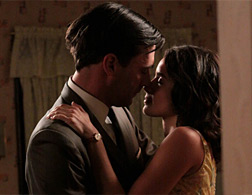
"I know exactly how it ends," Miss Farrell says as she puts off Don's advances. And that's the problem, I thought, as I watched the scene. So do we. It's a grim day for viewers when one character on a much-loved show says to another, "If we get together, it'll be totally predictable," and then they proceed to get together. You may roll your eyes each time Teach jogs on-screen, John. I start hoping Lois will ride by on the John Deere and write her out of the series once and for all.
One recurrent question in our conversations about Mad Men has been whether the show is fundamentally just a well-executed soap. Matthew Weiner is clearly aiming for something higher, but because he elected, from the very first episode, to focus so closely on the marathon philanderings of Don Draper, the show can occasionally revert to type. I get that both Betty and Don are using their affairs to enliven their humdrum surroundings and invest the most quotidian routines (Don commuting past that stretch of road; Betty receiving the mail) with hitherto unexplored erotic possibilities. In fact, I'm beginning to share the characters' boredom with their suburban milieu, so any novelty should be welcome. The problem is, a will-they-or-won't-they affair isn't going to cut it at this point. We've been there, with both Betty and Don, before. Now, if Betty were to take a cue from Happy Rockefeller, divorce Don, keep the kids, and move up to Albany— that I could get on board with. But this halting exchange of stilted letters feels unworthy of the show, and Don's flirtation with Suzanne just feels like bad writing. (Most execrable moment: when Don says, "I wanted to talk" and Suzanne replies, "Right. Says the man as he unbuckles his pants." Feisty!) I only wish Weiner had been a little more exacting in the writers' room on this episode, heeding Don's rule of thumb on the Hilton campaign: "If it's bad, don't use it."
When it comes to the Martin Luther King angle, I shared some of the reservations you both expressed, but I do think, in its own slightly on-the-nose way, the show was doing something interesting here. My first and most enduring impression of the civil rights movement was the extraordinary 1987 PBS miniseries Eyes on the Prize, which from elementary school onward my teachers found some reason to show us pretty much every year. (Pity Miss Farrell, thrust into the classroom before the advent of the VCR.) In Eyes on the Prize, the movement was presented in epic, heroic terms, and there was a sense—in the depiction of the March on Washington, or on Selma two years later—that the entire country was gripped by the urgent fervor of these events. So to see Don try to turn off the radio while King is speaking was arresting. And to hear Betty say, with what she thinks is empathy, that Carla can keep the radio on "your station"—as if the Birmingham church bombing was specialty news, the sort of thing Pete Campbell might read about in Jet—upends the conventional narrative of these events as sweeping clear across the country, becoming impossible to ignore. Apparently in Ossining, ignoring the civil rights movement was as easy as changing the station.
The other big surprise was Sal's encounter with Lee Garner ("I know what I know") Jr. What is Don saying when Sal asks, rhetorically, whether Don would have acquiesced to a girl under similar circumstances and Don replies, "That would depend on what kind of girl it was, and what I knew about her," and then adds, contemptuously, "You people …"? I mean, he's not saying, "The problem with you closeted gay men when it comes to your sex partners is you're too darn discerning," I'm assuming. Is the you people supposed to apply to Garner as well as Sal? Is Don suggesting that these sorts of indiscretions might be OK but not when they jeopardize accounts? Don says, "You'll be fine," as he shows Sal the door, and I think in some ways Sal will be, though it's interesting that his first move is to lie to his wife about work (using exactly the same excuse Don uses in the following scene—subtle) and seek some action in what I'm guessing was Washington Square Park. My greatest hope is that Sal flourishes as a commercial director. Success is the best revenge.
Where's Duck Phillips when we need him, to give Sal a soft landing at Gray? Failing that, I guess Bonwit Teller is hiring.
When your mother-in-law says you look like Perry Mason, just remember, it's not a compliment.
Patrick