Mad Men, Season 3
Week 3: Roger's Brilliant Serenade
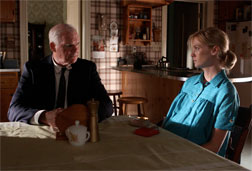
And I was all excited to follow the Lola plotline, in which Peggy struggles to get her impudent secretary to show some respect. Peggy didn't have the patience for that. One fascinating aspect of Ms. Olson's ambition is the withering contempt she has for her sisters in the secretarial ranks. Turns out, Peggy has fired Lola with such ease and conviction that it's literally "summary"—it happens off-screen.
Lola's replacement, the aptly named Olive, doesn't mind working weekends. What she does mind is Peggy hitting the wacky tobaccy. But Peggy doesn't need a mom. She needs someone to fetch water and prime the Dictaphone. "I have a secretary," she tells Olive, with a patronizing little smile. "That's you."
C'est magnifique.
I'm going to go ahead and say it. This was the best episode of Mad Men yet. In a bold move that could have been gimmicky, the writers used music to bring out the story. And not contemporary music, it seems worth noting—but outdated, antiquated ditties.
"It'll be just like the old days," someone says as Joan digs out her accordion, and her chanson (which, irritatingly, was dubbed, whereas the other numbers were delivered by the actors themselves) is straight from the Gallic nostalgia songbook. (And Julia, it was "C'est Magnifique," not "La Vie en Rose.") Kinsey's reprise of his barbershop glory (pre-mono) in the Tones was pure Princeton '55, even if, as it turns out, Kinsey himself was not. (And how excellent that Kinsey is capable of his own D-squared-style reinvention. "You never call me," Graves says. Of course Kinsey doesn't call him. Graves knows his secret.)
Pete and Trudy were transparently well-practiced, but still a delight. (Didn't one of you say in an earlier exchange that they're actually sort of perfect for each other? I've always thought so.) But they were dancing the Charleston, which was well out of fashion by 1963. When Jimmy Stewart and Donna Reid Charleston over the swimming pool in It's a Wonderful Life (1946), the whole senior class knows the moves. But even by the geriatric standards of this fusty country club, the Campbells are kicking it old school.
And as for Roger's fit of minstrelsy, well … I thought it was great.
Part of the danger, and the magic, of Mad Men is that it takes outmoded and monstrous conventions and plays them for laughs. Almost everyone at Roger's club is laughing during the scene, except for Don and, interestingly, Pete Campbell. But this time, we're definitely not in on the joke. It's one of Weiner's icky moments, and as I said last week, I think these scenes are what make Mad Men so bold and compelling. The song is grotesque, of course, but I agree with John that after all of Roger's charm, it's nice to see his bigotry (and his boorishness) laid bare.
What's more, the scene feels utterly authentic. This is a private club on "the island," where even the waiters aren't black. "You know, that's what's great about a place like this," Roger tells Don. "You can come here and be happy, and you get to choose your guests."
Roger rewards Don's forgiveness for the pass he made at Betty with hostile suspicion about a pass Don didn't make at Jane. When Roger underlines the club's exclusivity, he's responding to Don's brutal dressing down ("No one thinks you're happy. They think you're foolish"), but he's also reminding Don, as if Don needed to be reminded, that he doesn't belong.
Gibbon and Eliot notwithstanding, the world doesn't really end for people like Roger—it just shrinks down into little islands of retrograde privilege, members-only clubs where it's still safe to tell those jokes. It would be a comfort to think Roger and his ilk are going to die off altogether once the Civil Rights Act passes in 1964, but those clubs still exist today, albeit in decaying form, and as a white guy who, like Connie or Don, has been an occasional guest at such establishments, I've been regaled with jokes by old racists who figured that my skin color, and my presence there, made it acceptable to tell them.
"It's different inside," Connie says. It is different. And it ain't pretty.
There's much, much more to say about Roger's blackface moment; Don's clash with Roger; and Jane's blinding, checkerboard dress (which would be my pick for best outfit this week, if it didn't look so much like my kitchen floor).
But we've overlooked the most fascinating, possibly icky, and potentially consequential encounter of the evening: Betty's belly rub from the oh-so-forward Henry Francis. Was this a one-off, or are we going to see Mr. Francis again? The context should tell us something: Francis works for Nelson Rockefeller, who, as Jane remarks, has just "married Happy." In May 1963, after divorcing his wife of 30 years, Rockefeller married Margaretta "Happy" Murphy—who was only just divorced herself and had four children. Bert Cooper murmurs that divorce is political suicide (though, of course, Rockefeller would go on to become vice president, and, of course, Cooper calls it "hari kari"). And when someone asks why Rockefeller would marry a divorcee with children, Henry answers, as if it's the most obvious thing in the world, "They're in love."
Kind of a dangerous sentiment in a show full of loveless marriages, n'est ce pas?
Rum. Have some.
Patrick