The golden jubilee of a diamond-bright icon is upon us as the Barbie doll, introduced at the American International Toy Fair of 1959, passes a milestone on March 9. This presents an occasion to praise her timeless charms, to damn her anti-feminism, and, for those wired for negative capability, to hold both ideas in mind. Of the season’s two books on the subject, Barbie and Ruth: The Story of the World’s Most Famous Doll and the Woman Who Created Her is the more sensible affair. Author Robin Gerber details the career of Mattel co-founder Ruth Handler—who named her celebrated toy after her only daughter—with the precision of a business-school case study. Rather less judicious, Toy Monster: The Big, Bad World of Mattel, eructed by renowned sleaze broker Jerry Oppenheimer, holds that Barbie’s true creator was Mattel research-and-design executive Jack Ryan, who had a thing for dames of a Barbie-esque silhouette, one of whom appears, in the book’s first sentence, as his accomplice in “yet another evening of compulsive sex.”
Indeed, beyond matters of basic fact, the only quality that the two new Barbiographies share is the short shrift each gives the doll’s love interest. Such is the eternal lot of unfortunate Ken Carson, Barbie’s long-term beau and ever-ready escort. If history is any guide, Ken—an accessory, an ornament, a cold planet orbiting a hyper-giant star—will not quite be a VIP at this 50th-birthday gala. But his role, however minor, will be critical: Barbie wouldn’t be Barbie if she didn’t have a steady date.
Watch a Slate V history of the Barbie television commercial:
In the late 1950s, Handler observed her daughter using paper dolls to imagine adult lives and saw an opportunity to “three-dimensionalize” the play pattern. Though Mattel modeled Barbie’s physique on that of a German doll with a gold-digger Weltanschauung, she herself entered life as an independent woman. As noted in the definitive critical text on the subject, M.G. Lord’s Forever Barbie: The Unauthorized Biography of a Real Doll, Mattel’s ad agency introduced the plastic figurine as a flesh-and-blood mannequin: “She was a teenage fashion model, and the world was her runway.” Barbie never demanded a boyfriend, but the fantasies of the little girls consumed with her did. Ken made the scene in 1961, his namesake being Handler’s son.
“It all started at the dance,” according to the myth marketed by the TV commercial announcing Ken’s debut. Here was ball-gowned Barbie swiveling her head toward a young man in a shawl-collar evening suit. The ad continues, “Somehow she knew that she and Ken would be going together.” Perhaps what tipped her off was the expression on his blandly handsome face, which splits the difference between eager attentiveness and submissive captivation. After the new couple models some outfits for genteel picnics, polite frat parties, and afternoons of beach-blanket bingo, the commercial climaxes with Ken back in his tux and Barbie in a bridal gown. It’s left to your imagination whether they’ve just turned to face the officiant or have just now tied the knot, but for sure they don’t get a honeymoon. Is there any corner of the Barbie universe—among all the board games and sticker books and authorized novels—where the two live as man and wife? Though anything is possible at playtime, the point of Barbie’s having Ken around is not for her to marry him but for her to have the option. It is enough for him to be marriageable. Today, the most popular Ken model—one of the few sold in stores by its lonesome—is the Wedding Day Sparkle Groom Ken. Impossibly patient and unfailingly loyal, he’s always waiting for her at the altar and always will be until his plastic decomposes.
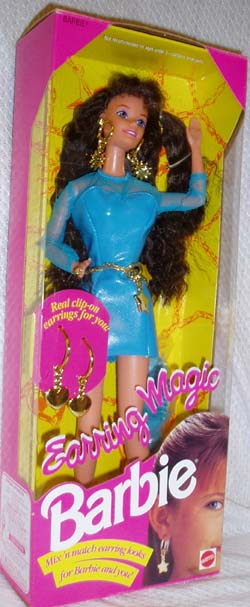
Those synthetics—the body is currently acrylonitrile butadiene styrene—have taken on many shapes over the years. Ken started out as lean and elegant and upper-class swell, befitting the “Ivy stripes” and “Ivy colors” mentioned in ad copy for his early outfits. According to the amazacrazily comprehensive collector’s site Keeping Ken—which is not safe to click on if you don’t want to have your mind blown—Mattel overhauled his body mold in the late ‘60s so that he could “reflect the rugged masculinity” of the times. These days, he is pretty cut. When my friend Marion, who is 3½, heard I was working on this piece, she voiced concern that I take notice of “his mighty arms.” In the clothes he has worn upon that body, Ken has emerged as the foremost fashion victim of the postwar era, taking turns as a mod, a rocker, a jazzbo, a disco king, etc., ad nauseum, all in the name of expressing his devotion to Barbie by coordinating with her. She is a slave to fashion, and he is a slave to her. Therefore, when she appeared in the early ‘90s as Earring Magic Barbie, he became the gay-iconic Earring Magic Ken.
There have been black Kens and Latin Kens, Kens with mustaches and Kens with voice boxes who said things like “I’ll get the food for the party!” and “What are you doing next weekend?” The only part of his anatomy that hasn’t changed is the one that’s never been there. Handler and the other women at Mattel were less sheepish than their male colleagues about giving Ken a pronounced “bump” at the crotch, but none of them ever considered endowing him correctly. Attending to a beauty beyond Cleopatra, he is beyond a eunuch. To compensate for his absent package, his outfits have been packaged with all manner of deputized phalli—a drum major’s baton here, a long-barreled rifle there. “The cruelest comment on his genital deficiency … came in 1964,” writes Lord, “with ‘Cheerful Chef,’ a backyard barbecue costume that included a long fork skewering a pink plastic weenie.”
But even with his manhood, Ken wouldn’t quite be a man. When I took my Beach Party Ken over to Marion’s place for a play date, I discovered that she has six Barbies—none of them bought by ambivalent Mommy—attending to the needs of her one hapless Ken. Marion and her mother evolved a game in which two evil sisters (represented by Cruella de Vil and the witch from Sleeping Beauty) repeatedly abducted the two Kens and tied them up in their lair, where they waited powerlessly for a Barbie to come to the rescue. Anecdotal evidence suggests that such narratives are common in the nursery, the demigoddess controlling the drone. One of Mattel’s original slogans for Ken was, “He’s a doll!” But really, he’s just Barbie’s plaything.