Bedtime at our house has two rituals: stories and songs. (Yes, some children take nightly baths. Ours prefer dirt.) The books come first, the lights go out, and then Simon, who is 5, asks me or my husband, Paul, to sing. Three or four or five songs later, he asks us to sing some more.
We oblige. Going to sleep has never come easily to Simon. And so the lullaby medley at our house often turns into a miniconcert, in terms of quantity if not quality. This is all very sweet, I know—whenever I complain about the singing, people whose children have grown up tell me I’ll miss it desperately someday. But at the moment, singing night after night gets tedious. I’m tired of my standard repertoire, and so is Simon. He has ruled out “Tender Shepherd” (“No more sheep”), “Hush Little Baby” (“I’m not a baby”), and “I Gave My Love a Cherry” ("Mommy stop singing that boring song!”). Also, almost anything in Hebrew and absolutely everything from Free To Be … You and Me. This is why, in our house, the songbook Rise Up Singing represents a nightly form of deliverance.
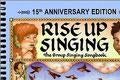
How many songs do most of us know by heart—beyond, that is, bits and snatches? How many of those songs wear well with kids? When folk singer Pete Seeger asked the first question of the men he was serving with in the Army in 1943, he was impressed with their responses. Now he thinks the list would be paltry. Rise Up Singing, which Seeger helped bring into being, is an answer to the ebbing away of shared lyric and melody. The book, which has sold more than 1 million copies, according to its creators, turns 20 this year. It is exactly as advertised on its blue, spiral-bound cover: “The Group Singing Songbook” with “Words, Chords, and Sources to 1,200 Songs.”
The editors of this compendium are Peter Blood, a nurse who lives in Amherst, Mass., and his wife, Annie Patterson, a graphic designer who assigned the book’s whimsical illustrations, which run toward smooching people and smiling animals. (On the cover, a girl with flowing tresses and a skirt of rivers and valleys helps birds—they can only be doves—take flight.) When Blood was a counselor in the 1970s at the Vermont summer camp Farm & Wilderness, his teenage campers wanted to sing Bob Dylan and Joni Mitchell. So Blood set them to work on a songbook. His first effort, called Winds of the People, was distributed informally. Then Blood and Patterson hooked up with Seeger and Sing Out!, the nonprofit chronicler of the folk movement, to round up the copyright permissions needed for official publication. Blood worked on the project full-time for two years “mostly haranguing publishers,” he says. Seeger’s manager helped him get their attention; his efforts are partly responsible for the hearty serving of Broadway songs that the book includes. The folk singers were easier to persuade. “They basically gave away their songs because they wanted them out there getting sung,” Blood says. “They knew it was a words-only book, so it wouldn’t compete with their recordings.”
A canny choice. In my experience, there’s a direct line between thumbing through Rise Up Singing and downloading songs from iTunes. The ballad “Pretty Peggy-O,” which I grew up listening to Joan Baez croon … there it is on Page 13, with angrier and more interesting lyrics than I remembered. The subversive lyrics to “This Land Is Your Land,” which I’d forgotten, that Woody Guthrie wrote? Page 5, along with (sacrilege!) a Canadian chorus.
All of this reveals, of course, that my affection for this songbook is overdetermined: I’m a child of the 1970s whose parents never graduated from folk to rock or anything else. More than I like to admit, the snatches of songs in my head come from a dozen albums that range, the opposite of widely, from Baez and Seeger (especially in his Weavers incarnation) to Simon and Garfunkel. Also lodged in my brain are pieces of a large number of equally embarrassing show tunes. And so for me, leafing through Rise Up Singing is like finishing a series of long-lost thoughts. Finally, I have in my grasp the second verse to “Day Is Done,” and, look, there’s a third one too, and now I won’t bring down Simon’s wrath by humming for bar after bar.
The book’s other small wonders are its intricate organization—it’s indexed by artist, title, subject, and culture—and its simplified guitar chords. For every song, Blood worked hard to find an arrangement that an amateur musician could handle, in a range that the amateur singers around him could handle. In fact, the main criteria for choosing songs for the book were whether they could be sung easily, whether Blood and Patterson liked a particular title, and whether it contributed to the book’s lefty political slant. “There aren’t a lot of Civil War songs,” Blood says. I bring up “The Night They Drove Old Dixie Down,” and he adds, “well, yeah, but that’s a song about war not going so well.”
Rise Up Singing doesn’t pretend to be all-inclusive. There isn’t a lot of blues or jazz or country, much less rock. Instead, the book has the kind of lock on one corner of Americana that fosters good-natured rebellion. According to Blood and Patterson, a group called Sit Down Singing went to the trouble to produce its own fake songbook—the perfect tribute from one ex-hippie to another.
In the campfire, singalong culture from which Blood comes, it’s not how well you sing, it’s that you’re singing at all. My husband lives out this motto a few times a week. He’s not so tuneful, but he sings a version of “Charlie on the MTA” that Simon can’t get enough of. This song has its logical fallacies. Written to protest a fare increase on the Boston T, its protagonist must “ride forever ‘neath the streets of Boston” because he doesn’t have the fare to get off—never mind that his wife shows up every day at the Scollay Square station to hand him a sandwich “as the train comes rumblin’ through.” As Simon’s older brother, Eli, likes to point out, she could have also handed over a nickel.
But this is not the point. The point is to give Simon the musical equivalent of comfort food. Parents weren’t Blood’s original target audience—”We originally thought about the book for schools or camps, or for the picket line,” he says—but Blood and Patterson think that families are a sizeable share of the book’s market. Sometimes, my kids sing along with me at night. And in my perfect universe, one of them learns how to play guitar.
