As far as biblical figures go, St. Joseph—the man who married the mother of Jesus—often gets short shrift: His life isn’t prominently featured in the Gospels, and he’s rarely depicted on Christmas cards. Yet Joseph did fulfill an astonishingly important task: raising the son of God. In 2008, James Martin explored what we do and don’t know about St. Joseph’s identity. His article is reprinted below.
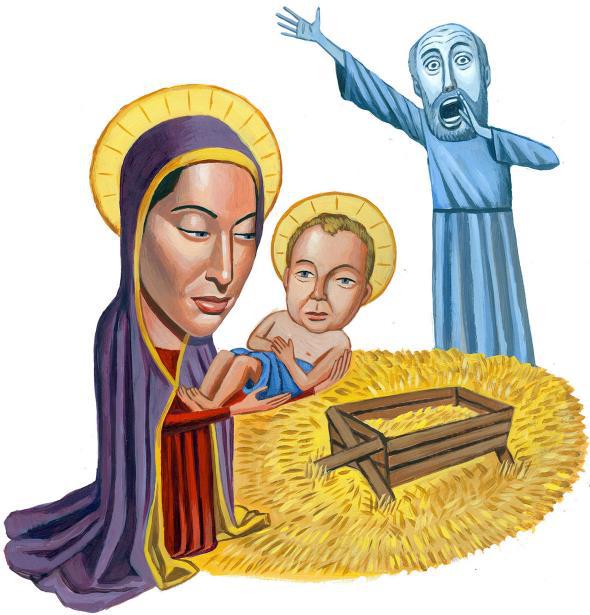
Christmas cards tend to fall into three categories: the family card (cheerful children in red and green sweaters), the secular card (snowmen, snowflakes, snowy villages), and the religious card. The religious card usually bears a portrait of the Virgin Mary gazing beatifically at the crib of her newborn son, Jesus. Behind her, the picture is just as some of the Gospels describe: shepherds, animals, maybe even the three wise men, though they actually were late on the scene.
But where’s St. Joseph? Where is the man to whom, according to the Gospel of Matthew, an angel announced the birth of Jesus? Where is the guy who married Mary even though she was already “with child,” the man who helped to raise Jesus, the carpenter who taught Jesus his craft?
He’s off to the side or stuck in the back, behind a shepherd. And he’s old, balding, and stooped, looking more like Mary’s father than her husband. Sometimes, he’s not there at all. Many Christmas cards show just Mary and Jesus. And how many carols even mention Joseph? He is at the Nativity scene and in American Christmas traditions. That’s a loss since Joseph can be a powerful figure not only for fathers but also for the average believer.
For a number of reasons, Joseph has presented something of a problem for the Catholic Church over the past two millennia. The miracle of Christmas was not only that God became human but also that this was accomplished through a virgin. Naturally, Mary is one of the stars of the story. But the emphasis on her virginity may have meant that her marriage to Joseph may have been an uncomfortable reality—after all, if they were married, didn’t they, well, have sex? That flew in the face of what became an early tradition in the Catholic Church—Mary’s “perpetual virginity.”
Better, then, to have Joseph in the background. Some scholars have posited that this is also the reason that he is portrayed as elderly in all those paintings, even though some experts estimate he was around 30 years old at the time of Jesus’ birth. Lawrence Cunningham, a professor of theology at Notre Dame and author of A Brief History of the Saints, told me, “Nine times out of 10 in Christian art, Joseph takes on more of father-protector role rather than a husband. That was a way of solving the sexuality problem.” Cunningham points out that in some paintings, Joseph is shown dozing off in the corner of the stable or even leaving the scene of the Nativity entirely, “out of modesty.”
But don’t blame Western artists for giving Joseph short shrift. They didn’t have much material to go on. Joseph is given no lines to speak in any of the Gospels, and he disappears entirely after Jesus’ childhood. Significantly, he is absent during Jesus’ public ministry and even at the Crucifixion, where Mary is featured prominently. This has led some scholars to believe that he must have died before the end of Jesus’ earthly life.
So what do we know about Joseph? Apart from his trade—he’s called a tekton in the Gospels, which is usually translated as carpenter but is more likely a general craftsman—not much. But Pheme Perkins, a professor of the New Testament at Boston College and the author of the widely used textbook Reading the New Testament, says you can draw some interesting conclusions if you read the Gospels carefully.
“The most obvious assumption in antiquity would have been that Joseph had been married before and was a widower,” she said. “Most likely, an arrangement was made for him to find a young wife.” This is the basis for the Catholic tradition that Jesus’ “brother and sisters,” who are mentioned in the Gospels, were from Joseph’s first marriage. (Mainline Protestant churches are more comfortable with the possibility that Mary could have given birth to other children after the birth of Jesus.)
And given that Mary seems not to have been forced to remarry after her husband’s death—the tradition in first-century Palestine—Joseph must have been a good provider, too. “He must have left them well-off,” Perkins said. However, she’s not certain that his portrayal as an elderly man in so many works of Christian art necessarily had to do with sexuality. “We usually make revered figures older,” she said. “If you look at most of the paintings of St. Peter and St. Paul, they look older, no matter what stage of life they’re in.”
Though most of Joseph’s life goes unmentioned in the Gospels, he carried out an astonishingly important task: raising the son of God. For the first years of Jesus’ life, and perhaps into young adulthood, he would have learned much of what he knew about the Jewish faith from his mother and his foster father. Perhaps the practices Jesus learned alongside Joseph in the carpentry shop—patience, hard work, creativity—were put to good use in his later ministry. Joseph represents the holiness of the “hidden life,” doing meaningful things without fanfare.
Perkins and Cunningham both see Joseph as a central figure in the Nativity story, one who can speak to contemporary men and women. The Gospel of Matthew makes clear that he is a “righteous man” who does what God asks of him. After discovering Mary’s pregnancy, Joseph thinks of “quietly” ending their marriage plans, so as not to “disgrace” her. But an angel reassures him in a dream. “Do not be afraid to take Mary as your wife,” says the angel, who explains the unusual circumstances of the birth. Joseph’s “righteousness” enables him to listen to God and carry out his difficult task.
His personality shines through wordlessly. “Here is a model of someone who represents all the virtues in the Hebrew Bible,” says Perkins. “He is asked to do something shocking, but because he’s righteous, he follows God’s guidance. And it’s no fun—not only to deal with that, but with the rest of the story—the flight into Egypt, too.”
During that latter part of the Christmas story, when the holy family flees from the murderous King Herod, Joseph was responsible for protecting Mary and her son in extreme conditions. Moreover, says Perkins, “To have to take your family into Egypt—that’s not a direction that Jewish stories want to go. It’s the wrong way.” She calls him a “model for how people can follow God through difficult times.”
Maybe it’s time to take a fresh look at this “model” and restore him to his rightful place in the Christmas story. Remember his natural age. Reimagine him in our art. And recall his very human example of “following God through difficult times.” That’s something that can offer encouragement not only to fathers but to every believer.
At the end of our conversation, Cunningham told me about one of his favorite paintings, by a Coptic nun, portraying the flight into Egypt. “It depicts the infant Jesus sitting on the shoulders of a young, robust Joseph,” he said. “Mary is actually standing at one side and a servant on the other.” St. Joseph is at the center of the picture.

