Slate's Bizbox


press box: Media criticism.

The New Yorker Draws FireBarry Blitt's cover illustration of the Obamas wigs out the chattering classes.


The cover of the July 21, 2008 issue of The New Yorker. Click image to expand.

Sweet mercy me. The New Yorker has offended Barack Obama, John McCain, the New Republic, Jake Tapper, the Huffington Post, and the sensibilities of thousands—maybe millions!—of Americans.

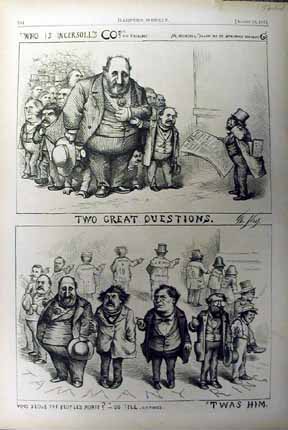
The source of all of this injury is not daring exposé or cutting criticism by a New Yorker writer but one of "them damned pictures"—to quote Boss Tweed of Tammany Hall, who bled pints every time he was poked by Thomas Nast's pen. "I don't care so much what the papers say about me," Tweed said of Nast's work. "My constituents can't read. But, damn it, they can see pictures!"

The damned picture riling the country today is the cover of The New Yorker's just-released July 21 issue. Drawn by Barry Blitt, it depicts Barack Obama as a Muslim U.S. president knocking knuckles in the Oval Office with his AK-47-toting, Afro-wearing, revolutionary wife, Michelle. Blitt completes the tableau with an American flag roasting in the fireplace and a framed portrait of Osama bin Laden looking down from the wall.


Rather than appreciating the joke—The New Yorker was cataloging and sending up the most extreme and common of the anti-Obama smears—the Obama campaign issued a roar of indignation ("tasteless and offensive"). The opportunistic McCain campaign wasted not a minute in echoing with its own protest. In their denunciations, both campaigns continued on the path Slate's John Dickerson described back in February, when he identified taking umbrage as "this year's hottest campaign tactic." As Dickerson noted in his piece and in a follow-up, the candidates have professionalized the business of taking umbrage, capitalizing on the offenses—perceived or imagined—to issue a new round of fundraising letters.

Still, this week's incident veered from the Dickerson template in that the umbrage—make that the alleged umbrage—was issued by a third party. I can understand how the campaigns, which drilled themselves in the umbrage dance during the primaries, might have acted reflexively to the magazine cover, but what excuse do the journalists and bloggers who condemned The New Yorker have?

Although every critic of the New Yorker understood the simple satire of the cover, the most fretful of them worried that the illustration would be misread by the ignorant masses who don't subscribe to the magazine. Los Angeles Times blogger Andrew Malcolm wrote, "That's the problem with satire. A lot of people won't get the joke. Or won't want to. And will use it for non-humorous purposes, which isn't the New Yorker's fault." Malcolm continues in this vein, calling it a "problem" that "there's no caption on the cover to ensure that everyone" will understand the punch line.

Here's ABC News' Jake Tapper singing the harmony line:

Intent factors into these matters, of course, but no Upper East Side liberal—no matter how superior they feel their intellect is—should assume that just because they're mocking such ridiculousness, the illustration won't feed into the same beast in emails and other media. It's a recruitment poster for the right-wing.

Calling on the press to protect the common man from the potential corruptions of satire is a strange, paternalistic assignment for any journalist to give his peers, but that appears to be what The New Yorker's detractors desire. I don't know whether to be crushed by that realization or elated by the notion that one of the most elite journals in the land has faith that Joe Sixpack can figure out a damned picture for himself.

How did we arrive at the point where a simple wisecrack like Blitt's causes such a hullabaloo? Has the public's taste for barbed drawings waned since the Paul Conrad, Herblock, Pat Oliphant, and Bill Mauldin heydays, or have the voices of the would-be bowdlerizers gotten stronger? Shall we don blinders and erect barriers so nobody is offended or misled?

Only weak thinkers fear strong images. The publication that convenes itself as a polite dinner party, serving only polenta and pureed peas, need not invite me to sup.

******

Richard Wright's epiphany after reading H.L. Mencken's Book of Prefaces in 1927: "Yes, this man was fighting, fighting with words. He was using words as a weapon, using them as one would use a club. Could words be weapons? Well, yes for here they were. Then, maybe, perhaps, I could use them as a weapon?" Send quotations to . (E-mail may be quoted by name in "The Fray," Slate's readers' forum, in a future article, or elsewhere unless the writer stipulates otherwise. Permanent disclosure: Slate is owned by the Washington Post Co.)

Track my errors: This hand-built RSS feed will ring every time Slate runs a "Press Box" correction. For e-mail notification of errors in this specific column, type the word Blitt salad in the subject head of an e-mail message and send it to .

Print This ArticlePRINTDiscuss this in The FrayDISCUSSEmail to a FriendE-MAIL
Share on FacebookPost to MySpace!Share with MixxDigg ThisShare with RedditShare with del.icio.usShare with FurlShare with Ma.gnolia.comShare with SphereShare with Stumble Upon
Jack Shafer is Slate's editor at large.
Join the Fray: our reader discussion forum
What did you think of this article?
POST A MESSAGE | READ MESSAGES

Comments from the Fray

It's the New Yorker that's stupid, for forgetting that one of the most important elements of satire is context. Put the same drawing on a TV screen with the Fox emblem in the corner and a pair of couch potatoes parked in front of it, put that on your cover, and you've got satire.

--expectator

(To reply, click here)

The New Yorker cover goes too far because Americans aren't willing to go far enough. When presented with superficial evidence that confirms their prejudices and preconceived notions, they stop and react accordingly. "See! Look! There it is! I was right! It's true." I hope this dark cloud has a silver lining. I hope the editors of the New Yorker are correct in their calculation that the cover picture will stimulate discussion and cause many people to look deeper than the rumors and allegations. I just don't think they gauged correctly when they estimated the average American's curiosity and willingness to challenge assumptions.

--Arlington

(To reply, click here)

I certainly have no problem with satire, especially with regard to politicians, who certainly need far more directed at them than they get these days.

And I even think that applies to Barack Obama, whose sanctification at the hands of fanatics is not only a disturbing reflection of the gullibility of our republic but misses the point of why he's such a good candidate: he's a relentless, intelligent opportunist who can be a tremendous antidote to the permissive idiocy of the past eight years.

But the one point I'd humbly offer up is that there is effective satire and there is ineffective satire. Effective satire is intelligent, perceptive, disruptive and edifying. I don't think the New Yorker's image is effective satire for these reasons:

1. Those who will "get" the image are many, but what actual effect it achieves for them beyond getting a chuckle I don't know. It's not particularly clever: "Let's compile all the false rumors about Obama and his wife and consolidate them in a funny cartoon that will send them up." Well, those who already know the rumors aren't true will laugh at the stupidity of those who don't know. But it won't be anything new for them.

2. Satire is usually framed around the actual person or institution being satirized, i.e. Herblock's Nixon satire usually depicted Nixon in some way, or Stalin, or whatever political figure was his target. Obviously the point here, assuming there's nothing sinister going on, is to satirize false information. But it's an extremely awkward proposition to satirize false information about a given person by actually depicting that person. There's a cognitive disjoint, because historically the satire should depict the subject of satire, but here it's Obama, who, again, assuming the best, is actually not the target.

3. At best this satire is preaching to the choir. The problem is, when satire preaches to a choir and the non-choir member steps in, things can look awfully disturbing. It's a weird parallel to draw, I know, but in the case of Jeremiah Wright, his sermons were directed to a congregation that knew him well, as well as his work and constitution. When we saw him from the outside we freaked out. Transpose the situation, imperfect though the comparison may be, to this picture. New Yorker readers, being clever and well-informed, all chuckle at the cover and pish-posh those articles that make such a show of decrying it. Only, when non-New Yorker-readers see that image, they may see something quite different, if they don't for instance, understand the irony that often characterizes the publication or its satirical bent and/or history. That's obviously not the magazine's responsibility to control, but that image is easily transferable to non-New Yorker readers out of context. That is to say, intelligent satire makes difficult work of turning it into another piece of propaganda. The New Yorker pic does just the opposite.

That's all. I think it was a silly decision to publish it because it could be so easily misused and was so awkward in its general execution (see reason 2). Awful, horribly offensive? Of course not. Stupid? Yes. Though I have a feeling that the editorial staff on the magazine would fear the latter designation more than the former...

--quietbelow

(To reply, click here)

Of course The New Yorker intended for the illustration to be satirical. The problem is: satire, and satiric caricature, are hard. Really, seriously hard. And this cover completely fails at it… The concept is simple enough: convey in caricature all the smears about the Obamas, and this in and of itself will look so absurd that it will be funny. At some point, however, the illustrator or the editors should have realized what was self-evident: the very fact the these absurd smears are gaining traction means that no simple illustration of them will have their intended effect.

Because the drawing is executed so straight-forwardly and earnestly, it doesn't look like a parody; it looks like an attack ad. It doesn't look like it's making fun of people who believe the smears; it looks like a way to ingrain those smears in people's memories. Put this drawing on the National Review, and would it seem out of place? Would it seem like they "didn't mean it that way"? Of course not.

Any satire that can be easily used to further the viewpoint it's trying to satirize, is, by definition, a failure. The New Yorker cover fails abysmally

--howlless

(To reply, click here)

(7/15)


Washington Post
The Washington Post
OPINIONS
Imagine if...
Hiatt | What if McCain had waged his campaign based on respect?
Editorial: Meddlesome PalinKing: The Danger of Palin Power