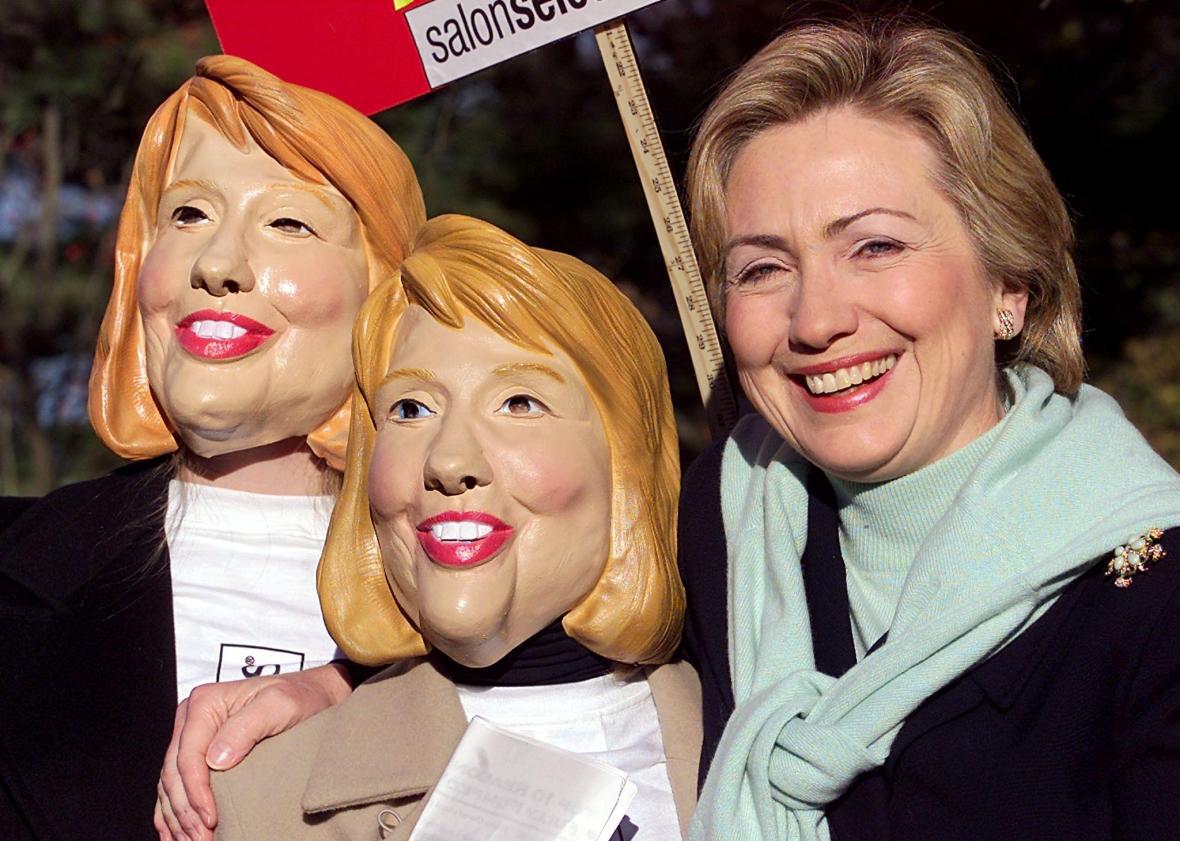
A new survey reveals that of all the 2008 presidential candidates, Hillary Clinton and Rudy Giuliani would make for the scariest Halloween costumes. Last-minute shoppers can still pick up Halloween masks of Dick Cheney, Laura Bush, Donald Rumsfeld, Bill Clinton, the Rev. Al Sharpton, and other famous people who probably didn’t give manufacturers permission to market their mugs. Could Hillary Clinton order the companies to stop selling her face?
Not really. She and her lawyers could make a case, but it’s hard for public figures like politicians to sue and win in these situations. Depending on state laws, private individuals can control how their image is used under the “right of publicity,” the legal principle that applies if someone uses your name or likeness to sell a product. (For example, a Texas teenager has sued Virgin Mobile for using a picture of her without permission in an Australian advertising campaign.) But when it’s a politician or other prominent public figure, the right of publicity comes into conflict with the First Amendment, and our right to speak about—and mock—our leaders.
A politician or movie star does have some control over where her face appears. For example, Hillary Clinton or Hilary Swank could sue a company for using her face without permission to advertise a product—just like the Texas teenager. But unlike private individuals, prominent public figures are fair game when it comes to posters, T-shirts, and other products that make a statement. A comical and distorted Halloween mask has even greater protection; its “transformative” nature makes it a creative work protected by the First Amendment. The less the mask looks like the actual person, the weaker the potential lawsuit. For example, there’s no mistaking this Michael “Wacko Jacko” Jackson mask for a genuine likeness. And there’s no suing the manufacturer.
The right of publicity falls under state law and varies widely—in some states it applies only to public figures, for example, and not every state uses the “transformative” standard. Clinton’s home state of New York is famous for ruling against right-of-publicity claims in favor of free speech arguments. In the 1960s, Pat Paulsen, a TV comedian engaged in a mock campaign for president, sued the manufacturers of “Paulsen for President” posters. The company won on First Amendment grounds. California, where Gov. Arnold Schwarzenegger settled out of court after suing a bobblehead-manufacturing company in 2004, recently passed an even more expansive right-of-publicity law. The new legislation gives post-death rights of publicity to any celebrity who passed away before 1984, so that the heirs can continue to protect their forebear’s image.
Sometimes, a public figure can protect her image with just the threat of a lawsuit. In 2004, a small T-shirt company began to sell “Save Mary-Kate” T-shirts featuring Mary-Kate Olsen, who had recently sought treatment for an eating disorder. Olsen’s lawyers sent a cease-and-desist letter to stop selling the shirts, citing the right of publicity. Though the two people selling the shirts could probably have won in court, their small operation didn’t have the money to fight Mary-Kate’s legal team.
Explainer thanks Clay Calvert of Pennsylvania State University, F. Jay Dougherty of Loyola Law School in Los Angeles, and Mark S. Lee of Manatt, Phelps & Phillips, LLP.
