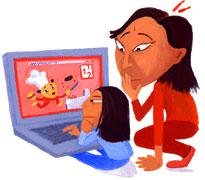
Until a Slate editor asked me if my daughter was obsessed with Club Penguin, I had never heard of the thing. Of course, she had. My daughter and many of her classmates have their own computers, for homework. Unlike their television viewing, a lot of their computer use is not closely monitored. As I asked my daughter about Club Penguin and other kid-centric virtual worlds, it became clear that one of their main appeals is that I’m largely oblivious to how much time she spends on them. (I do know she’s not online with pedophiles because I regularly ask, “You’re not online with pedophiles, are you?”)
To educate myself—and to find out what the target audience for these sites really thinks of them—I organized a focus group of five sixth-graders, all 11 years old. I set up two laptops and let the kids show me their favorites. At times the project seemed like a demonstration for a gender studies class with the boys at one computer, the girls at another. Anna, a budding sociologist, explained, “Most sites for girls are an online world—it’s socializing. For boys, it’s gaming.”
Broadly speaking, sites like Club Penguin allow kids to pick out an avatar that they guide through activities. As far as I could tell, this consists mostly of shopping and decorating. To purchase this fake clothing and furniture requires fake money, and to earn it, players are required to play a series of arcade-style games. What better lesson can we teach our kids: If you’ve just blown through your home-equity loan, you can always avoid bankruptcy by spending a couple of days in Vegas.
The Walt Disney Co. won’t be happy to hear that nobody was enchanted with Club Penguin. The site, which Disney just bought for $700 million, has a limited free area where you can get your own igloo, befriend other penguins, and invite them over to admire your igloo-decorating skills. The biggest drawback of the site: In order to do advanced decorating, players have to ask their parents to pay $5.95 a month, or $57.95 a year. All the kids had enough insight into economics and psychology to know that asking their parents would not only get a “No” but draw undue attention to their leisure activities. “I only do what’s free, but you get bored quickly,” Anna said. Ellie thought the befriending feature was something of a sham. First of all, these penguin friendships were too meaningless even for kids who do much of their real-life socializing online. Second of all, because she wasn’t a member, Ellie was embarrassed to invite people to her barren igloo because it looked “pathetic.”
All of my testers much preferred Millsberry. This is a creation of the food company General Mills (which owns Pillsbury, thus Millsberry). It, too, allows kids to earn money by playing arcade games so they can decorate their homes and fill them with healthy foods such as Lucky Charms, Trix, and Reese’s Puffs. Emily says the site offers some valuable lessons: “It teaches me not to spend so much money because they price things so outrageously high.” The costs of goods in Millsberry were reminiscent of the Weimar Republic. At the Millsberry Academy store, a sweat shirt is 200 Millsbucks, a notebook 75, and a ruler 35. Such prices emphasize the necessity of working hard—at the arcade. Emily says she’s managed to accumulate big savings because she multitasks by playing the games while she chats on e-mail. Ellie proudly showed off the pool that cost her 15,000 Millsbucks. “It took me a long time to save for it. Then I used all my money and I starved.”
The girls were embarrassed to admit it, because they are too old to play with actual Barbies, but they liked Barbie.com. The site’s various sickening mantras—”I love shopping!” and “Beauty is our Duty!”—made me remember the more robust Barbie games of my childhood. One favorite was when my friends and I switched Barbie and Ken’s heads, stripped them, then smashed their torsos together. Now that’s healthy kids’ play.
Ben and Peter couldn’t even look at the girls’ laptop during the Barbie session. Ben went to his favorite site, Sports Illustrated for Kids. Through SIKids.com, he manages various fantasy teams and also plays online games. He showed Peter the site’s All Star Dodgeball, where you get Shaquille O’Neal, Mia Hamm, and other athletes fight it out, if not to death then at least to unconsciousness. Then Ben went to AddictingGames.com and started playing Bowman, a game in which you control an archer and whose instructions read, “Your best shot is through the other guy’s head.”
For the sake of this article, I decided to see what advantages accrued to the player who could persuade a parent to cough up a membership. My daughter and I went to an actual store where I purchased a $15 stuffed poodle that came with an access code allowing entry to the paid part of Webkinz.com, a site owned by the stuffed-animal retailer Ganz. The goal at Webkinz: to accumulate enough wealth to keep your stuffed-animal avatar living in the kind of style to which a Leona Helmsley pet could become accustomed.
It was refreshing to find that players could earn money by actually doing jobs. There were many choices: hamburger cook, gem miner, newz delivery, flooring assistant. The description for flooring assistant read, “Help install fancy floors in the homes of the rich and famous.” This may actually be good training—attending to the citizens of Richistan is one of the bright spots in our economy. The job was challenging, consisting of pattern-matching of the kind offered during a neurological assessment. The creators of Webkinz must also have consulted with the French Ministry of Labor, because once a job is done, players are not allowed to work for another eight hours. The kids found this to be an outrageous restriction of their right to work.
Now that I’ve found out what my daughter is actually doing on her computer, I’ve concluded that these sites are mostly benign. They still left me depressed, though. I know much of kids’ play is about imitating grown-up life. But instead of actually playing house or creating a fort in the back yard, their play has shrunk to a screen programmed by adults, some employed by massive corporations. When I mentioned how it used to be, Ellie asked, “Did you have computers when you were my age?” I shook my head. And she gave me a look that said, “Quod erat demonstrandum.” Anna tried to cheer me up. “If you were watching us do it, you’d think it’s a waste of time and it’s not teaching us anything. But it’s not a waste of time because it’s fun.” Ben added, “It’s a whole other world tucked away. It’s almost like secret information and your parents don’t know what you’re doing.”
It was Peter who made me feel that not all is lost, and some parents (although not me) are managing to hold onto the way childhood used to be. Peter doesn’t have his own computer, which is fine with him because “I have a lot of homework and I have piano and trumpet. We have to set the table, and eat, and wash the dishes. And I usually go to the park two hours a day—it’s a block up. That’s more fun. I do random things there with friends, like jump down 13 stairs at a time, then 12 stairs, random stuff.” That does sound like fun. Maybe when he gets older, he could turn his random stuff into a Web site. Jumping down 12 stairs is free. The 13th will cost you $5.95.
