Obama's Achilles' Heel
What's he ever done?
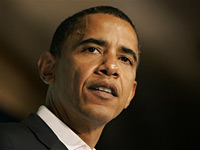
This is the third in a series of articles about each presidential candidate's Achilles' heel. A companion video to this story appears on Slate V.

If you haven't been able to keep up with the charges and countercharges in the Barack Obama/Hillary Clinton fight over who would make a better commander in chief, don't worry, you can catch up. It'll be going on for the next six months. It started at the YouTube debate and in 48 hours exploded from a flap to a dust-up to an official grudge match. For the first time in the previously docile campaign, the candidates themselves traded snipes, and their aides swapped phony accusations on cable television.
The reason the fight flared so fast can be found in this result from Gallup poll: The key and overwhelming reason voters prefer Clinton to Obama is that they believe she has more experience. Obama wants to change that, so in the debate and in the days thereafter, he criticized Clinton's 2002 vote to authorize force in Iraq and asked why she didn't demand an exit strategy from the administration at the time. Clinton could have defended herself by pointing out she did call for an exit strategy, but she wants to keep that balance of experience leaning in her favor, so she chose instead to portray Obama as a callow youth. She claimed that he was "naive and irresponsible" for suggesting that he would negotiate with dictators in Iran and Cuba. Obama shot back the equivalent of "so's your mom," claiming it was her Iraq vote that was naive and irresponsible. Clinton had distorted Obama's debate answer to make it seem like he would thoughtlessly negotiate with dictators, so he distorted right back by questioning her motives and claiming again and again that she was like George Bush.
The root of the Obama/Clinton spat is the fundamental question about his campaign: Does he have enough experience to be president? By highlighting that he was right about Iraq and Clinton was wrong, Obama answers that question by reframing it: He may not have Clinton's résumé, but he has better judgment.
In the polls, Clinton does far better than Obama on questions of experience, leadership, and capacity to handle a crisis. She trounces him by more than 30 points among Democrats looking more for strength and experience in a recent ABC News/Washington Post poll. Worse for Obama, when voters are asked the question in the abstract whether he has enough experience for the job, only 30 percent of respondents said yes in a Wall Street Journal/NBC poll. On the same question, Clinton scores in the 70s.
On the other hand, Obama receives his highest marks in polls from people who think he is new, fresh, and inspiring. If voters vote with their hearts, his experience problems might not matter that much. His candidacy also will test how voters assimilate their feelings about George Bush. Bush had no foreign-policy experience, and while he was surrounded by people who did have such experience, he has proven that there's no substitute for actual knowledge. On the other hand, voters are so depressed after the Bush presidency (70 percent of the public think the country is going in the wrong direction) they might rush to a candidate who seems able to electrify the country.
Democratic strategists debate whether experience is Obama's biggest problem or whether he faces a bigger challenge broadening his support among voters. Despite his success in recruiting record numbers of donors and turning out huge crowds, Obama's position in national and key state polls has leveled off. He does well with upper-income voters but has trouble connecting with those who make less than $35,000 and those who have graduated only from high school. He is often compared to other boutique candidates such as Eugene McCarthy and Bill Bradley, who were always in the murmur of elite drawing rooms but never caught on with the blue-collar base of the party.
For the moment, Obama is hampered by his own celebrity. To build a connection with voters in the early caucus and primary states, he needs to work smaller venues. Close interaction with voters allows them to take away a deeper impression and gives him feedback about what people are worried about and what they want to hear. He has an ear for this. Obama has compared talking to black church audiences to a jazz session where his rhetoric feeds off the room. But he can't jam if the room is too noisy, and for the moment, too many people are showing up at his rallies for him to create that intimate feel. "The campaign has tried to schedule smaller events to allow more personal contact with voters," says Polk County Democratic Chairman Tom Henderson, "but he almost always ends up drawing huge crowds."
Obama's other challenge, as one adviser put it, is the perception that he's "all sizzle and no steak." The huge crowds and stirring but vague reform rhetoric don't give voters anything they can take home in their pocket. This has lead to some high-profile failures—at a health-care forum in Nevada and with firefighters in Washington—in venues where audiences wanted to hear specifics about ideas that will change their lives. Obama's rhetoric makes this task more difficult. He presents himself as a paradigm-shifting candidate, which means people are expecting to be floored not just by his charisma but by his ideas.
These problems can be fixed. Interviews with Iowa and New Hampshire veterans suggest Obama's organization in the early states is far better than Howard Dean's was, and he has a better chance of capturing the African-American vote than the other brainy failures of the past. He can also improve his market share among Democrats who want change. In the recent Washington Post/ABC poll, party voters valued a candidate who brings a new direction and new ideas more than they valued strong leadership and experience—by 52 percent to 42 percent. Though Obama trails or is even with Clinton on the question of which candidate better represents change, his look and manner are so new it's not hard to imagine how he might convince voters.
On the campaign trail, Obama can shrink his crowds and move from the delicate soufflé speeches to ones that talk in a concrete way about how he is going to change people's lives. He did this in a recent urban poverty speech and has taken to reading to audiences what specific government services they're being denied by the billions being spent each month on the Iraq war. John Edwards, among others, had criticized Obama for offering voters only hope, but at the last debate, Edwards praised Obama for the seriousness of his health-care plan. It's not a bold and transformative plan, but that may not matter so much. Obama merely needs to make the case that he's serious enough, so that when his ideas are matched with his charisma, he can build a national consensus for policies better than any other candidate. "We all bought Bill Clinton's blue sky," says Iowa Woodbury * County Democratic Chairwoman Teresa Wolf, who is not backing a candidate. "Why not Obama's as long as it's a blue sky."
What Obama can't grow on the campaign trail is a different life experience. And Hillary Clinton and her campaign are going to be relentless in raising the experience issue. To fix this problem the Obama team is insisting that Obama has a different kind of what they call "real" experience. They're running television commercials highlighting his years as a community organizer and state senator. "A lot of people think that Barack Obama was born at the DNC convention in 2004," says his communications director Robert Gibbs. (That's probably because the campaign uses the clip so often to promote him.) The ads start with chapter headings for each of the stages of his career and plenty of black-and-white photos to suggest he has had an epic life. On the stump and in debates, Obama is also stressing his past. When he spoke about his urban agenda, he pointed out that poverty was "the cause that led me to a life of public service almost 25 years ago.''
The campaign is also redefining what experience means for Clinton, using her years in the Senate and White House to brand her as a creature of Washington and the past. Beyond his prescience on the Iraq war, Obama is making a larger claim: that he has better judgment than any other candidate on foreign-policy issues because he is not a captive of the Beltway. He supports this by pointing to his early years growing up overseas, which he stretches into "a life of living overseas." His reception in Africa last fall certainly suggests he has a world appeal like no other candidate. In an attempt to add a little military shine, he has enlisted a retired Air Force major general to his campaign who has been crisscrossing Iowa on something called the Obama for Commander in Chief Tour.
Plenty of candidates have won the presidency without foreign-policy experience. Bill Clinton and George W. Bush lacked foreign-policy experience. Even during the Cold War, Jimmy Carter and Ronald Reagan were elected. But unlike Obama, these presidents at least had executive experience as governors.
By claiming a special judgment in foreign policy, Obama exposes himself to uncomfortable follow-ups. He made dramatic claims that Clinton's conditional views on negotiating with rogue nations meant her approach was merely "Bush-Cheney light," but Obama had expressed a nearly identical view just before the big spat. He says he wouldn't be afraid to tell leaders like Iran's Mahmoud Ahmadinejad hard truths face to face. On what past experience will he draw for these high-wire negotiations? What high pressures has he endured to prepare him for the appealing, but risky, diplomacy he promises? Obama supporters are fond of comparing him to John F. Kennedy, but they have forgotten that Kennedy's first meeting with Khruschev didn't go so well and his first foreign-policy adventure, the Bay of Pigs, was a disaster because of the new president's inexperience and naiveté.
Obama also exposes himself politically by focusing too keenly on Clinton's Iraq record in the Senate. His argument is that she was insufficiently questioning of the administration, but despite his prescience as a candidate in 2002, he was hardly an anti-war leader when he got to Washington. His record in the Senate is not consistent with his self-styled campaign image as a bold, transformational leadership voice on Iraq.
The best thing going for Obama in the fight with Clinton over his leadership credentials may be the fight itself. He gets to show that he's combative, self-assured, and not afraid of a confrontation. In fact, he seems to delight in it. Since Clinton is considered a formidable opponent, he's getting the chance to demonstrate toughness to voters that isn't readily apparent from looking at his actual career.
Correction, July 30, 2007: This article originally claimed that Teresa Wolf is Democratic chairwoman of Waterloo County, Iowa. She is Democratic chairwoman of Woodbury County. (Return to the corrected sentence.)