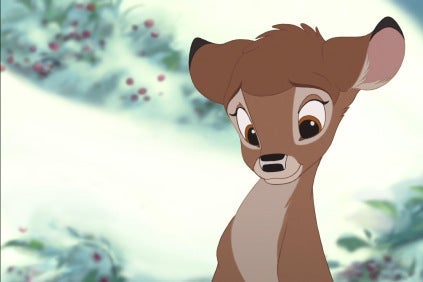
Last year, when Disney acquired Pixar, it installed Pixar big shots John Lasseter and Ed Catmull into positions of power in its flagship division, Walt Disney Animation Studios. Lasseter and Catmull are making their presence felt. A few weeks ago, they announced a dramatic reorganization of Disney’s animation departments, eliminating one of the company’s most lucrative, yet most criticized, products: straight-to-DVD sequels of classic animated films like Bambi and Cinderella. The Pixarians had long been critical of such sequels (Pixar co-founder Steve Jobs called them “embarrassing” back in 2003) and the move was viewed by many as a triumph of class over commerce. The artistic geniuses at Pixar were axing the money-grubbers who had sullied the good names of classic Disney cartoons.
But have you ever actually watched one of Disney’s DVD sequels? If you’re expecting half-assed hack-work, you’re in for a surprise. Lady and the Tramp II (2001), Bambi II (2006), and Cinderella III (2007), to take three recent examples, are certainly not perfect, but they’re worthy successors to the originals, carrying the well-worn stories forward with care and charm. What’s more, the movies tell their stories in the classic animation mode, using hand-drawn images, winning songs, and an energetic but not hyperactive style that has entertained children since Snow White and the Seven Dwarves. And which, given the chance, can still engage children today.
The summer of 2007 has once again seen a steady stream of the computer-animated features that have replaced traditional animation on the major studios’ slates. These films tend to share certain qualities: a fast-paced plot; crisp, shiny animation; and a Shrekian desire to pack every single frame with pratfalls, jokes, and action. Yet this year’s Surf’s Up, Shrek the Third, and Meet the Robinsons—like last year’s Monster House, Barnyard, and Over the Hedge—seem to be provoking a kind of animation fatigue in audiences. The average gross of animated films fell from $149 million in 2004 to $88 million in 2006. Shrek the Third, meanwhile, is down 25 percent from 2004’s Shrek 2.
Perhaps ticket buyers (i.e., parents) long for a different era of animation. If so, Disney’s sequels will do a much better job of reminding them of the animated classics than the slick gagfests in today’s theaters. Despite their straight-to-DVD status, there’s nothing cheap or knocked-off about the animators’ work on these sequels. They have a rich, hand-drawn look that few studios’ CG efforts can match. (The exception, of course, is Pixar: Ratatouille is so well shot it should be eligible for the cinematography Oscar.) The dogs of Lady and the Tramp II are wonderfully expressive, stumbling through their junkyard environs in an endearingly imperfect way that sleek, computer-generated characters simply can’t manage. And Bambi II is filled with some of the most painterly, awe-inspiring forest settings I’ve ever seen onscreen. Computers can make a forest look real; old-fashioned animation can make a forest look at once imposing and alluring.
And unlike the current crop of animated features, Disney’s direct-to-DVD sequels tell their stories simply, without a constant barrage of slapstick and winking pop-culture references. All three films I watched were entirely free of crotch-kicking, and the only fart joke belonged, appropriately, to a skunk. Instead, the jokes tend to be quiet, the action gripping if only occasional, and the entire pace of the movie enjoyably slower than you’re likely to see onscreen these days. How much slower? Lady and the Tramp II and Cinderella III even make time for character-defining songs, the way animated movies used to.
Of course, none of this would matter if the movies abused the beloved classic characters whose stories they take up. Pixar’s head honchos seem to believe this is the case, but their concerns are misplaced. The sequels stay true to the characters, using them to teach some of the same gentle lessons as the originals. Lady and the Tramp II follows Scamp, the rambunctious son of Lady and Tramp, as he learns that finding a family that loves you is more important than trying to be “wild.” And Bambi II tracks the evolving relationship between Bambi and his father, the Prince of the Forest, as Bambi comes of age and comes to grips with the loss of his mother and his fear of the unknown.
Is it sacrilege to say that some of the characters and themes in these sequels are actually better-handled than in the originals? In Bambi II, Bambi’s father learns how to be a devoted, hands-on dad. As a father myself, I’d rather have my daughter watch the kinder stag of Bambi II than the distant, regal cipher of the first film. Plus, while his mother’s death certainly weighs on Bambi in the sequel, there’s nothing approaching the traumatic sequence in the original when Bambi’s mom gets shot.
Or take the example of Cinderella III. In the original film, the wicked stepsisters are oafish caricatures who exist solely to abuse the lovely heroine. In the latest sequel, magical mischief (and a bit of time travel) allows one of the stepsisters the chance to experience the love of Prince Charming; as a result, she reforms her wicked ways and becomes a friend and ally to Cinderella, and a braver, richer character herself. Cinderella III even has a little fun with the absurdity of the original’s conceit: “You think there’s only one woman in the whole kingdom who wears a size 4 and a half?” the Prince’s father asks at one point.
Far from sullying the spirit of the original classic films, Disney’s straight-to-DVD sequels respect their inspirations while finding new stories to tell. In Lady and the Tramp II, Scamp and his junkyard-dog belle Angel visit the same Italian restaurant famously visited by Scamp’s parents. They share a plate of spaghetti and meatballs, just like Scamp’s parents did. Adult viewers watching the sequel likely brace themselves, as I did, for some embarrassing gaffe that will tarnish their memories of a beloved childhood moment. But that gaffe never comes. Scamp noses a meatball over to Angel, but in a witty, doggy divergence from the original, she scarfs up the whole plate with nary a glance at her beau. It’s a charming moment, and an emblematic one: No, the sequels aren’t the originals, but yes, they’re awfully sweet all on their own.
