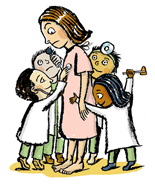
Over the course of three days recently, I had 23 head-to-toe physicals from 23 second-year students at the Georgetown School of Medicine. I was the first person these would-be doctors had ever fully examined on their own. Some were shaking so violently when they approached me with their otoscopes—the pointed device for looking in the ear—that I feared an imminent lobotomy. Some were certain about the location of my organs, but were stymied by the mechanics of my hospital gown and drape. And a few were so polished and confident that they could be dropped midseason into Grey’s Anatomy.
Georgetown allowed me to be a “standardized patient”—that is, a trained person who is paid $15 an hour to be poked and prodded by inexperienced fingers, so that med students can learn communication and examination skills before they are sicced on actual sick people. In Human Guinea Pig, I try things you might want to do but don’t have the time or opportunity. However, even if you had the time or opportunity, you probably wouldn’t want to be examined by 23 medical students.
The concept of the standardized patient has been around for decades, but only in recent years have medical schools made training with them a regular part of their curriculum. I talked to a 50-ish physician friend about my experiences, and he said when he was in medical school and it was time for the first rectal/genital exam, the students were told to pair off and examine each other. “So, do you pick someone you like, or someone you don’t like?” he recalled. “Either way, it’s lose-lose.”
Now there are standardized patients trained for genital duty (they’re called GUTAs, for genitourinary teaching associates), but I signed up for something less invasive. Mine was the simplest possible assignment. I was to sit on the edge of a padded table in one of those awful, flapping hospital gowns, in a room equipped with recording devices in the ceiling. Each doctor had 30 minutes to conduct a standard head-to-toe physical: from my vital signs, to my nerve function, to my reflexes, etc. Then I was to go to a computer and check off whether they’d done all 45 parts of the exam (“Palpated for fremitus,” “Auscultated carotids”), and write my comments on their bedside manner.
There are some obvious things you hope no doctor ever says to you, but on this assignment, I discovered there are a few others:
“I have to admit I have some butterflies.”
“I’ve never felt anyone’s liver.”
“I’m so sorry! Are you all right?”
I actually was charmed by the students who acknowledged their nervousness, and it was adorable the way most of them would stop after finishing one body part, look upward as if at a floating textbook, mumble some mnemonics, then continue the exam. Before he left the room, Dr. K (although they can’t yet call themselves “doctor,” I’ll call them that here; they’re so eager, they deserve it) ran his eyes over me and said, “Let me check if I forgot any major systems. That would be bad.” But nervousness in a doctor can be dangerous. Dr. F had a relationship with her instruments that reminded me of Edward Scissorhands. She apologized profusely after stabbing me with the otoscope.
Sometimes it was hard for me not to laugh. Dr. A was so sweetly flustered that in a perfect Chaplinesque slapstick, he would drop his reflex hammer on the floor, bend to pick it up, and then discover that his pen had fallen out of his white coat. Dr. N wasted the first eight minutes of the exam trying repeatedly to get a blood pressure reading. The panic in his eyes seemed to say, “She appears to be alive, yet she has no vital signs.” He finally solved the dilemma when he realized he was listening to my arm with the wrong side of the stethoscope. (My blood pressure readings, which require technical skills on the part of the doctor, varied from 87/60 to 125/90.) Sometimes it was hard for the student not to laugh. Shy and mousy Dr. B, after peering into my eyes and ears, said, “Now I have to look up your nose!” and let out an embarrassed snort.
From the moment petite, blond Dr. C came in the room, she took command. Before she started, she briefly told me what the exam consisted of, then explained each procedure before she did it. Her touch was confident, and she did all 45 parts of the exam without hesitation. She asked me to tell her if anything hurt or made me uncomfortable. After she listened to my abdomen and proclaimed, “Good bowel sounds,” I felt gratified I was able to please her.
Dr. C made me wonder what it is that makes some people glide elegantly as swans, while others stumble awkwardly as mud hens. My main mud hen was Dr. I. He began poorly by asking me where the recording camera was, then addressed all his findings to it. For example, after I successfully stuck out my tongue, he said to the ceiling, “Patient’s cranial nerve No. 12 is intact.”
Like many of the students, Dr. I was baffled by how to assess my heart and lung function without breaching the fortress of my bra. Most students, while listening through the stethoscope to my back, simply worked around the bra. But Dr. I informed me he needed to unsnap it (no, he didn’t use the one-handed technique). Then he stood in front of me, looked at my gown like a colonel contemplating an incursion, and struck. He peeled off the top of the gown, dropping it into my lap, slipped the bra off my shoulder, and left me hanging while he protractedly listened to my heart. (Dear Male Readers: Doctors don’t strip their female patients.)
I sat there, as the tape ran, debating whether to stop the exam. Sure he had on a white jacket and was using a stethoscope, but in reality, Dr. I was no doctor, but just a pimple-faced kid who’d taken off my bra. My pondering was interrupted by an abrupt knock on the door. We looked over, and standing there was the real doctor in charge of the program.
“No breast exam!” she said firmly to Dr. I. He was left sputtering as she closed the door. I redid my bra and put on my gown. Dr. I gamely tried to continue, but he was so shaken he forgot to take my blood pressure, and before he could get to my reflexes, an announcement over the PA said the time was up. He had to put down his hammer like a contestant on Top Chef forced to drop the spatula before plating the side dish.
After every three exams, standardized patients take a break in a private lounge. There were about 20 of us divided into two groups. My group was undergoing the physicals, while a group of older SPs were pretending to have hurt themselves in a fall. Almost all my fellow patients were professional actors who supplement their income by appearing in a repertory circuit at the medical schools of Georgetown, George Washington, and the military’s Uniformed Services University. I envied that some really got to exercise their acting chops. One told me she recently portrayed a depressed alcoholic with irritable bowel syndrome who wasn’t even supposed to know she was depressed and alcoholic—the medical student was supposed to figure that out.
An older SP had recently been at George Washington, where she had to portray a sex-crazed senior citizen. Her story was that she had been frustrated during her entire marriage because she wanted sex daily, but her husband would only satisfy her weekly or monthly. When he died, she moved to assisted living, where she cut a swath through the remaining men and ended up with a sexually transmitted disease. She says of the students required to take her history, “They were freaking out with embarrassment.”
When I went back to my examining table, I tried to think what my reaction would be to my students if they were real doctors and I was a real patient. In response to most I would have thought, “This is disturbing.” A few would have made me wonder whether I was in an episode of Punk’d. But a handful were so ready, so ordained to be physicians, that I simply would have been impressed by my young doctor.
Sometimes I got to see their excitement at playing doctor while I played patient. Dr. S, a future McDreamy with a hand in a cast from a rugby collision, moved in close with the ophthalmoscope to examine the fundus (OK, the interior lining) of my eye. Just as we were almost touching he said, “There it is!” with the same delight a sailor would cry out, “Land ho!” Some tried making doctorly conversation. “Have you ever had a physical before?” one asked. I nodded yes, but wanted to add, “Lately, I get one about every half hour.”
Finally, I felt privileged to be there at the beginning and help send these healers on their way. So, to you Drs. A through W (even you, Dr. I), I hope your nerves settle down when you examine your patients’ nerves, I hope you never get sued for malpractice, and I hope you make a lot of people better and even save some lives.
Thanks to reader Joseph Orloski for suggesting this assignment.
