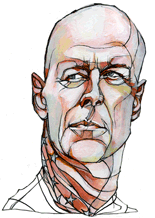
On the city streets of America, buses have been displaying a strange ad. No art, just white print on black, a slogan stranded between English and gibberish: “Yippee Ki Yay Mo—.” Although the line is not spelled the way it’s pronounced, it’s still recognizable as the first half of a well-known action-movie one-liner. The ad is teasing the June 27 release of Live Free or Die Hard. Since the Die Hard franchise, and its catchphrase, have been absent from the screen for 12 years, a question arises: do the words “Yippee-ki-yay, motherfucker” still matter? And why did they resonate in the first place?
First heard in the original Die Hard in 1988, “Yippee-ki-yay, motherfucker,” is one of the many one-liners that have graced the action film, a body of work not known for its strong verbal tradition. Indeed, the delivery of the one-liner ranks among the most cherished rites of this ritualistic genre. Whether a quip, catchphrase, or callback to an earlier installment in a franchise, one-liners, even at their corniest, provoke the same glee as the most pyrotastic action sequences.
Many one-liners are bad, if treasured, puns (Arnold put his stamp on “You’re fired” long before Donald did). Others display a wit that we might grudgingly concede (“Barbeque, huh? How do you like your ribs?“). The one-liner is also remarkably versatile. It spans the grandiose (“I’m going to show you God does exist“; “I’m your worst nightmare“) to the minimalist (“Get off my plane“; “Whoah“). It ranges from the functional (“Dead or alive, you’re coming with me“) to the iconic (“Go ahead … make my day“). And while some are uninspired (“It’s time to die“), others are absurd (“I have come here to chew bubble gum and kick ass—and I’m all out of bubble gum“), self-referential (“No sequel for you“), and sardonic (“Go ahead … I don’t shop here“).
The 1980s were the golden age of the one-liner, with the films of Arnold Schwarzenegger, Sylvester Stallone, Chuck Norris, and Clint Eastwood, and the ascension of such screenwriters as Steven E. de Souza and Shane Black, who penned many of the decade’s high-concept action and buddy movies (Die Hard, Commando, and Lethal Weapon chief among them). Yet, like many action film conventions, the one-liner has roots in other genres. In the landmark Western The Searchers (1956), John Wayne growled, “That’ll be the day,” prompting Buddy Holly to immortalize the catchphrase in a hit single the following year. And not only did the James Bond franchise give us “Bond—James Bond,” but lines such as “Shocking! Positively shocking!“; “He had to fly“; and “He got the boot” prove that Bond also gave action films their penchant for punning. Throughout the series, Bond’s cheeky dialogue defuses the emotion of a given scene, just as the one-liner does throughout the action genre.
Such glibness lays bare the action hero’s core reticence. “I ain’t got time to bleed,” insists Predator’s Jesse Ventura, who would repurpose the line for the title of his book, I Ain’t Got Time To Bleed: Reworking the Body Politic From the Bottom Up.Less quoted but even more germane is the declaration by Road House’s Patrick Swayze, “Pain don’t hurt.” A contradiction, yes, but one that defines both the action hero and, more literally, one of the genre’s most iconic roles: the title character of The Terminator.
That 1984 movie inaugurated Arnold Schwarzenegger’s signature, “I’ll be back.” In this case, the one-liner is funny only in hindsight, as the cyborg comes right back, fully armed and with a pickup-truck-of-mass-destruction to boot. Reversing the typical action-sequence structure, the quip is the set-up, the violence is the punch line. There is nothing especially remarkable about “I’ll be back” (it is not, after all, Cobra’s “You’re the disease, and I’m the cure,” a line noted by the press six months before the film’s 1986 opening). Even so, “I’ll be back” distills the action movie’s ritualistic appeal. The pleasure of hearing it said from movie to movie is the same as hearing a story told time after time.
Most one-liners articulate the hero’s self-regard (or in Harry Callahan’s case, regard for his .44 Magnum), and why shouldn’t they? The action genre is primarily an exercise in hero-worship. But Die Hard’s wisecrack is remarkable for how it refers not to one hero but to a tradition of heroism. It is a line born of pride, not of ego.
When terrorist-slash-exceptional thief Hans Gruber (Alan Rickman) taunts hero John McClane (Bruce Willis), “Who are you? Just another American who saw too many movies as a child?” and asks this “Mr. Cowboy” if he really thinks he stands a chance, McClane’s answer—“Yippee-ki-yay, motherfucker”—marks the moment that McClane, an everyman, assumes the mantle of America’s archetypal heroes: Roy Rogers, John Wayne, Gunsmoke’s Marshall Dillon, and others who have been so vital to American boyhood. Unlike the many action-movie one-liners that are rooted in the hero’s narcissism, McClane’s stems from our collective wish-fulfillment. He is not referring to himself, not suggesting an “I” or a “me” but an us. And considering the European Gruber’s appreciation of fashion, finance, and the classics, McClane’s comeback acquires an additional subtext: Our pop culture can beat up your high culture.
In John McClane’s stance, there lies a bravado that bridges two American traditions. “Yippee-ki-yay” summons America’s mythic, gunfighter past, while “motherfucker” belongs to the modern action movie. Seen in this light, the line also recalls the macho cinema of the 1970s, when Clint Eastwood, Charles Bronson, and Don Siegel helped create the action genre while continuing to trade in Westerns.
A quarter of the line (or half, depending on how you count) is profane, and yet “Yippee-ki-yay, motherfucker” is actually a delicate wisecrack. Underscoring the line’s bridging of generations is the symmetry of its construction. On either side of the comma, past and present each get four syllables. This balance is manifested in the evenness of Willis’ first—and best—delivery of the line. Subtly, he eases off “fucker,” the word that, by virtue of its syntactical position, and its very nature, we might expect to land hardest on our ears. That Willis does not employ the same deftness in the sequels is a pity. The phrase is most effective not as a buildup to some hammer punch, but as one seamless unit of defiance.
With Die Hard 2: Die Harder (1990) and Die Hard With a Vengeance (1995), “Yippee-kai-yay, motherfucker” transformed from a one-liner to a catchphrase. It has also been lampooned by celebrities including Ice-T and Dr. Joyce Brothers, parodied by Ben Stiller, and, more recently, commemorated in song. Now, for the franchise’s fourth installment, the line has become an advertising slogan, standing less for the continuity of American heroism than for the continuity of the Die Hard brand. (With wry religiosity, the ads attribute “Yippee Ki Yay Mo—” to “John 6:27,” referring to McClane’s June 27 return.) In contrast, early in the third film’s campaign, Fox trumpeted the movie with the line “McClane Is Back.” Whereas the character was then the primary draw, his catchphrase has since become an independent asset.
The marketing value of “Yippee-ki-yay, motherfucker” may not equal that of Bruce Willis, but then, the line is an eight-syllable phrase, not an international superstar. Its role in the new film’s advertising testifies that “Yippee-ki-yay, motherfucker” continues to excite our nostalgia—no longer for a distant, heroic past, but for the line itself and the movie era from which it sprang. This marks the improbable distance “Yippee-ki-yay …” has traveled: from a wisecrack to a trademark to the hallmark of a genre.
