The White House, the 9/11 commission, and Congress are all considering recommending the appointment of a new intelligence czar, who would head up the government’s 15 intelligence agencies and offices. As it stands now, the director of central intelligence, currently George Tenet, controls only the Central Intelligence Agency and its budget—a small slice of the total pie. What are the 14 other intel agencies, and what does each one do?
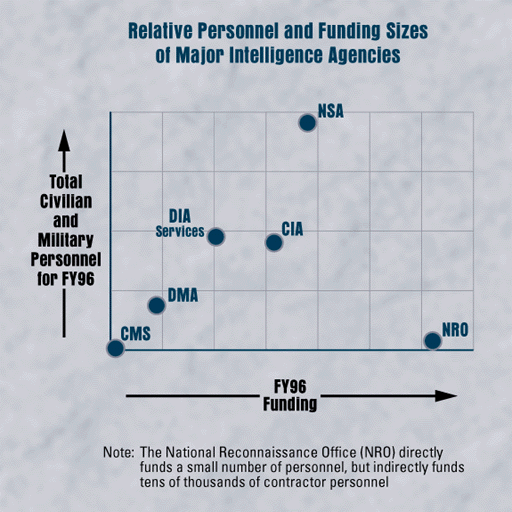
The Department of Defense houses four agencies that are dedicated solely to intelligence and is thought to spend about 85 percent of the country’s annual intelligence budget, which weighs in at about $40 billion. (The stand-alone CIA controls a much smaller portion of the available cash.) Their budgets are all classified, but it’s possible to get a rough picture of their activities through media reports and a refreshingly loose-lipped presidential commission. In apparent order of size, the agencies are:
National Reconnaissance Office. Builds, launches, and maintains the country’s spy satellites. In the mid-1990s, a Clinton-appointed commission on intelligence showed the NRO getting about 50 percent more funding than any other intel agency, about $6 billion at the time.
National Security Agency. Intercepts and, if necessary, cracks foreign signals, whether e-mail messages, cellphone calls, or regular land-line calls.
Defense Intelligence Agency. Gives the military information and tips on other countries’ militaries. It had a moment of fame soon after its creation in 1961, when a DIA official appeared on national television with photos of Soviet missile sites in Cuba. More recently, it got a bit of attention for having stated before the Iraq invasion that there was “no reliable information” that Saddam had chemical weapons.
National Geospatial-Intelligence Agency. Analyzes satellite photos, using them to make maps and other goodies, such as 3-D simulations of terrain and targets.
So that’s four. In addition, each of the United States’ five armed services—the Army, Air Force, Navy, Marines, and yes, Coast Guard—has its own intel branch. Compared to the big boys listed above, these offices are relatively small; they usually focus on tactical issues their servicemen and -women face in the field. That makes nine.
Most of the remaining offices consume intelligence rather than gather it. The departments of State, Treasury, and Energy each have an intel unit. Relying on their particular expertise, these groups analyze other agencies’ data and give assessments to their secretaries. (It was State and DOE intel branches that expressed reservations about the larger intel community’s conclusions on Iraq’s supposed nukes program.) So much for 10, 11, and 12. No. 13 operates in a similar manner and is housed in the Department of Homeland Security; it’s the office behind the multi-hued threat alert.
And while there is talk about creating a domestic intel agency along the lines of the British MI-5, the FBI insists it already is one. The G-Woman in charge of the bureau’s “Intelligence Program,” Maureen Baginski—who was previously a top official at the National Security Agency—explains that rather than being housed in a discrete office, intel is “the job of everyone at the FBI.”
Explainer thanks the Steven Aftergood of the Federation of American Scientists, John Pike of Globalsecurity.org, and Anya Guilsher of the CIA.