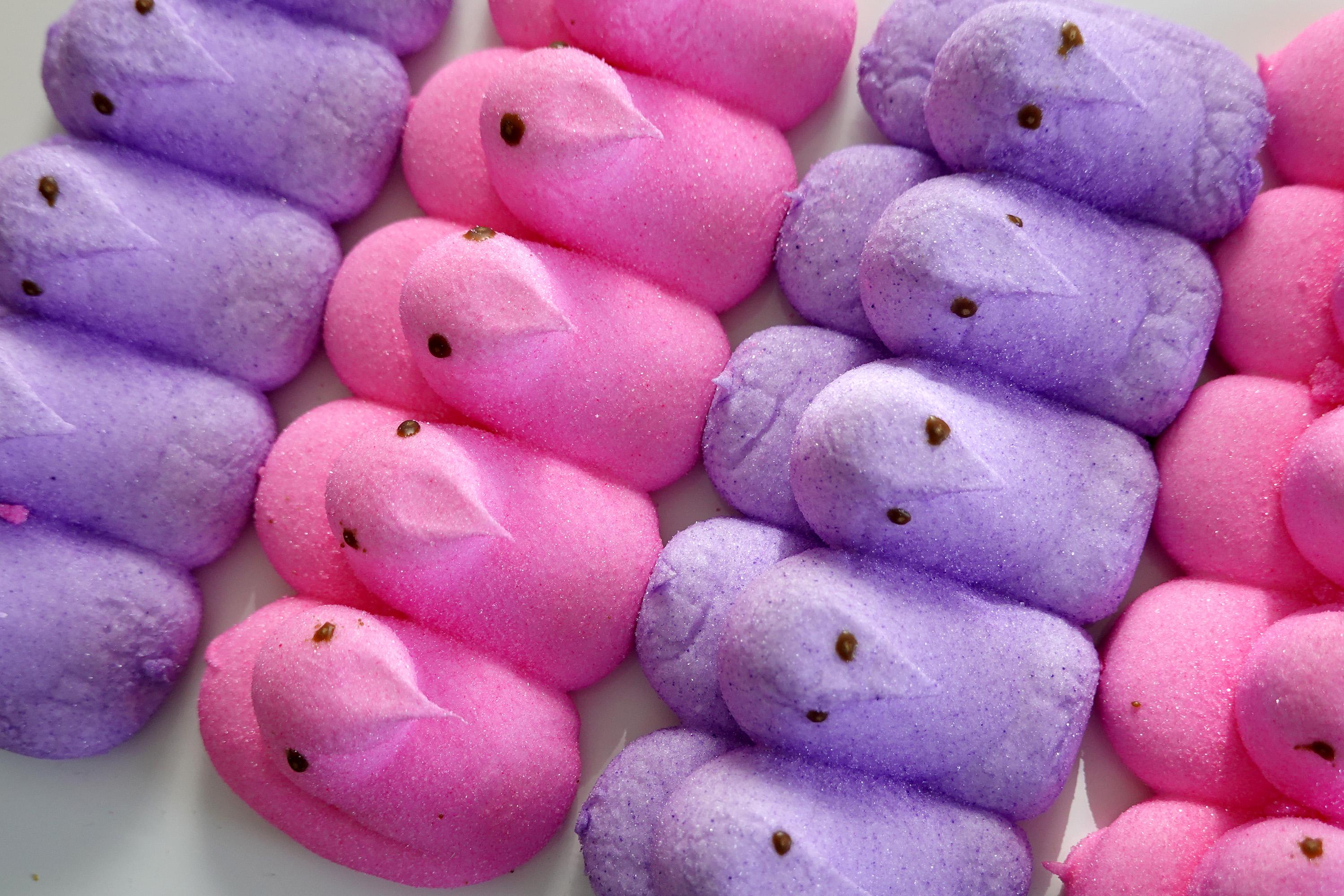
Along with Easter comes a barrage of Easter candy, perhaps none as much a pop-culture curiosity as Peeps. In a 2004 Explainer, Rachel Deahl researched Peeps’ ties to Easter and our fascination with the confection. The article is printed below.
This Easter Americans will consume an estimated 700 million Marshmallow Peeps. Some will also be consumed by them—fanatics maintain Web sites featuring everything from Peep erotica, dubbed “Peep Smut,” to an inventive online movie called “Lord of the Peeps,” and each year at least a few newspapers print odes to the candy. But for all the fascination with Peeps, it’s never been clear why the sugary treats are associated with Easter. The marshmallow rabbits represent the Easter Bunny, but what do marshmallow chicks have to do with the resurrection of Christ?
As it turns out, chicks have little to do with Jesus and a lot to do with spring. In 1917, Sam Born, a Russian immigrant, opened a small candy shop in New York City that sold chocolates and other confections. When the company grew, Born relocated it to Bethlehem, Pa., and named it Just Born, after a slogan he’d coined to advertise the freshness of his wares. Then, in 1953, Just Born bought a local Pennsylvania confectioner called the Rodda Candy Company.
Although Just Born acquired Rodda for its jelly-bean-making capabilities, the Born family was fascinated with the three-dimensional marshmallow Easter chicks, called Peeps, that Rodda was also making at the time. Lauren Easterly, the Peeps brand manager at Just Born, said that a group of women at Rodda made Peeps by hand in the back of the factory. In 1953, it took Rodda 27 hours to make one Peep. Just Born mechanized Peep production and was able to bring the confection to consumers on a mass scale by 1954.
No one at Just Born could explain why the Rodda Candy Company thought yellow chicks made for appropriate Easter candies. Company spokesmen also couldn’t confirm whether Rodda was making marshmallow confections in other shapes in 1953, although Rodda did manufacture marshmallow eggs at one point. Whatever shapes Rodda was making, however, Just Born zeroed in on the chick; the company didn’t start distributing the marshmallow candy in other shapes (such as bunnies) until the 1960s.
Candy historians speculate that the Peeps’ link to Easter has more to do with the pagan origins of the holiday than its Christian roots. Eggs, and consequently chicks, are a long-standing symbol of fertility and rebirth, an appropriate image for a holiday that celebrates the coming of spring. Originally part of a pagan fertility ritual symbolizing new life, the egg became incorporated into Easter as pagan rites were absorbed into Christianity with the Christianization of Central Europe.
That the Rodda Candy Company was based in Pennsylvania is also of note because German immigrants, many of whom settled in the state, are largely credited with popularizing the Easter Bunny tradition in America. Eastre was a Teutonic goddess of the dawn who was able to change a bird into a rabbit, a creature known for its fertility. In the 19th century, Germans gave a related gift during the Easter season: a basket of eggs with figures of bunnies placed in it. The Easter basket, and the Easter Bunny, really became popular in this country following the Civil War, and as one candy historian noted, it would have required no great leap of imagination for Rodda (or earlier candy makers) to place a few chicks among the eggs.
Explainer thanks Anthony Aveni of Colgate Univeristy, Beth Kimmerle, and Tim Richardson.
