Winter Travels in Samiland
Today's slide show: The Jokkmokk Winter Market
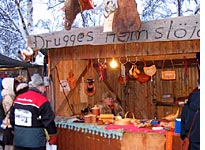
One of the myths about the north is that it's dark all winter. That's certainly true in November and December, though the blue polar light washing over snow—as well as the Scandinavian custom of placing small lamps and candles in windows—makes the long nights more enchanting than you'd expect. Still, by January everyone is more than ready for the sun to return. The days begin to lengthen remarkably quickly, and by early February, when Jokkmokk's winter market takes place, there's a good eight hours of light. The day I arrived in Jokkmokk I even had to get out my sunglasses for an hour when the snow-glitter was at its height.
Jokkmokk, a town of about 3,500, 125 miles south of Kiruna and set in forests on the Lule River, has been a market site for 399 years, when Sweden's King Charles IX decided to regulate trading between the Sami and the merchants, or more truthfully, to figure out ways to collect more taxes in order to pay for his frequent wars. Now held for three days beginning the first Thursday in February, and an increasingly important place to view and purchase locally made handicrafts and art, much of it produced by Swedish and Norwegian Samis, Jokkmokk's winter market briefly swells the town's population to 30,000.
Since there are only two hotels, booked up years in advance, and private rooms are at a premium, I considered myself lucky to have snagged a snug basement room in the home of weaver Evy Engfors, who would be selling woven rugs and table runners during the market. I wasn't there much; most of the time, I, like everyone was else, was roaming the snow-packed streets in search of excitement, culture, and bargains.
Dozens of vendors had driven their campers into town Wednesday evening and set up booths along the streets. The market was officially opened at noon Thursday with a short speech and a small reindeer caravan, consisting of a few white reindeer pulling boat-shaped sleds. I snapped shamelessly along with the other tourists, then it was time to look over the merchandise. Naturally, there were many vendors selling long johns and sweaters, as well as felt booties and sole inserts, fur-lined leather hats, and sheepskin gloves. Instead of fruits and vegetables were frozen fish and shrimp (no need for refrigeration; the below-freezing temperatures did the job), moose sausages, and chunks of dried reindeer. But, in addition to large stalls displaying machine-knit Norwegian sweaters or kitchen utensils, there were also family stands where the products were homemade: cloudberry preserves and double-thick knitted socks, mittens, and hats. The vendors were well wrapped-up, but there were still a lot of men with frozen mustaches behind the counters.
People-watching in the north is more a matter of bundle-watching, but some of the bundles were fabulous. In addition to sheepskins and wool, visitors had turned up in furs, some luxurious, such as a woman in dark sable who looked as though she were on her way to the opera, and some rather more ragged. One big guy sauntered by in a sleeveless bearskin coat, open at the chest to reveal a big paw dangling from a chain. Not the kind of thing that would go down well in most public places in the States, but somehow less repugnant amid the snowy market jostle. Here and there were Sami hats, scarves, and occasional full Sami winter gear—reindeer-skin coats, trousers, leggings, and boots. A few were wearing belted tunics and dresses; more would turn up in this traditional wear during the evening concerts and parties.
Although the Sami lived simply and often nomadically in the past, that doesn't mean they were isolated or that they weren't keen traders. For centuries, goods came from as far away as Arabia and Italy via Muscovy—the old principality of Russia. The Sami loved silver; they also nourished a love for bright colors and flourishes. Their cloth tunics with elaborate woven bands sewn into the shoulders and backs may have been influenced by Renaissance Italy, and the large peaked hats that men from several regions wear likely had their origins in sailors caps from Russia.
The winter markets were not only a place where merchants came to trade metal and other goods for furs and dried reindeer and salmon, but also to collect taxes for the Swedish and Danish kings (sometimes both). Sometimes missionaries came with them, proselytizing Lutheranism. In spite of the mixed history of these contacts between the Sami and outsiders, the winter markets were the highlight of the season. They went on for three weeks or more and people came from miles around, both to barter furs for silver and dried fish for embroidery thread, and to go to church and party, fall in love, and marry. Pretty much the same reasons as today, if the adolescents out on the street at night—dressed up in their coolest gear, whether it was a leather jacket or a Sami dress—were any indication. Jokkmokk is one of the only market venues with an unbroken history, though three days seems to be plenty, and church-going has been more or less set aside in favor of museum- and workshop-hopping.
If Kiruna is the political head of Swedish Sápmi, with the parliament and the Swedish headquarters of Sami radio, Jokkmokk is its cultural soul, with a college where students from many backgrounds study language and handicraft. Ájtte, Jokkmokk's museum, has come to be one of the focal points of all Samiland. During the winter market it's the venue for nature slideshows and films, lectures (delivered in Swedish and occasionally Sami), and musical events. I headed over to go through the exhibits and to watch a film from the 1940s, first aired on Swedish television. It showed the lives of the reindeer nomads as they moved ceaselessly from winter forests to summer pastures. By the 1950s, that way of life would be firmly over, pushed aside not only by roads and cars, but also by the snowmobiles of the Sami reindeer herders themselves.
Ájtte's main brief is presenting Sami culture, past and present, but it's also an information point for travelers and hikers who want to explore the superb parks of the Swedish mountains and watersheds to the west of Jokkmokk. I allowed myself to fantasize about a long backpack trip through the gorgeous summer scenery pictured in one exhibit, before reading the accompanying notes about the five or six different sorts of mosquitoes I would encounter. No, winter travel had its merits—and anyway, it wasn't that cold, only minus 25 centigrade so today. Sometimes, I heard, the temperature got down to minus 40 at the winter market. As long as I kept moving, I'd be all right. I wasn't quite ready to invest in a bearskin coat, but I admit that those fur-lined leather caps were looking pretty good to someone in a fleece hat from Land's End.