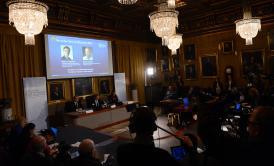
American biomedical researchers Robert Lefkowitz and Brian Kobilka were awarded the Nobel Prize in chemistry today for their groundbreaking work on G-protein-coupled receptors.
What the heck are those? The Associated Press explains:
About half of all medications act on these receptors, including beta blockers and antihistamines, so learning about them will help scientists to come up with better drugs. The human body has about 1,000 kinds of such receptors, structures on the surface of cells, which let the body respond to a wide variety of chemical signals, like adrenaline. Some receptors are in the nose, tongue and eyes, and let us sense smells, tastes and light.
Lefkowitz works at the Howard Hughes Medical Institute and Duke University Medical Center, where the 69-year-old is a professor. Kobilka, 57, used to work under Lefkowitz at Duke before leaving for Stanford University School of Medicine, where he is now a professor. You can read the official Nobel announcement here.
It’s worth pointing out that it wouldn’t be a stretch to say that this year’s chemistry award winners actually did their groundbreaking work in biology—something that continues a recent trend when it comes to the Nobel Prize. In 2009, the award went to a trio of scientists who discovered the function of the ribosome, a part of the cell that builds proteins; in 2006 the prize went to a biochemist who figured out how DNA is read; and in 2003 it went to a pair of researchers who discovered how cells shuttle salts and water through a cell membrane.
Slate contributor Geoff Brumfiel, who is also a physics reporter for Nature, summed things up like so this morning via Twitter: “Chemistry is everywhere! (Except in this year’s #chemistry #Nobel.)”
Unlike with the prizes in physics and medicine, Slate’s family and friends failed to accurately predict who and what would win the chemistry award. You can see the rest of Slate’s Nobel prize predictions here. Next up tomorrow: Literature.
