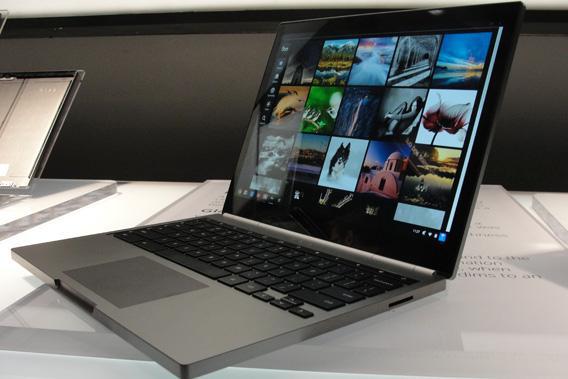
So I’m late to this party. It’s been two weeks since Google unveiled the Chromebook Pixel—a stylish yet mystifying addition to its line of machines that run the Chrome operating system—and pretty much every tech reviewer in the world has already offered his assessment. They all agree, too: With its stylish design and amazing high-resolution touch display, the Pixel is a wondrous machine … and only an idiot would consider buying it.
The Pixel starts at $1,299, but it has a limitation that other high-end laptops don’t: It can run only a single native program, the Chrome browser. Take it away, David Pogue: “If you’re going to spend $1,300, why on earth would you buy a laptop that does nothing but surf the Web?” How about you, The Verge? “Everyone should want a Chromebook Pixel. … But almost no one should buy one.” OK, let’s check in at Gizmodo: “The Chromebook Pixel is amazing. Don’t buy it.”
I wish I could muster up some Slate-worthy contrarianism, but I’m right there with those guys. In the couple weeks that I’ve had the Pixel, I’ve marveled at almost everything about it. Its display is indeed delightful, turning the Web’s ordinarily drab text into the crisp stuff you remember from glossy magazines. Its track pad and touch screen are fantastic; indeed, the Pixel’s is the first track pad not made by Apple that I didn’t want to jab with a sharp stick. Yes, the machine is a little too heavy—at 3.3 pounds it’s about 6 ounces more than the 13-inch MacBook Air, which sells for almost $200 less and does a whole lot more. Yet its extra weight is in keeping with an overall solidity. Made out of dark, precision-machined aluminum, the Pixel looks and feels like a computer designed by Harley Davidson: It’s all sharp, tough angles, and its moving parts are buttery smooth. This thing was made with a lot of care. I hope Apple’s design chief Jony Ive has ordered several of these. As a really rich guy who loves beautiful computers, he’s one of the few people in the world who’d truly appreciate the Pixel.
For the rest of us, the Pixel is foolish, a nice-looking but fatally hobbled bauble. If you want a great laptop, buy a MacBook Air. If you want a great laptop and you can’t stand Apple, buy an Asus Zenbook or a Lenovo ThinkPad X1 Carbon. If you want a second computer to just browse the Web, buy a $250 Samsung Chromebook (or an iPad, iPad Mini, Nexus 7, or Nexus 10). This is all so obvious you don’t need a tech reviewer to tell you any of it. You don’t even need to have touched the Pixel to figure it out. You shouldn’t usually shop for machines by tech specs alone, but in this case the specs tell the whole story.
In short, then: There is no market for the Pixel. It’s a machine made for overloyal Google employees or—because it comes with a three-year deal for 1 terabyte of space at Google Drive, something Google usually sells for $1,800—for someone who’s looking for a good deal on cloud storage.
So why did Google make it? That’s the mystery I’ve been wrestling with these last few days. And despite the Pixel’s being a nonstarter right now, I’m beginning to think it’s brilliant as an idea, albeit one whose time has not yet arrived. Why? Let me sketch out a few thoughts.
The Pixel is for tomorrow.
Despite its limitations, the Pixel is capable in a lot of important ways. It can’t run native programs—i.e., no Microsoft Office, no Photoshop, no Skype—but a dwindling number of us spend a dwindling number of hours on native programs anyway. I do my email, calendar, banking, shopping, news-reading, and nearly everything else online. My only remaining desktop vice is Word and sometimes Excel, but I use those only because I’m stuck in my ways and don’t really like Google’s online word-processor and spreadsheet programs. (Microsoft’s online editions of Word and Excel are pretty good—if forced to, I could likely migrate to those pretty easily.)
It might take a few years, but the lure of desktop apps will eventually surrender to the obvious advantages of a cloud-connected machine. Online versions of desktop software will get better and wireless Internet connectivity will become ubiquitous. At that point, the Chromebook will run pretty much everything pretty much everywhere. When that happens, it’s the noncloud machines that will begin to look foolish.
After all, the Pixel has an advantage that the Macbook Air and Lenovo Carbon can’t match: Other than charging it up, the Pixel requires zero maintenance. You never have to back it up; everything you do on it is, by definition, always backed up. You never have to worry about keeping it up to date—it always just is. Syncing comes for free, too: Switch from one Chromebook to another and all your stuff is there. Sure, you can make your regular laptop do these kinds of things, but they’re not baked in. A Chromebook means never having to worry about anything. Once you get past the absence of actual programs, that could be a big inducement.
The Pixel will get cheaper. Probably a lot cheaper than its competitors.
Yes, $1,300 is a lot, but the Pixel won’t stay that expensive for long. If you study Google’s basic business model, you have to conclude that the Pixel’s price will fall substantially over the next few years—probably to a point far below that of comparable Apple and Windows machines.
Why’s that? Because Google doesn’t need to make a profit on device sales, while its competitors do. Indeed, Apple’s entire business model is based on device profits, so it’s never going to sell the MacBook Air at cost. Plus, to keep selling newer models, Apple has to keep upgrading the Air’s hardware—every year the processor will get faster, the solid-state drive more capacious, the screen better, and on and on. This means that the Air’s price is likely to remain constant for several years.
High-end Windows laptop manufacturers face the same pressure. And even if they lower their prices, Windows PC vendors will run up against a floor price: the licensing cost for Windows.
Chromebooks don’t face that pressure. For one thing, all the stuff that makes the Pixel run—the Chrome OS, Google Drive online storage, Google Docs, Gmail—is, for Google, essentially recycled technology. Google was doing all that stuff anyway, probably at a profit. If you think about it that way, the Pixel’s only real cost is the hardware. Not only will that hardware get cheaper, but the Pixel—because it only runs the Web—doesn’t need as advanced hardware as its PC rivals. In three years’ time, today’s Pixel will still run the Web really well, but Google might be able to sell it for two-thirds or maybe half the price. And it can only go down from there. By 2018, a Pixel-like machine will be the price of an iPad, I imagine. At that price it’d be unbeatable.
Google’s opportunity is huge.
But wait a second. Why would Google go to the trouble of making a high-end machine only to sell it at cost? Oh, silly friend—because there is no surer way to permanently connect a person to the Google universe than to set him up with a Chromebook. To get the most out of the Pixel, you’ll run your entire life through Google—you’ll use Chrome as your primary browser, you get media from Google’s Play store, you run your office stuff through Google Docs, and you’ll do all of your searches through Google.com. “The lifetime value of a Chrome user is phenomenal,” Nikesh Arora, Google’s chief business officer, said on an investor call a couple years ago. Now imagine an entire PC made out of Chrome. That’s better than phenomenal.
But it’s not just that Google could make a lot of money from Chromebooks. The other benefit, for Google, is that if Chromebooks take off, it’ll be a direct hit against Apple and Microsoft. A $500 high-quality Chromebook would compete with Macs and iOS devices as well as Windows tablets, laptops, and hybrids. It won’t be for everyone, but by standing as a cheap, compelling alternative for some customers, the Pixel—or something like it—will necessarily force competitors to lower their prices and, thus, profits.
Yes, a lot of my ideas here are speculation. I might be way off on how quickly the Pixel’s price will fall and how soon consumers will take to cloud-only machines. Despite the uncertainty, though, the Pixel looks like a pretty good gamble for Google. It may not pan out—but if it does, watch out.
