Nicholas Makris was on a mission. His goal was simple enough: The acoustical engineer at MIT wanted to find some old Navy equipment to study the cod fisheries in the North Atlantic. The cod population seemed to be in trouble, and Makris wanted to take an accurate census and to see just how bad the situation was.
Makris thought he could do the job with a special type of sonar and other equipment used by the Navy during the Cold War to monitor the depths for Soviet submarines. It was 2002, however, and much of the equipment hadn’t been touched for nearly two decades. Most of it was inoperable, and even the working paraphernalia was sitting in a warehouse and gathering dust. Ultimately, Makris and his team got the equipment back in working order, but it took a lot of time and money. “There’s a problem when a technology is used for only one purpose and that purpose goes away,” Makris said. “We need to take the sword and forge plows out of it or else the sword is going to rust.”
A group of scientists makes a compelling case in Science this week for formally bringing together tree-hugging environmentalists and government and military stiffs by having them work together to gather data on the world. The information both groups are after—about everything from chemicals in the air to explosions in the Earth’s crust—is actually quite similar. Scientists are already repurposing some Cold War technologies to study every aspect of the environment, from the bottom of the oceans to the top of the atmosphere. Other technology is still being used for its original military purposes, and the government is already paying to have data monitored and analyzed. It would be an easy and obvious step to piggyback environmental research onto national security research. Rather than fight childish turf wars over who gets what funding and why, the scientists propose that everyone play nice and share.
It sounds almost naïve to expect such cooperation. After all, many kids don’t even share their 64-packs of crayons. How can we expect large governmental agencies to share projects that can cost hundreds of millions of dollars? The solution is to make sure that everyone involved, from environmental groups to the U.S. Navy, gets something out of the bargain. The benefit to everyone else is that we get to know more and learn more than if these sometimes mutually suspicious groups don’t play well with others.
The idea of adapting technology is ancient. The Chinese originally invented gunpowder for fireworks; its military use in cannons and muskets was an afterthought. Gutenberg’s printing press was a rejiggered wine press, and Viagra was originally developed as a blood pressure medication.
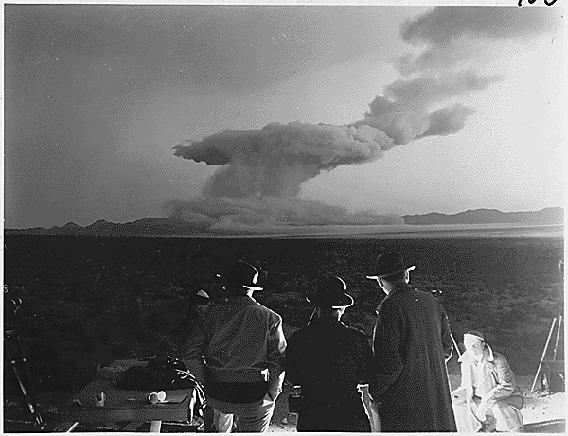
One of the first marriages between Cold War technology and environmental science was in the heyday of nuclear weapons testing in the 1950s. The military wanted to know what factors affected the spread of nuclear fallout in the event of an attack on the United States. Other scientists and government officials wanted to use the opportunity to study the long-term environmental effects of plumes of radioactive chemicals in the water and air. The chilling results of these studies indicated that nuclear testing was far more dangerous than initially thought. The research was one of the many factors that led to the adoption of the Comprehensive Nuclear Test Ban Treaty by the United Nations in 1996, which banned all nuclear explosions, both military and civilian. (Although Bill Clinton signed the treaty, it has yet to be ratified by the Senate; despite this, the United States has maintained a moratorium on all nuclear testing since 1992.)
To enforce the treaty, the U.S. and other governments regularly monitor the atmosphere for signs of radioactive chemicals produced by nuclear explosions. These monitors served a crucial function in the days and months following the meltdown at the Fukushima nuclear reactor after the devastating earthquake and tsunami that struck Japan in 2011.
“This is an example of the real environmental benefit in monitoring and being able to document whether the health effects would be large or not. We could let countries know as the plume went around the world whether it was getting more or less dangerous,” said Raymond Jeanloz of the University of California-Berkeley and lead author of the Science article.
Today, many nations “test” nuclear weapons by running computer simulations of the blast and resulting fallout plume. These simulations require detailed mathematical models of all the potential variables. This work has spurred the development of mathematical models of climate change. As in the Cold War, improvements in computers and mathematics has had a profound impact on scientists’ ability to model how humans are changing the environment.
Oceanographers have found Cold War advances in sonar crucial to their studies of life beneath the waves. Over the past decade, Makris has used Soviet-sub-detecting sonar to study the behavior of large shoals of fish. Typical sonar detects objects in a very limited radius beneath the boat. It also has a long lag between pings of sound that bounce back off an underwater object, so tracking a randomly moving target can be difficult.
The Navy developed a souped-up sonar that could track an object’s motion over hundreds of miles by using a lower frequency of sound that would not be distorted over long distances. It also reduced the time between sound pings. Older sonar could only detect the fish that happened to be swimming right under the research vessel, but the technology perfected during the Cold War can follow a distant shoal as it moves around. “No one had ever seen what a 20-kilometer-long fish shoal looked like before,” Makris said. “And not only did we see what they looked like, we could watch them evolve over time.”
Makris has discovered shoals of fish off the coast of Manhattan that were just as big as the island itself. He can also distinguish between different species of fish due to the different ways they reflect sound waves.
The flow of technology hasn’t been all one way. The U.S. Geological Survey was founded in 1879 to study the land in the rapidly growing country. Part of the mission of the modern USGS is to monitor earthquake activity both in the United States and around the world. Sensors deployed by the USGS pick up the massive vibrations caused by earthquakes—or other disturbances to the Earth’s crust.
Earlier this week, USGS sensors detected suspicious seismological activity in North Korea. Further analysis showed that it originated in an area previously linked to the underground detonation of nuclear warheads. Geologic information about the Earth’s crust indicated that a naturally occurring earthquake was extremely unlikely there. The data, coupled with other intelligence, indicated that North Korea had, in fact, successfully detonated a nuclear weapon.
“I think there’s great value in monitoring the environment very pervasively,” Jeanloz said, whether someone is looking at levels of pollution in the atmosphere or normal seismic activity to detect earthquakes and potential nuclear blasts. “In large part, it can serve as a complement to what is traditionally thought of as arms control.”
Take a project known as HIAPER (High-Performance Instrumented Airborne Platform for Environmental Research), pioneered by Steven Wofsy of Harvard. He and his team stuffed a Gulfstream V jet chock-full of instrumentation and flew the plane several times between the North and South poles gathering detailed atmospheric information. They found that, as the Arctic Ocean melted due to global warming, it was emitting high levels of methane gas that would ultimately increase the rate of melting and lead to more methane emissions. While his mission collected valuable information, Wofsy noted, it could easily have gathered other data relevant to monitoring nuclear test ban treaties.
“Under a dual use framework, you could get funding from different parts of the government to sort of leverage the environmental benefits,” Wofsy said. “It’s a good idea, it’s visionary, but I don’t see it happening anytime soon.”
Of course, including additional data to analyze still costs money, and securing cash from budget-limited funding agencies isn’t easy. The problem isn’t the technology, Jeanloz says, it’s the political will to pay for such “dual use” endeavors.
The trick is getting government agencies to expand their thinking. An arms control treaty sounds like an opportunity to keep our neighbors in line, rather than a chance to learn more about pollution and global warming. And as long as the environmental monitoring is seen as merely an add-on or a bonus feature, it will get jettisoned when money gets tight or the anti-science movement gains momentum.
Certainly preventing a nuclear attack or other nefarious actions is important to global security. But understanding and protecting the environment is just as crucial to global security. If we don’t understand how the world works, how chemicals travel through the air and water, patterns of earthquake activity, or even how massive shoals of fish move and evolve, then we can’t prevent, prepare for, or adapt to a changing environment. Linking environmental research to national security reinforces the idea that trashing the world around us is detrimental to our country’s well-being. That is the real opportunity and the real shift in the way technology is used.
