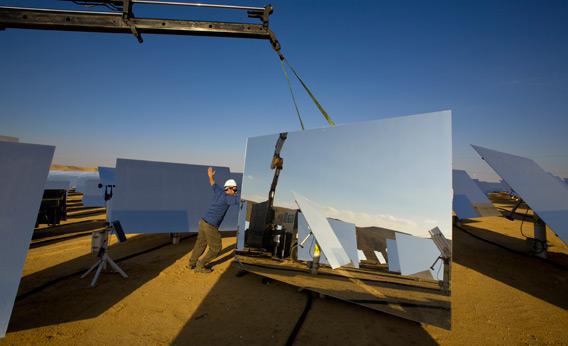
This was supposed to be a happy time for BrightSource Energy. A year ago, on Earth Day 2011, the Oakland, Calif.-based solar-power startup announced plans to go public in spring 2012. The stock offering was hailed as a validation of the potential of solar thermal energy, a technology that holds the promise of powering homes and businesses around the clock. (Traditional photovoltaic solar panels transmit power only when the sun is shining.)
BrightSource hadn’t yet figured out how to make solar thermal power as cheap as wind turbines or photovoltaics. That was OK, though, because it had a major buyer lined up: the state of California, which has passed laws requiring it to cut greenhouse-gas emissions by ambitious amounts. Solar thermal power would play only a minor part in California’s first goal, which is to cut emissions 25 percent by 2020. But it could be crucial to meeting the state’s second goal, to slice emissions another 80 percent by 2050.
Such long-range thinking is hard to accommodate in a market economy. What investor wants to pour her fortune into a company that might take off only after she’s dead? To those who care about climate change, then, BrightSource’s IPO was a beacon: proof that smart state-level policies could foster private investment in innovative technologies.
In the year since BrightSource announced its IPO, however, clouds have formed over the U.S. solar industry. A boom in hydraulic fracturing has sent natural gas prices plummeting, making alternative energy sources such as solar look much pricier by comparison. Meanwhile, congressional Republicans have signaled that they plan to let the clean-energy subsidies introduced in the Obama administration’s 2009 stimulus bill expire. A $9 billion cash-grant program, which quietly created thousands of jobs, has already lapsed.
At the same time, China has made solar manufacturing a centerpiece of its economic agenda, sending a tide of cheap photovoltaic panels to American shores. Prices for those panels have dropped an incredible 75 percent in the past three years. That’s great for consumers in the short term—installing solar panels on your roof has never been so affordable. It’s also a boon for the companies that install those panels. SolarCity, a California startup that has become a national leader in designing, leasing, and installing solar-panel systems, has apparently profited handsomely. It announced plans for its own IPO just last week.
But for American companies that manufacture solar panels, the triple whammy of cheap natural gas, austerity in the United States and Europe, and cheap Chinese photovoltaics has been devastating. The most dramatic flameout happened at Solyndra, the California startup that was trying to make solar panels more efficient. Solyndra, though, struggled to make its solar tech affordable, and when prices for traditional panels plummeted, the company went bankrupt. It took with it some $500 million in federal guaranteed loans, to the outrage of Republicans who felt the government shouldn’t have been investing so heavily in clean energy to begin with. More significantly, the ensuing media storm (which included unfounded allegations of cronyism and fraud) made the entire clean-technology industry political poison.
Solyndra was only the most visible in a line of dominoes It was preceded into insolvency by Massachusetts-based Evergreen Solar and Intel spinoff SpectraWatt.* Next to fall was Arizona-based Stirling Energy Systems, followed by Solar Millennium, a German giant with a big U.S. presence. First Solar, a 13-year-old Arizona-based firm that went public in 2006, was until recently the world’s largest solar-panel manufacturer. Just last year, it topped Forbes’ list of America’s 25 fastest-growing tech companies. But last month, the company announced it was laying off 2,000 workers, shuttering a factory in Germany, and idling plants in Malaysia. Its shares have tanked, falling from a high of $170 last February to just $18 today, with no sign of improvement ahead.
Amid the gloom, BrightSource’s star still shone. On April 11, the day before its initial public offering, the tech-business blog GigaOm called the impending IPO “a big boost for a beleaguered industry.” Hours later, BrightSource announced it was canceling the public stock offering. It cited “adverse market conditions.” The company insists it made the decision “from a position of strength” and says it remains viable. Its $2.2 billion plant in California’s Mojave Desert is fully funded, thanks to investments from NRG Energy and Google and a $1.375 billion federal loan guarantee. Still, BrightSource’s future looks much dimmer than it did just a few weeks ago.
The irony here is that the United States’ “solar bubble” is bursting at a time of sustained growth in the global market for solar power. While American and German companies are going belly up, Chinese firms like Suntech and Trina are expanding, thanks in part to tens of billions of dollars in government loans and credits. Though Chinese consumers make up less than one-tenth of the global market for solar power, its firms now control an estimated 70 percent of the production market for solar modules. In 2005, imports of solar cells and modules from China to the United States totaled $22,000. In 2011, that figure was $2.8 billion.
The remaining U.S. firms are now fighting for survival, and they’re turning to the federal government for help. With subsidies a political nonstarter, solar businesses seized on a different approach. A consortium of manufacturers led by the U.S. division of the German firm SolarWorld have been pushing the Department of Commerce to slap tariffs on Chinese solar panels, alleging violations of international trade rules. SolarWorld claims the big Chinese firms have been “dumping” panels on the U.S. market at below cost to drive stateside competitors out of business. Once the Chinese have cornered the market, the logic goes, they’ll hike prices back to their natural levels.
The American solar industry isn’t united behind this idea, though. Last fall, just one month after SolarWorld formed its lobbying group, the Coalition of American Solar Manufacturers, the U.S.-based companies that lease and install solar panels formed their own trade group, the Coalition for Affordable Solar Energy. While CASM cried for tariffs, CASE lobbied against them, warning that such protectionism could spark a solar trade war with China. A trade battle, the solar installers argued, would drive up prices, hurting the financing and installation sector of their American solar market, which accounts for more jobs than the manufacturing sector. Moreover, China might retaliate with anti-dumping cases against the high-tech companies that refine silicon, a crucial material in solar panels. In that scenario, everyone would lose.
As the Commerce Department launched its investigation of China’s trade practices last fall, the fight between U.S. manufacturers and installers grew vicious. The installers hurled numbers, commissioning a report that said a 100-percent tariff would cost American workers 50,000 jobs. They also hurled accusations of xenophobia, pointing to an ad that SolarWorld ran in Germany tarring Chinese goods as shoddy and cheap. SolarWorld apologized for the ad, but didn’t back down from the fight, calling the installers’ main spokesman a shill for the Chinese manufacturers. The fight got so nasty that the liberal blog Talking Points Memo asked, “Will America’s Solar Civil War Destroy the Industry?”
The divide between manufacturers and installers is a symptom of the U.S. solar industry’s problems, not the cause. And the causes are not as simple as either side makes them out to be. China isn’t the only reason companies like Evergreen, Solyndra, and BrightSource have struggled. All three made big bets on novel technologies that wouldn’t be economically competitive in the short term even against domestic competition. In a free market, some bets on innovation fail, and others take a long time to pay off. Solyndra was an example of the former. BrightSource is hoping it will be an example of the latter. If the United States wants to be a major player in clean energy, it has to accept both outcomes as natural consequences of supporting a nascent industry.
The installers are right that a trade war with China would be a setback for all concerned. But they’re wrong to argue that the United States should simply accept a backseat in solar manufacturing. In some labor-intensive manufacturing sectors, such as textiles, it’s true that the United States can’t compete with China and other developing countries. But it’s far from clear that’s the case in solar manufacturing, particularly since U.S. companies remain leaders in the production of polysilicon, the linchpin of the supply chain. In fact, an October study by the U.S. Department of Energy concluded that American companies have a slight comparative advantage over their Chinese competitors in solar-panel manufacturing. If that’s true, then the woes of First Solar (whose products are similar to those of the big Chinese manufacturers) aren’t the result of a bad bet, but of a tilted playing field. An investigation of China’s policies, then, would be warranted.
So far, the Department of Commerce has wisely steered a middle course. It agreed to investigate claims of both illegal export subsidies and illegal dumping, and in March it responded to the illegal-subsidy claim by imposing modest countervailing tariffs of 3 to 5 percent on Chinese panels. It’s expected to respond to the dumping allegations later this month.
Sen. Ron Wyden, D-Ore., who chairs the Senate subcommittee on international trade, customs, and global competitiveness, is hoping the Commerce Department hits back against Chinese manufacturers. “There needs to be more than a slap on the wrist here,” his deputy chief of staff told me. “That’s not how we’re going to get China to play by the rules.”
That’s true, but the United States also has to be smart about how it responds. Perhaps the best idea, though not the most politically realistic one, comes from Dan Kammen, an energy policy expert at UC-Berkeley. Instead of a war of escalating tariffs, bringing higher prices for everyone, he argues the United States should join China in a solar version of a “race to the top,” with both countries supporting solar innovation equally and transparently. If the reward is a world in which increasingly efficient solar power gradually takes the place of dirty and finite fossil fuels, a few more Solyndras along the way would be a small price to pay.
Correction, May 4, 2012: This article originally and incorrectly referred to “Colorado-based Evergreen” as a solar company that had gone bankrupt. It was actually Massachusetts-based Evergreen Solar that went bankrupt.
