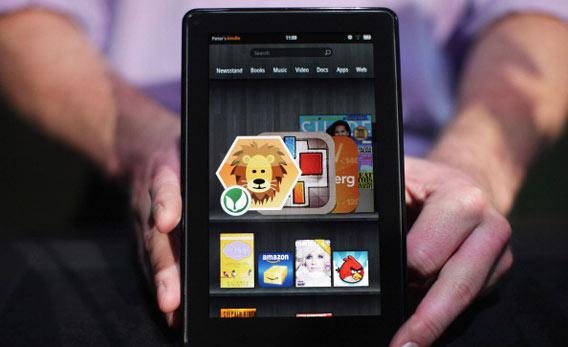
The Kindle Fire isn’t a spectacular device, but it may be a revolutionary one. This sounds contradictory. But as I argued in August, every iPad competitor to date has promised to do more than Apple’s tablet—they’ve touted better performance, better compatibility with PCs, and the ability to run Flash. All of them flamed out when they couldn’t deliver. Amazon is taking a smarter approach: At just $199, less than one-half the price of the iPad, the Kindle Fire doesn’t even promise to be in the same league as Apple’s device. After using it for a few days, I found that it delivers: Amazon set out to build an underachieving tablet, and that’s exactly what it got.
The Fire—which is both smaller and lighter than the iPad, but also chunkier and uglier—feels chintzy and ungainly in your hands. In portrait mode, it’s too narrow to hold with two hands but too wide for one. It has one of the worst speakers I’ve ever encountered on a mobile device. (If you want to do anything involving audio, you’ll need to use headphones.) The Fire also lacks important hardware features—like physical buttons to go back to the home screen and adjust the volume—which would be OK if its touch interface worked well. It doesn’t. You sometimes have to press on-screen buttons repeatedly to get them to register, and even then you’re not assured of success, because the Fire often misinterprets what you wanted to press.
The software is plagued not only with bugs—its built-in apps crashed on me a couple of times, including once when I was simply trying to search the Kindle bookstore—but also design flaws. Getting around from app to app takes too many taps, and there’s no easy way to customize the Fire to your own preferences. Among other things, you can’t delete certain icons from your home screen; the Fire’s front page shows a large icon for each bit of media you’ve encountered on the device, and if you want to show something else, tough luck. (Since I wanted to see how well the Fire handled full-color magazines, I bought a copy of Maxim from the Fire’s Newstand app. Now I can’t get the Maxim cover to disappear from my home screen. Embarrassing!)
Fans of the iPad will regard these flaws as losing the whole ballgame, and many will dismiss Amazon’s device as just another in a long line of failed iPad killers. But that would be shortsighted. The Fire’s got a lot of problems, but none of them outweighs its one overriding advantage: It’s super cheap. In my few days using the device, I managed to do pretty much everything that I like to do on my iPad. Still, when you take into account its reduced capabilities and inferior interface, I’d rate the Fire as something like 70 percent of an iPad. When you consider that the Fire costs only 40 percent as much as Apple’s tablet, though, that’s not a bad deal. If spending $500 to get the real thing is within your budget, by all means, go to an Apple store. But if all you’re looking for is 70 percent of an iPad, then why spend any more?
If you’re interested only in video and books, the Fire could be the tablet for you. Netflix plays beautifully on the device, and you can buy and stream thousands of titles from Amazon’s own video store. Members of Amazon Prime get free access to about 13,000 movies and TV shows; the Fire comes with one free month of Prime membership, which then goes for $79 a year. Of course, being a Kindle, the Fire is also hooked in to Amazon’s bulging online bookstore. Fans of the standard Kindle’s E-Ink screen won’t love the Fire’s LCD display, but if you’re used to reading on your phone or your iPad, the Fire will feel the same. Unlike the E-Ink Kindle, it also works in the dark.
The best way to sum up everything else on the Fire is, “Eh.” Its Web browser isn’t as fast as the iPad’s, but it’ll be adequate for most people. (The Fire plays Flash videos, too, though the quality isn’t fantastic.) The Fire’s built-in app store has lots of popular programs—Facebook, Hulu Plus, Pandora, lots of Twitter clients—but if you’re an app fiend, you’ll be better off with the iPad. And finally, while the Fire is good at books, it’s not so great at newspapers and magazines. Some of the titles in the Kindle’s Newstand store make no special effort to display on the tablet—the New York Times, for instance, publishes its stories as a boring list. Other titles try to mimic their print pages, but this feels off as well. Because magazine pages are of a different proportion than the Kindle Fire’s screen, a full print page can’t fill up the Fire’s display. You’ve got to zoom out to see the whole page, in which case everything looks too small; but if you zoom in, you’ve got to do a lot of panning to see the page. In short: If you’re into Maxim, stick with print.
Shortly after Jeff Bezos unveiled the Fire in September, the research firm iSuppli reported that it probably costs Amazon about $210 to make each Fire. In other words, Amazon is losing at least $10 on every tablet it sells. This is not surprising. Bezos is the Crazy Eddie of the tech industry, and his business model, with the Fire, is to get the device out to millions of people and make up for the loss with all the books, music, movies, and Prime memberships he expects to sell through the device.
Before I used the Fire, I considered this a circuitous way to make money. Though it’s not quite as roundabout as Google’s plan to give away Android in order to one day make a profit on ads from mobile phones, it’s also not nearly as straightforward as the old-fashioned way Apple makes money: by selling its products for more than it spends to make them. Yet the more I used the Fire, the more I warmed to Bezos’ strategy. The Fire, like the E-Ink Kindle, is phenomenally good at separating users from their money. You’re always just a couple of clicks away from a purchase, and when you do buy something, there are no hurdles—you don’t even have to enter your password. Bezos once reported that Kindle owners become voracious book buyers; once you get a Kindle, you start buying nearly twice as many books as you did in the past. I suspect the Fire will have an even greater effect on purchases, and that it will be especially effective at pushing people to subscribe to Amazon Prime. According to some estimates, the average Prime member doubles his Amazon purchases in the first year of using that service. If a cheap Kindle Fire is nothing more than a Trojan horse for selling Prime subscriptions, then that could be a gold mine for Amazon.
And yet, I doubt Amazon will ever make the same profit on its tablet that Apple makes from the iPad. (It costs Apple about $330 to make the cheapest iPad, which the company sells for $499.) But we’ll see: If the Fire takes off, Apple may have no choice but to reduce the price of the iPad. That probably won’t happen next year, because demand for the iPad remains through the roof. But remember that Bezos is always slashing prices. I wouldn’t be surprised if, over the next few years, the Fire’s price goes down to $150, maybe even $100. At that point, Apple will have to respond with cheaper iPads for everyone. That’s why we should all hail Amazon’s not-very-good, supercheap tablet: good enough for not much money might change everything.
