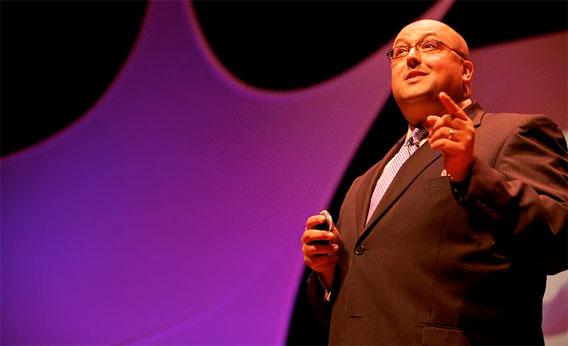
When his book The Googlization of Everything (and Why We Should Worry) came out in March of last year, Siva Vaidhyanathan gained an epithet: “the Google gadfly.” The chair of the University of Virginia’s department of Media Studies won’t discount Google’s many achievements, but he fears its power. Google mediates our knowledge in unprecedented ways, he says, and its utopian, do-gooder rhetoric disguises the fact that no one really knows what it’s up to.
That wariness is one reason Vaidhyanathan will argue for the motion, “When it comes to politics, the Internet is closing our minds,” at the Slate/Intelligence Squared live debate on April 17. He’ll contend that commercial platforms like Google and Facebook would rather flatter than surprise us—and that they’re developing the tools to encase us in personalized bubbles. Vaidhyanathan also thinks the press overstates the role of social media in political revolution.
Recently, I spoke with Vaidhyanathan about Twitter, the blogosphere, and his blueprint for a Human Knowledge Project that would vet and organize the sum of the world’s information. Excerpts of our conversation are below.
Slate: You’ll claim next week that the Internet is closing our minds when it comes to politics. Can you preview a few of your arguments?
Siva Vaidhyanathan: There are several cases to make. One—and this is the premise of Eli’s book [co-debater Eli Pariser, author of The Filter Bubble]—is that we use platforms like Facebook and Google that have an incentive to focus our attention on familiar things. The No. 1 motivation for both Facebook and Google is to satisfy our desires by placing relevant ads in front of us. They also highlight what they judge to be relevant content. So if you’re looking for shoes or cars, that’s a wonderful thing; it saves you a lot of time. If you’re looking for music, it’s a pretty good thing, allowing you to focus on certain genres and artists. But politically, it’s bad for democracy. We’ve created echo chambers for ourselves. Using Facebook or Google, we’re more likely to come across like-minded posts from like-minded people. A republic works better when we make the extra effort to engage with a variety of points of view.
Another argument goes that, in our discussions about politics, we pay too much attention to exciting Internet innovations. We’re distracted by the fact that lots of people use Twitter, Facebook, and YouTube for political purposes. This thrills us because so many elites in the United States spend an unhealthy amount of time interacting with these platforms. We’re able to pretend that the thing we most engage with actually matters. It’s what I call techno-narcissism: the notion that the technologies that fascinate and entertain us must somehow be deeply important to the world. Look at the facile press coverage of social media during the Arab Spring. We have a tendency to ignore real human interaction, risk, and sacrifice.
Slate: But there must be a correct way to use the Internet to address these issues, right? Or is it totally incompatible with deep political thought?
Vaidhyanathan: The Internet has great potential for engaging in politics because it lets people speak to each other according to different power relations than they’re used to. We’re all equals on the Internet. But what’s interesting is the platforms we choose to use. More often than not, we’re plugged into commercial services, like YouTube, Facebook, and Twitter—and that means we’re essentially surrendering to the rules and limitations those companies must obey. Our needs as citizens to have rich public conversations are met inside technological walled communities. We’re debating in a shopping mall instead of a town square.
For example, the Indian government is very interested in censorship. Every Internet company that does business in India is worried about getting kicked out of the market. So a political activist in India using Facebook who runs up against the state is not going to find Facebook on his side, and this is one of the perils of using private services.
Slate: Which Internet companies worry you most? Are some more high-minded than others?
Vaidhyanathan: The “filter bubble” phenomenon shows itself most clearly with Facebook and Google. I know of no similar filtering or bending of results on Twitter. In general, Twitter is a much better platform today for learning about the world—but that doesn’t mean that it’s going to be that way forever. Twitter is committed to free speech, but it’s also committed to Twitter. There are going to be moments when that conflict becomes serious.
Slate: What are the means by which these platforms shape our political views?
Vaidhyanathan: When I go on Facebook, I almost never see posts from my conservative friends. I have 3,100 Facebook friends. I’m guessing that there are 700 conservatives on that list, including relatives. But Facebook has over time made sure that things that might upset me get hidden.
Google’s doing similar things by customizing search results. If I were a skeptic of climate change and I had clicked on a lot of climate change skeptic sites, Google would know that. And as I searched more for issues related to climate change, it would recognize my pattern and try to give me more of what it thinks I like. That means I’m less likely to be challenged, to find something that might surprise me.
Slate: So should we all opt out of Google’s personalized search option?
Vaidhyanathan: It depends. People should be aware of what’s going on, and of the advantages and disadvantages. If you’re a baseball fan in Boston and you type in S-O-X, you’re probably going to want to see Red Sox results, rather than White Sox results. In Chicago, it’s just the opposite. When your engagement with the information at that moment is consumptive, then by all means, personalized search helps. But if what you’re doing is trying to learn about the world—if your search is driven by curiosity or even by commitment, you should turn personalized search off, at least occasionally. You can even have two browsers open side by side.
Slate: What do you make of the argument that the mainstream media, pre-Internet, was its own filter bubble, and that information circulates more freely now?
Vaidhyanathan: I agree in the abstract. When we had fewer channels, we had a bubble that was rather extreme. And everyone agreed it was a problem, on the left and right. There were a lot of regulatory attempts, like the Fairness Doctrine, to come up with more publicly-minded accounts of what was going on. Then, it looked like the unlimited channels of the Internet would solve the filter bubble problem. But the fact that Facebook and Google are now the dominant venues through which people explore the world has reinstituted a filter bubble system. Those platforms select the channels we get.
Slate: Your critics say that you don’t give humanity enough credit. Why assume that people will only click on links they think they’ll agree with?
Vaidhyanathan: I’m looking at how people actually behave. My approach is to concede that Google should do what Google wants: Companies should do what’s good for them. We’re fooling ourselves if we think they’re there to do anything else. So it’s important for us to remind our neighbors, our fellow Americans, that there are different and perhaps better ways to interact with these tools, because we’re not always going to get the results that are optimal for running a democratic republic.
Slate: Google and Facebook don’t have any ethical obligations as curators of the world’s information?
Vaidhyanathan: No. It’s our obligation to recognize their limitations and not be idealistic about their contributions. And we can invent new platforms through which to engage in politics. To take one example, people talk about the blogosphere to represent interactivity. That’s a really powerful environment—not exactly noncommercial, but not dominated by any particular corporate auteur. The blogosphere has been one of the great pro-democratic contributions of the Internet.
Slate: Can you elaborate on this quote from your book? You say, “Google’s great trick is to make everyone feel satisfied with the possibility of choice, without actually exercising it.”
Vaidhyanathan: First of all, Google’s not the only element of our society that does this. The supermarket and Target do it too. The illusion of choice means that you get a number of different product options all filtered and selected within a fairly narrow range. What Google is doing, and it does it well, is scouring billions of documents whenever you plug in a simple search.
But the more Google tends to structure results around what we’ve already told Google about ourselves, the more Google is able to predict what we want. And though Google gives us thousands of results, most people rarely click below No. 3. I’d like to see people click to Page 2 occasionally. I would like us to click on the 10th result sometimes, just to see.
Slate: Does it worry you that Google maintains such strong ties to the White House? I’m thinking of Google chairman Eric Schmidt, who’s on the President’s Technology Advisory Council and was active in the 2008 campaign. Also Andrew McLaughlin, previously head of Google’s global public policy, now the White House deputy chief technology officer—
Vaidhyanathan: Yes, but I’m just as concerned that the former chairman of GE runs the President’s Council on Jobs and Competitiveness. In so many areas of life, rich people get to call the shots and set the agendas. That’s a big problem with American politics, and the Internet has not upended it. I’m not worried that Eric Schmidt’s access to the White House gives Google any sort of regulatory immunity. In fact, there’s plenty of evidence that the Obama administration has been forceful about punishing Google for antitrust and privacy violations. I am much more concerned that Google’s way of thinking becomes the default way of thinking at the highest levels of power.
Slate: What’s Google’s way of thinking? Something scientific, rational, data-driven?
Vaidhyanathan: I’m all for scientific and rational. But there’s a particular mode of thought based on certain assumptions and logical algorithms—like, everything can be done cheaper as long as data flows better. That’s an unhealthy assumption and can get you in a lot of trouble.
Slate: Could you talk a little bit about your idea for a Human Knowledge Project?
Vaidhyanathan: When Google announced in 2004 that it was scanning in books from university libraries and that it was going to try to perform the services of a library for the world, there was a lot of hyperbole coming out of all sorts of corners. These days you don’t hear so much hyperbole because people realized, down the line, that Google actually wanted to create a huge used-book store. That left us with this tantalizing possibility: We now have the technology to create a global, digital collection of knowledge, one that could be easily and cheaply accessed by people all over the world.
The Human Knowledge Project is a way of sparking a conversation: I want to get a whole bunch of smart people thinking about what it’s going to take to create this universal library of knowledge. We need to get a lot of smart people to consider the impediments—what are the legal, political, and technological obstacles—and then to try to figure out a way out of them. And we might decide the problems aren’t worth solving—the cost and effort of solving them could be too great. But either way, I’d rather have a rich political discussion than just throw up our hands and let Google do it.
Slate: Smart people together in a room. That’s a better alternative to algorithms?
Vaidhyanathan: Totally. Especially if there’s beer.
