We Still Need To Save the Rain Forests
Biodiversity efforts are often targeted toward saving cute animals. But the real problem is disappearing forests, wetlands, and mangroves.
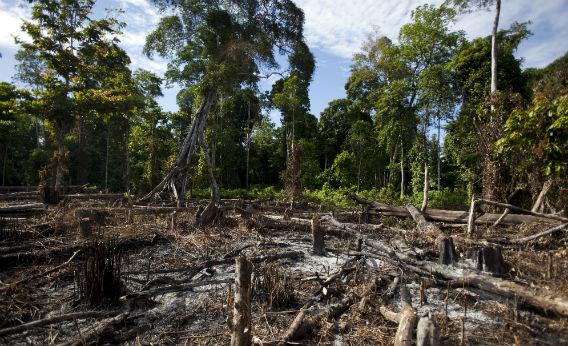
Photograph by Robert Nickelsberg/Getty Images.
In this series, Bjorn Lomborg explores the smartest investments to respond to global challenges—and readers get to have their say. See the earlier articles here. And read Bjorn’s responses to readers and find out which investments are currently at the top of Slate readers’ priority list. Be sure to vote in the poll at the bottom of each article.
So far in this series, we have focused on how to get more food, water and sanitation, and better health care to those in need. Now we turn to the problem of keeping resources available for future generations.
The issue of disappearing biodiversity has increasingly received mainstream media attention in the past few years, and is starting to compete with climate change as the environmental threat that we talk about the most. Often, biodiversity campaigners have attempted to capture our attention with pictures of cuddly endangered animals or alarming figures about the rate of disappearing species.
In practice it is difficult to actually quantify the loss of biodiversity, let alone put a value on it. What scientists can do instead is measure “ecosystem services.” These are the natural processes by which the environment produces resources used by humans, such as clean water, timber, habitat for fisheries, and pollination of native and agricultural plants. Also included are genetic materials that can help make new life-saving drugs, the recreational and cultural uses of natural environments, the control of agricultural pests, and the value of biomass storing CO2 (as a counter to global warming).
The links between biodiversity and ecosystem services is still undergoing research. But the most important known fact is that these services have faced major (and measurable) losses. According to the Millennium Ecosystem Assessment, the planet during the last century lost 50 percent of its wetlands, 40 percent of its forests and 35 percent of its mangroves. About 60 percent of global ecosystem services have been degraded in just 50 years.
In a research paper on biodiversity released today for Copenhagen Consensus 2012, Salman Hussain and Anil Markandya find that there will be a significant loss of biodiversity over the next 40 years. They estimate that this loss could be about 12 percent globally, with South Asia facing a loss of 30 percent and sub-Saharan Africa 18 percent. They look at three interventions and compare these to doing nothing.
The first solution focuses on increasing agricultural productivity through research and development. This may seem like a roundabout way to address biodiversity, but as the global population has increased to 7 billion, we have cut down more and more forest to grow our food. Between now and 2050, we will likely expand agricultural area another 10 percent, and that land will come from forests and grasslands. Thus, if we could increase agricultural productivity, we would need to take less and be able to leave more to nature. (It’s interesting to note that investment in agricultural R&D was also suggested as a way of reducing hunger and malnutrition at the start of the Copenhagen Consensus 2012 series.)
The authors estimate that with a $14.5 billion annual infusion into research, we can achieve 20 percent higher annual growth rates for crops and 40 percent higher growth rates for livestock, which over the next 40 years will significantly reduce the pressures on nature.
Looking just at tropical forests, this would save an area the same size as Spain, along with a similar amount of temperate forests and more than twice that area of grasslands. In total, the benefits will be on the order of $53 billion. When we take into account that these forests will store more carbon, for every dollar spent, we will do about seven times the amount of good both for biodiversity and climate. And, of course, we will have made more food available and at cheaper prices for future generations, substantially increasing the total benefits.
Hussain and Markandya note that currently about 10 percent of all land globally is deemed to be “protected” from destruction. They explore increasing protected land to about 20 percent globally (across a large number of ecological regions), over three decades. There are obvious benefits but also significant costs, principally the loss of output from the land that is taken out of use.
Land scarcity arising from such a policy would likely force an increase in agricultural productivity. The cost estimates for the newly protected lands have a big impact on the overall results. With higher assumptions, the program costs more than it achieves, even when the benefits of avoided climate change are included. With lower assumptions it only barely passes, making $1 spent achieve slightly more than a $1 worth of good.
However, Hussain and Markandya note that the main reason for this program would be to enhance biodiversity conservation; our current methods of estimation do not fully capture those benefits, so these estimates could be an underestimation.
Forests are one of the main homes to biodiversity. The final program Hussain and Markandya propose seeks to prevent all dense forests from being converted to agriculture over a 30-year period. The academics do not attempt to assess the political viability of such an approach. To use the same measure as above, it would save more than seven times the area of Spain in tropical forests.
The benefits are very high, but there is considerable uncertainty about the costs. With estimates they find reasonable, the benefits exceed the costs even without including the CO2 storage value, and the solution is attractive because it will get a minimum of $7 back on the dollar.
The research laid out by Hussain and Markandya points to a range of concrete options we could take, if we’re serious about responding to this challenge.
What’s your view? Are these investments that you think that policy-makers and philanthropists should prioritize? Have your say in the poll:
Remember: In each of the stories published to date, there’s a poll, and you can still go back and vote in all of the polls today. Each day, as well as publishing a new topic of research, I respond to your comments and update you on how readers are prioritizing pieces so far. See which priorities are currently the favorites of Slate readers.
Tomorrow, we will look at the other big environmental issue: climate change. We’ll draw from four different research papers written by teams of respected climate economists, examining the full range of policy options beyond those that we hear the most about.
In this series, Bjorn Lomborg explores the smartest investments to respond to global challenges—and readers get to have their say. See the earlier articles here. And read Bjorn’s responses to readers and find out which investments are currently at the top of Slate readers’ priority list. Be sure to vote in the poll at the bottom of each article.