In early July, Italian swimmer Flavia Zoccari became both a metaphor and an omen for FINA, swimming’s international governing body. Just before a race at the Mediterranean Games, Zoccari’s high-tech Jaked bodysuit burst open in the rear, forcing her to drop out of competition.
Four weeks later, that’s the state of the whole sport: All its embarrassing bits are hanging out, exposed by the newest generation of swimwear. At the world championships in Rome, swimmers are cramming into speed-engineered, air-trapping, water-impermeable suits like the Jaked that have been kicking the sport’s record book to soggy shreds. More world records were set in the first five days of the meet than in the entire Beijing Olympics.
“I really believe all the new suits should be banned,” Germany’s Paul Biedermann said after he and his polyurethane Arena X-Glide suit broke Ian Thorpe’s seven-year-old record in the 400-meter freestyle. By his own reckoning, the suit had been “worth about two seconds.”
FINA announced it would come through with a ban on full-body suits—but not till 2010, and still pending wrangling over the meaning of the word textiles. In the meantime, records keep falling in Rome. The BBC’s online listing of the new record-holders includes each one’s model of swimsuit, with an asterisk for competitors wearing anything less than 100 percent polyurethane.
Michael Phelps, contractually stuck with the Speedo LZR that helped him dominate in Beijing, has been recast as an aquatic John Henry, a mortal man competing against implacable technology. Laboring in his now-obsolescent swimsuit, he finished more than a second behind Biedermann’s bodysuit in the 200-meter freestyle, then battled back with a win and a new record of his own in the 200 butterfly.
Swimming has long relied on flimflam to inflate interest. The whole structure of a swim meet is an exercise in creative accounting: No other sport gives out so many separate medals for doing minor variations on the same thing. In Beijing, Phelps got one gold medal for swimming 200 meters in 1:42.96. Then he got another gold medal for swimming 200 meters in 1:52.03. Then he got yet another gold medal for swimming 200 meters in 1:54.23. Freestyle, butterfly, freestyle-butterfly medley—different strokes for the same old folks. It was as if, having sprinted 100 meters for the gold, Usain Bolt could have followed up by winning the 100-meter skip, the 100-meter bunny hop, and the 100-meter moonwalk.
The more mildly different ways there are to race, the more mildly different ways there are to break records. “We’re the most popular boring sport in the world and so we need and only survive on records,” Austrian swimmer Markus Rogan said the other day. “So we’re going to need whatever we can do to keep doing records.”
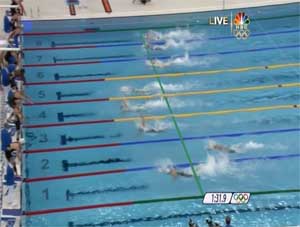
Rogan was trying to defend the fast suits. But he was invoking a humiliating truth about swimming: Swimmers compete against the record book because nobody cares who wins a competition among swimmers. In Beijing, Phelps’ only consistent adversary was the “world record line,” that TV-land projection that indicates whether a swimmer is going faster than anyone has swum before. He was literally racing against the clock.
The health of a sport is inversely proportional to how interested people are in seeing its records broken. Michael Jordan never seriously threatened to surpass Wilt Chamberlain’s 100-point game, but people liked seeing him score 55 just fine. You can watch a lot of pro football without hearing anyone mention Norm Van Brocklin; the goal of the NFL is to get you believing that the game in front of you is the most important contest in the history of human conflict (this includes preseason games).
Even in baseball, the celebrated numbers have mostly been used to add some intrigue during the slow parts. The steroid-deformed home-run sideshow between Mark McGwire and Sammy Sosa in 1998 was a sad attempt by baseball to compensate for canceling the 1994 World Series—and a symptom of more bad news on its way.
It’s harder to tune out the records in sports where the scoreboard is a clock or a meter stick—which is why those sports are inherently less popular. But if you do build your business on breaking records, it’s best to be judicious about it. Sergei Bubka, the greatest pole vaulter of all time, set nearly three dozen world records in his career, indoors and outdoors—often out-jumping his previous records by a single centimeter, to leave room for future triumph.
Swimming, by contrast, is stuck with a Barry Bonds-like wealth of enhanced numbers. If the sport does go back to normal suits and normal times next year, Rome 2009 and Paul Biedermann will mark the pinnacle of achievement for untold years to come. FINA can try salting the record books with asterisks—but if 100 percent polyurethane is retroactively bogus, what about Phelps’$2 50-percent polyurethane LZR from Beijing? Or it can just give up the ban on fancy suits and resume the arms race till the swimmers all have propellers in their behinds and hydrofoils attached to their pectorals. (One of the suits in Rome is already called the Adidas Hydrofoil.)
The sport’s infatuation with the clock led it to ignore the importance of the calendar. Swimming is one of the sports that nobody wants to hear about in non-Olympic years. Caught up in the momentum of Beijing—and the surging market for $500 swimsuits—FINA allowed an off-year championship to become a showcase for out-of-control technology.
Phelps’ eight medals were partly to blame for the mess. But Phelps displayed better instincts than the people who run his sport. As soon as the Olympics were behind him, he got out of the pool for a while, smoked pot, and chased women. For this, he was made the object of a moral panic and slapped with a three-month suspension. And the sport kept churning along without him toward its current fiasco. Take a hint from your best athlete, FINA, and take it easy. Stop trying to get attention when it doesn’t matter, and maybe we’ll care about you again in three years, in London.