The game is over in Afghanistan. An American presence can no longer serve any purpose. Or, rather, it can only extend and exacerbate the pathologies of this war. It is time to get out, and more quickly than President Obama had been planning. The consequences of leaving may be grim, but the consequences of staying are probably grimmer.
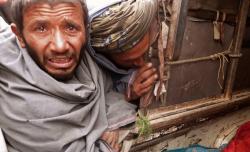
Sunday’s massacre in Kandahar province, in which a veteran U.S. Army staff sergeant sneaked out of his base at 3 a.m., strolled into a village, and methodically gunned down 16 Afghan civilians, including nine children, is but the latest sign of a massive unraveling.
Two weekends earlier, an Afghan gunman killed two U.S. officers inside the Interior Ministry’s headquarters (making the ninth and tenth Americans who have lost their lives this year at the hands of Afghans they’d been training). Shortly before then, violent riots broke out when Americans were discovered burning copies of the Quran. Just two days before the Kandahar rampage, NATO helicopters flying over Kapisa province, in eastern Afghanistan, fired on a group of civilians, killing four and injuring three, prompting large street protests.
Finally, the New York Times reported over the weekend that Afghan president Hamid Karzai is starting to enforce a law banning the use of private security guards to protect foreign business and aid workers, requiring that Afghan police be used instead. Even before the incident in Kandahar, Western officials were predicting that the new law would force a shutdown of nearly every development project; no civilians would want to stick around without someone reliable guarding their backs—and after the string of incidents, no Afghan can be regarded as reliable, any more than Afghans can regard any American as reliable.
And there’s the problem. The U.S. and NATO strategy in Afghanistan relies on building trust, and those bonds of trust—always tenuous at best—are now severed, perhaps irreparably.
Trust has been a centerpiece of the basic counterinsurgency strategy, which calls for NATO troops to focus on protecting the Afghan people, living among them, gaining intelligence from them on the insurgency, and helping to provide them basic services, in order to strengthen the ties between the people and their government, and thus to undermine their ties to the Taliban.
Trust has also been essential to the transition strategy, in which NATO troops train and gradually hand over authority to the Afghan army and police.
The counterinsurgency strategy falls apart if the Afghan people have to worry that an American soldier in their midst might come murder their family in the night. The transition strategy falls apart if NATO troops have to worry that an Afghan cop or soldier they’re training might, at any moment, shoot them in the back.
Some of this collapse might be contained if, say, a respected Afghan leader moved swiftly to tamp down the outrage. These recent killings of civilians or allies are, after all, in one sense, anomalies. The Quran burnings, bureaucratic incompetence; the helicopter shootings in Kapisa province, an accident of warfare; the Kandahar massacre, an isolated case of, apparently, a soldier gone haywire; even the shootings of the two U.S. officers at the Interior Ministry’s headquarters seem to have been motivated by unique circumstances.
But President Karzai is not highly respected among his people; if he were, he might not be facing such a strong, agile insurgency. And because he’s not very popular, he can’t risk losing further favor by standing up for foreign armies, especially now.
The whole relationship between the United States and Karzai has been a tangled web from the outset. The Americans have had to prop up his regime; but if they’re seen as too close, Afghans will see them as abetting the regime’s corruption (the main source of Karzai’s illegitimacy). Karzai depends on the Americans for security (his and his country’s), but if he makes excuses for their flagrant misdeeds, Afghans will see him as an imperial puppet.
After those two U.S. officers were slain inside the Interior Ministry’s headquarters, Karzai’s first reaction was to say the gunman might have been a Westerner. After the Quran burnings, he waited a few days before stating that the act might not have been deliberate or hostile. After the Kandahar massacre, Karzai’s first comment was to denounce the “U.S. forces” (plural) who committed the act. (He later acknowledged that the gunman had acted alone but not before rumors of death squads and helicopters overhead began to spread, rumors that, of course, will be believed by many).
Karzai first tried to ban private security guards in October 2010, until Gen. David Petraeus, then the U.S. commander in Afghanistan, talked him out of it, convincing him that it would likely shut down all Western-funded development projects. It is hard to see what kind of leverage Petraeus’ successor, Gen. John Allen, or Ambassador Ryan Crocker might possess to make Karzai back down under the present circumstances.
In November 2010, in the wake of a spate of accidental civilian casualties, Karzai gave an interview to the Washington Post, demanding that the United States cut back on military operations and stop the Special Operations Forces’ nighttime raids altogether, seeing them as a violation of Afghan sovereignty and dignity. The raids were taking a huge toll on Taliban fighters; U.S. commanders saw them as essential to the war plan. Petraeus phoned Karzai’s national security adviser and said, “Your president has put me in an untenable position. Please take note of that word. I chose it carefully.” Fearing that Petraeus might resign, which would almost certainly have marked a prelude to U.S. withdrawal, Karzai backpedaled instantly.
Sixteen months later, untenable seems an apt description of our alliance with Karzai’s government and thus our strategy in this war. It’s time to cut losses, because whatever gains the war might once have offered are now nowhere in sight.
