Once again, we find ourselves way in over our heads in Afghanistan, and at the worst possible time: when President Obama, who seems to have recognized this fact, is trying to get out while preserving a modicum of stability—something the Taliban, other insurgents, and possibly well-armed criminal gangs seem determined to block.
We don’t yet know the precise motive of the man who killed two American officers in a highly secure area of the Afghan interior ministry’s headquarters over the weekend. But the incident should not be surprising; it’s a classic case of insurgency tactics—right out of a textbook—and an illustration of why counterinsurgency campaigns are so difficult, almost impossible, to wage.
Of the 58 NATO soldiers killed in Afghanistan so far this year, 10 have been at the hands of Afghan personnel whom they’d been training. (The gunman this past weekend is said to be the highly trusted driver of an interior ministry official.) Obama’s plan for an end game in Afghanistan—accepted by other NATO ministers—relies on turning security and governance over to the Afghans themselves. To do that, Western soldiers and civilian specialists need to accelerate the training of Afghan security forces and ministries. And to do that, there must be trust. If the Americans and Europeans have to worry that their Afghan counterparts might shoot them at any moment, there can’t be trust; hence there can’t be training; hence there’s diminished hope that the Afghan government will hold its own once the Westerners depart.
As a result, in the short run, Gen. John Allen, commander of U.S. and NATO forces, has pulled all personnel from the Afghan ministries. In the medium-to-long run, President Obama is reportedly reassessing the timetable for withdrawal. The question is whether the recent events should prompt him to get out more quickly (as the French decided, when two of their soldiers were killed under similar circumstances) or to stay in for a longer time (as Republican Sen. John McCain is urging). A case could be made for either course.
But the main thing is this: It’s foolish to believe, as some spokesmen have said, that the killings are isolated incidents. The numbers disprove that; so does a look at the history and nature of insurgency warfare.
In his classic 1964 book, Counterinsurgency Warfare: Theory and Practice, which commanders of these wars often cite as a sort of bible, David Galula, at the time a retired French colonel with experience in Algeria and elsewhere, wrote:
Promoting disorder is a legitimate objective for the insurgent. It … serves to undermine the strength and the authority of the counterinsurgent. Moreover, disorder—the normal state of nature—is cheap to create and very costly to prevent. The insurgent blows up a bridge, so every bridge has to be guarded; he throws a grenade in a movie theater, so every person entering a public place has to be searched. When the insurgent burns a farm, all the farmers clamor for protection; if they do not receive it, they may be tempted to deal privately with the insurgent.
Or, as Gen. David Petraeus summed it up in the Army’s 2006 field manual on counterinsurgency: “Insurgents succeed by sowing chaos and disorder anywhere; the government fails unless it maintains a degree of order everywhere.”
This was clearly one motive behind the killing last summer of several Afghan government officials, including one of President Hamid Karzai’s closest aides and even his brother. The point, or again one of the points, was to send a message to Afghans: If Karzai and the American military can’t protect powerful guys like this, they certainly can’t protect you.
Insurgency wars are usually battles for the allegiance or control of the people. The objective of a counterinsurgency campaign, as Galula and Petraeus and many others have said, is to persuade the local people that we can protect them, and provide them with basic services, more than the insurgents can. If the people don’t believe this, if the insurgents persuade them otherwise, the war is all but lost.
If the insurgents demonstrate that not even American officers are safe, not even in the most secure corridors of the Afghan interior ministry, it has three effects:
First, it reinforces the theme that the government and its protectors can’t protect the Afghan people. Second, it sows distrust between the government and its protectors at a time when trust is essential. Therefore, third, it severely weakens the government, either laying the groundwork for its toppling once NATO leaves or compelling NATO to stay longer (which isn’t necessarily bad for any of the players in the region—the war has brought all of them a lot of money).
Another bit of discouraging news, this in the Feb. 24 Washington Post: Ryan Crocker, U.S. ambassador to Afghanistan, reported in a top-secret cable last month that the insurgents’ safe havens in northwestern Pakistan are still teeming with activity, especially by the Haqqani network. In other words, the CIA’s incessant, and often successful, drone strikes against insurgent leaders in those areas have had little strategic effect.
From the onset of Obama’s decision to send more troops to Afghanistan nearly three years ago, top U.S. military officers have noted that little progress can be made in the war if Pakistan’s sanctuaries weren’t cleared out. This caveat also came from a section in Galula’s book about the role of geography in working for or against an insurgency:
The length of the borders, particularly if the neighboring countries are sympathetic to the insurgents, as was the case in Greece, Indochina, and Algeria, favors the insurgent.
The Afghan-Pakistan border, it should be noted, is about 1,600 miles long.
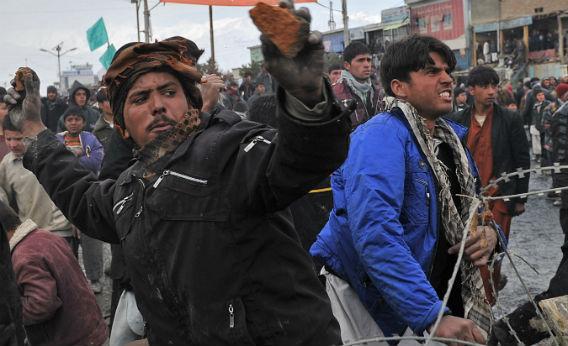
Aggravating all of these developments, of course, are the riots protesting the destruction of Qurans by American personnel. No doubt this was an accident; the people involved probably had no idea what they were destroying. But it’s a legitimate question to ask how unaware people could have been involved in destroying things in the first place. All the books on counterinsurgency stress the importance of cultural awareness: To win over the people, soldiers and other personnel at all echelons need to know what the people value. One awful mistake can overwhelm 100 good deeds. Or, as Petraeus’ field manual put it, “Lose moral legitimacy, lose the war.”
That is another reason why these kinds of wars are so risky to enter, so hard to fight, and so awkward to exit. It’s also one reason why, in his recent strategic review of defense policy, Obama and Defense Secretary Leon Panetta ordered that the Army shall no longer size or structure its forces for “large-scale, prolonged stability operations.” In other words, no more wars like this in the future. In the meantime, we’re stuck in this one, and, as usual, all the options look bad.
