It looks like something seriously different is about to happen with the defense budget—and not just the budget, but the way the Pentagon does business and the military fights wars.
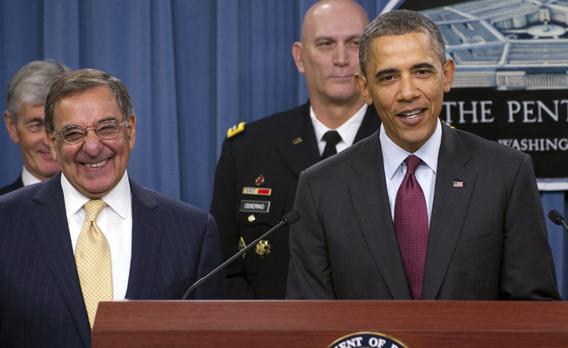
President Obama sought to dramatize this fact—or at least to deepen its impression—by going to the Pentagon press room himself (something no previous president had ever done) to lay out the main points of the new “Defense Strategic Guidance,” a document that was hammered out in a half-dozen meetings involving the president, the service chiefs, and the national-security bureaucracy. The precise scope and even nature of these changes are not yet clear. The top Pentagon officials—who followed the president’s appearance with a slightly more expansive press conference—are leaving the details to their budget rollout in a few weeks.
But certain inferences can be drawn from some of their statements. The biggest one is that the Army and Marine Corps will soon be facing an enormous—one might even say, existential—crisis.
Take a close look at these remarks:
Obama: As we look beyond the wars in Iraq and Afghanistan—and the end of long-term nation-building with large military footprints—we’ll be able to ensure our security with smaller conventional ground forces.
Secretary of Defense Leon Panetta: The Army and Marine Corps will no longer need to be sized to support large-scale stability operations.
The president and the secretary aren’t stating merely that they don’t intend to get involved in something like Iraq or Afghanistan in the foreseeable future. They’re saying that when the Army and Marine chiefs calculate how many troops they need for various contingencies, they are not allowed to assume that one of those contingencies might be a long war that involves lots of troops engaged in “stability operations.” (That’s shorthand for operations designed to stabilize a country after a war by helping its leaders impose order, re-establish legitimate government, and provide basic services).
Two big questions come to mind. First, is this the end of counterinsurgency, at least as it relates to much of the doctrine, training, education, and strategy that the Army has pursued during the last five years?
At a follow-on news conference, Ashton Carter, the deputy secretary of defense, waved away such concerns, saying the military would retain the “know-how” and “critical skills” to “regenerate” this capability if it is needed once again. But this is easier said than done. If the president and defense secretary say that “stability operations” are no longer a core mission of the Army and Marine Corps, then the senior officers—many of whom were never thrilled about doing those things to begin with—are likely to whack away at the resources (training bases, educational curricula, and so forth) that created and sustained this “know-how.” (One exception will be Special Operations Forces, which have always performed these sorts of missions and which Obama says he wants to increase.)
The second question: What are the core missions for ground forces now? Panetta said the size of the Army and Marines will be cut substantially, in part because of budget restrictions and in part because of the strategic rethink. News reports say that Panetta will cut the active-duty Army from 570,000 troops to 490,000 troops. But the chiefs had already assumed a post-Iraq reduction to 520,000. Slicing another 30,000 isn’t a big deal. What’s worrying a lot of Army officers is how they’re going to justify even as many as 490,000.
A new Korean war is one scenario, but is today’s Army—the best-trained, best-equipped fighting force in the world—really going to want to devote the bulk of its efforts to manning a static garrison on the DMZ?
Panetta and Carter suggested one possibility when they mentioned the continued necessity of “security assistance”—that is, supplying and training allied armies. A few years ago, John Nagl suggested that the Army form an “advisory corps” that would specialize in just that. He faced resistance from senior officers who didn’t want any of their scarce brigades to give up their “combat capability.” But where’s the combat? If the future face of American warfare is going to look less like Iraq and Afghanistan, it may look more like Libya, Uganda, and Somalia. An advisory corps would have a role there.
Senior Army officers must also be a little concerned by another aspect of the defense review: its clear tilt toward building up the Air Force and the Navy.
For instance:
Panetta: The U.S. military will increase its institutional weight and focus on enhanced presence, power projection, and deterrence in Asia-Pacific. This region is growing in importance to the future of the United States economy and our national security. This means, for instance, improving capabilities that maintain our military’s technological edge and freedom of action.
There’s a lot of code words in this statement, but, in the “Asia-Pacific” theater, “enhanced presence,” “power projection,” “deterrence,” “technological edge,” and “freedom of action” add up to this: visible naval power (aircraft carriers and other warships) and long-range aircraft. The phrases tend not to imply ground troops (which aren’t likely to be called up in a war against China in any case).
Much has been written of late about the “strategic shift” to the Pacific in the face of growing concerns among Asian allies about China’s expansionist tendencies, especially in the South China Sea. Reports have it that Obama has decided not to cut the number of aircraft carriers from 11 to 10, as some had suggested, though doing so would save a lot of money
This new defense guidance was driven by the fiscal crisis above all. The budget agreement struck last year requires the Pentagon to cut its plans by $487 billion over the next 10 years—and $263 billion of that over the next five years. (This does not include the hundreds of billions saved by the fact that the Iraq war is over and the Afghanistan war is winding down.)
How are they going to get the savings? Some will come from personnel cuts. But that won’t cover it all. Ash Carter said today that there will be “major changes in every category” of the defense budget. Again, no details were given, but there were some hints:
Obama: We’ll continue to get rid of outdated Cold War-era systems, so that we can invest in the capabilities we need for the future …
What might these “outdated Cold-War era systems” be? Nuclear weapons are a good possibility. Michele Flournoy, undersecretary of defense for policy, said in answer to one reporter’s question that the budget will reflect the fact that nuclear deterrence can be maintained with smaller numbers of nuclear weapons. How much smaller? Stay tuned.
The last secretary of defense, Robert Gates, saved a lot of money, by halting the F-22 stealth fighter program. Panetta would save, potentially, even more by putting a stop to its cousin, the F-35 Joint Strike Fighter. A short-range jet configured mainly for air-to-air duels, over land, against a comparable foe—that sounds like an “outdated Cold War-era system” to me.
Other ideas? It’s unclear, though I would suggest that someone take a close look at the Navy’s calculus for how many war ships (cruisers, frigates, and destroyers) really need to escort an aircraft carrier on patrol; how many planes need to be based on the decks of those carriers; and whether, for instance, small submarines, armed with cruise missiles, might be able to perform many of the same tasks.
In any case, for those bored or repelled by Republican primaries, the upcoming clashes over the defense budget might serve as a rousing spectacle. Massive cuts, major restructurings, meddling with the “roles and missions” of the armed services—these are messy undertakings, which is why they’re so rarely undertaken. They can get particularly ugly in the aftermath of a war or in the midst of an economic crunch.
The question is whether Panetta and Dempsey can impose discipline. What usually happens in these situations is that one service chief or another conspires behind the scenes with key legislators—usually those from a district with an endangered weapons manufacturer or defense base—to get a decision reversed. Gates laid down the law when he was secretary, even fired the Air Force chief of staff and secretary in part because they didn’t go along with his decisions to kill the F-22 and step up production of drones. Panetta should be ready to do the same, plus some.
