Two things are clear about U.S. policy toward Afghanistan. First, we are steadily withdrawing our combat troops over the next two years. Second, we have no plan for ensuring that the place doesn’t fall apart afterward.
A study published today by the Center for a New American Security, a Washington think tank, calls this a “civil-military disconnect.” Political leaders here and in Afghanistan have decided we’re getting out in 2014. But U.S. military commanders on the ground act as if they’re staying forever. They take the lead in most military operations, while Afghan soldiers are being trained in a rote manner, so that nobody knows whether they’ll be ready to take over the fight until they’re left holding the bag.
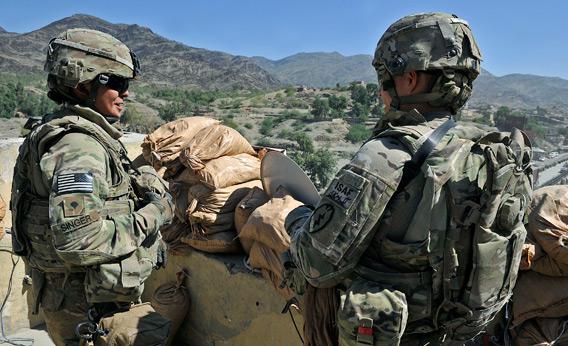
Retired Lt. Gen. David Barno and Andrew Exum, the study’s two authors—as well as a separate article in Foreign Affairs by John Nagl, the president of CNAS—propose a shift in strategy to ensure that we leave Afghanistan in the hands of a capable local force. First, they argue, the U.S. should create a special corps within the U.S. Army and Marines to train and advise the Afghan army. Second, we should embed small teams from these corps within Afghan army units, so they can train and advise the Afghans on the job.
This is a bigger shift than it might seem, and under the circumstances it’s a good idea, not only for the war in Afghanistan but the future of the U.S. military more broadly.
At the moment, some U.S. units “partner” with Afghan units, but, when things get rough, the Americans take over. It’s a lot easier that way, and less risky. The problem, though, is that the Afghans never get much practice at developing the mindset or practicing the combat skills that they’ll need when they’re alone.
There are obstacles to this sort of shift, and they all reside within the U.S. military. The Army and Marine Corps bureaucracies have resisted the occasional effort to develop a dedicated advisory corps. They see their main mission as combat, and while they will take on other missions (as they’ve done for the counterinsurgency campaigns in Iraq and Afghanistan), they oppose restricting any of their units to non-combat tasks.
But here’s the problem: Not every soldier is well suited to train or advise other soldiers, especially other nations’ soldiers. “Security-force assistance,” as the task is formally called, is an art in itself; its practitioners need special training to do the training.
Here’s another problem: Since the Army and Marines tend to promote officers on the basis of their performance in combat, few officers would want to join this advisory corps, even if it existed.
So the study proposes two fixes to these problems. First, the Army and Marines should create a new command, empowered with the necessary mandates, to oversee, select, train, equip, and deploy the trainer-advisers. Second, the promotion boards should be required to reward a certain number of trainer-advisers each year along with the more conventional soldiers.
This is not an entirely new idea. When Gen. Martin Dempsey was briefly Army chief of staff, before President Obama kicked him upstairs to be chairman of the Joint Chiefs of Staff, he entertained the idea of not quite an advisory corps but rather a corps of regional experts, who would be trained and promoted separately from combat soldiers. Their missions could have included training and advising foreign armies. It is unclear where Dempsey’s replacement, Gen. Ray Odierno, stands on the issue.
The think-tank authors argued at a press conference this morning that “security-force assistance” would be a good mission for the Army and Marines to develop in the long run, quite apart from Afghanistan. The military budget is going to be cut. President Obama, Secretary of Defense Leon Panetta, and Secretary of State Hillary Clinton have all signaled a shift in national-security priorities to East Asia and the Pacific, a region better suited for air and naval power than for ground forces. It’s a safe bet, therefore, that the Army and Marines will feel the budget axe most painfully and that they’ll follow the order by slashing their most expensive line-item: personnel.
Over the next several years, there may be insurgencies, terrorist uprisings, or other “irregular wars” that could affect U.S. security interests. But the U.S. military may lack sufficient troops to fight these wars itself. And after the hemorrhage of lives and treasure in Iraq and Afghanistan, the Congress and the public will likely be unwilling to get involved in a big way, in any case. Helping local security forces fight their own war—and having a specialized corps that can offer this help—may be not merely the next best thing but the better approach.
If a specialized corps isn’t in the offing (and there are reasonable, not merely bureaucratic, objections to the idea, especially if the Army is going to shrink, leaving it with even less combat power than before), then some have suggested that a three- or four-star general, just below the chief of staff, be put in charge of the advisory mission, working perhaps with the Special Operations Command (which has experience at this sort of thing) to select, promote, and deploy the officers who would concentrate on these sorts of operations.
The authors of the two studies—who, separately, made weeklong trips to various war zones and command posts in Afghanistan—are worth listening to on these matters. David Barno was U.S. commander in Afghanistan from October 2003 through May 2005. Andrew Exum was a former special-ops officer and a member of the team of consultants that helped write Gen. Stanley McChrystal’s 2009 strategic assessment of Afghanistan (the one that recommended at least 40,000 extra troops for a full-fledged counterinsurgency strategy).
John Nagl, author of the Foreign Affairs article, helped write the Army’s field manual on counterinsurgency and has long been an advocate of a separate advisory corps. In 2006, he was given command of an armor battalion that had been modified, at least on paper, to do nothing but train and advise foreign armies, specifically the Iraqi army.* But Nagl soon realized that his higher-ups didn’t take it seriously. Soldiers were assigned to the battalion on an “ad hoc” basis, he later complained. Its officers had no experience as trainers or advisers. In January 2008, fed up, he resigned from the Army.
Three months earlier, then-Secretary of Defense Robert Gates said, in a speech to the Association of the U.S. Army, “[A]rguably, the most important military component in the War on Terror is not the fighting we do ourselves but how well we enable and empower our partners to defend and govern their own countries.”
Not only was Gates advocating Nagl’s idea, he was reciting—almost verbatim, though without credit—the first line of an essay that Nagl had written the previous June. The essay was the first paper published by a brand new think tank called the Center for a New American Security, of which Nagl became the president after retiring from the Army.
And now the tale comes full circle. Nagl and two of his associates have written persuasive cases for the Army and Marines to expand their train-and-advise missions. The first time around, not even Gates, who forced many other changes on the military, could get his way on this one. Now, with two wars winding down and constrained resources, it’s time for the chiefs to take the idea more seriously.
Correction, Dec. 5, 2011: This article originally stated that Nagl had taken command of an infantry battalion in 2007. It was an armor battalion in 2007. (Return to the corrected sentence.)
