Monday, July 10, 2006
Monday, July 10, 2006
John Sparrow: As Mexico’s disputed election heads toward constitutional crisis, nobody’s asking the big question: How will the U.S. Supreme Court decide this one?
So far, the most striking aspect of John Roberts’ performance as chief justice is that we still have another quarter century or two to mull it over. At 51, he’s a boy king who has yet to show whether he’s Prince Hal on his way to becoming Henry V or George W. on his way to being George W.
The early report cards on the Roberts Court are all over the lot. In the New York Times, Adam Cohen writes that this term, Roberts reserved his much-ballyhooed “judicial modesty” for cases when Democrats and criminal defendants wanted judicial action. Whenever conservative principles were on the line, Cohen says, Roberts became “a raging judicial activist.”
Here in Slate, Rodger Citron credits Roberts for honoring his pledge to be a process-oriented minimalist by reducing dissent and by resolving more cases without deciding them. Give Roberts time, and perhaps eventually he can persuade the entire court to agree to decide nothing.
Back at the Times, longtime court reporter Linda Greenhouse cites legal praise for Roberts’ real passion, which is not modesty but punctuation. As proof, Yale professor Akhil Amar points to one line from a recent Roberts opinion: “The state did—nothing.” Amar tells Greenhouse, “That little dash is brilliant.”
Happily, I don’t read Supreme Court opinions for a living, so I’m in no position to judge whether that little sentence is above average. But the next 30 years could be a long slog if the measure of judicial success is doing nothing, and the measure of judicial literary brilliance is a pause for effect that means—nothing.
Dash of Brilliance?: To check on the boy king’s progress, I decided to read his opinion in the case of the brilliant dash.
The only explanation for how this matter ended up on the court docket is that conservative clerks couldn’t resist taking up an inconsequential Arkansas case named Jones v. Flowers. The case involves an Arkansas man named Jones who failed to pay property tax for several years on a Little Rock house that he no longer lived in because he’d left his wife. The state twice sent him notice by certified mail that his house would be sold to pay back taxes, but no one was home to sign for the letters, and no one showed up at the Post Office to claim them. The state then sold the house to a woman named Flowers, and Jones sued, claiming he hadn’t received sufficient notice. The Arkansas Supreme Court ruled for Flowers, citing a U.S. Supreme Court precedent that actual notice is not required so long as the state makes a reasonable effort.
In a rare break with his conservative allies on the court, Roberts joined a 5-3 majority in asserting that Jones deserved “a bit more” notice. The “new wrinkle” in this case, he writes, is that because Arkansas used certified mail, the state knew its notice never reached Jones.
The issue sounds more like a boring hypothetical in Civil Procedure than a burning question for the Supreme Court, but Jones does at least have a claim. Unfortunately, Roberts doesn’t have much of an answer. He writes that Arkansas should have sent the letter a third time by regular mail or addressed it to “occupant” on the theory that the same ex- who twice ignored notice of a certified letter for Jones would be more likely to read it if it were disguised as junk mail.
Keeping Up With the Joneses: Those hoping that Jones v. Flowers might usher in a new era for due process will have their hopes—dashed. Roberts says it would be too much of a burden to expect the state to actually find Jones by looking up his new address in the Little Rock phone book. Apparently, he shared the state’s view that “there are a lot of Joneses in the phone book, and a lot of phone books.” The chief justice doesn’t care whether state agencies find their man, as long as state bureaucrats cover their bits and pieces. His opinion suggests that there is a third way between judicial modesty and judicial activism: judicial nudginess.
You’d think that if anyone were leaping to defend property rights from bureaucratic overreach, justices Thomas and Scalia would go first. But those two join Justice Kennedy in arguing that their new colleague’s scheme is “burdensome, impractical, and no more likely to effect notice than the methods actually employed by the State.”
Shockingly, they could be right. Far from clearing anything up, Roberts’ opinion is so narrow that it will probably just produce more confusion about how much nonnotice is enough—and force more judges to step into bureaucrats’ shoes.
Greenhouse cites another case in which Roberts second-guessed the bureaucracy, ruling that a federal narcotics law didn’t apply to a Brazilian religious group that imported hallucinogenic tea: “The government’s argument echoes the classic rejoinder of bureaucrats throughout history: If I make an exception for you, I’ll have to make one for everybody, so no exceptions.” Roberts seems to like one-off cases where the exception proves to be the ruling.
Thursday, July 6, 2006
Thursday, July 6, 2006
The Big 6-0: On his 55th birthday, reporters asked President Bush if he would shoot his age in golf. This year, as he turns 60 today, the question is whether his age will keep up with his disapproval ratings.
In an apparent sign of human progress, not a single newsmagazine marked the president’s 60th by putting the Baby Boom generation on the cover. There was a time when you didn’t need a calendar to know the year ended in “6.” Time told us when the Baby Boom turned 40. Life told us when Boomers hit 50.
Of course, the case for human progress might be stronger if Newsweek hadn’t jumped the gun back in November 2005, with a cover called “Ready or Not, Boomers Turn 60.” If one newsmagazine can commemorate the Baby Boom’s conception, perhaps another ought to preview its demise. U.S. News could save its cover on “The Baby Boom at 100” for 2046, but why wait, and run the risk that neither newsweeklies nor our generation will still be around? Boomers are the target audience for these covers, so we should have the chance to read them before we’ve forgotten which generational cohort we belong to.
One newsmag cover per decade hardly does America’s largest generation justice. As the Milwaukee Journal-Sentinel points out, “Every seven seconds, a baby boomer turns 60 – a phenomenon that will continue for the next 18 years.” Boomernet.com says you’re not getting older – after 21,915 days, you’ve lost count.
Self-Hating Boom: Not to be outdone, Slate skips ahead to the long overdue question, “Was the Baby Boom a Hoax?”
Obviously, the Baby Boom was an irrefutable demographic fact. But as a political matter, was it ever really the generational movement that endless commentary has imposed upon it? Or was it just simulated to look that way, like the moon landing?
As a late model Boomer, I should know the answer, but I don’t. I’m too conflicted by my membership in an even iffier generation, the Baby Bust. We were born between 1958 and 1964, missed out on the idealism of the ‘60s, and went straight to the disillusionment of the ‘70s. Our cohort has produced Jeffrey Dahmer, David Koresh, and Timothy McVeigh – and we’re still in our 40s.
One demographer told USA Today, “Bush and Clinton, both leading-edge boomers, show the diversity of opinions and philosophies of the baby boom generation.” Another described the current divide between red and blue states as the direct result of boomers: “The culture wars of today are a boomer vs. boomer phenomenon, and Bush and Clinton are good examples of that generation.”
In other words, the Baby Boom generation is 78 million people born over a span of 18 years who live in the same country, grew up watching the same TV shows, suffer the same aches and pains, and disagree about almost everything else.
Middle Kingdom: A generation so big that every member felt like a middle child was bound to grow up craving attention. But the Baby Boom’s political self-consciousness may have saddled it with more burdens than it deserved. George W. Bush tried to exploit that self-image in the snarkiest, most disingenuous passage of his 2000 convention speech, when – after years of pretending not to have been part of the Baby Boom generation, he signed back up simply to criticize Bill Clinton for letting boomers down: “Our current president embodied the potential of a generation – so many talents, so much charm, such great skill… . So much promise to no great purpose.”
Let us hope that there is never a president who embodies squandered purpose as much as George W. Bush. But those shortcomings are all his own, not his generation’s. The New York Times may be right to call Bush “America’s most powerful baby boomer,” but there is little evidence that he ever really identified with his generation, or that most Americans between the ages of 42 and 60 even still think of ourselves as a generation, if we ever did. After two baby boom presidents born six weeks apart 60 years ago whose records and world views could scarcely be more different, we can safely eliminate generation as a dominant political factor.
Friday, June 30, 2006
Friday, June 30, 2006
Flying Saucers: If the Founders got together for a reunion this July 4, they’d have much to celebrate. Trading King George III for George Washington turned out to be the greatest straight player swap of all time. Bailing on the British Empire in favor of the American experiment showed investment foresight worthy of Warren Buffett. The Declaration of Independence changed the world, and even if the current administration sometimes forgets it exists, the Constitution is still going strong, too.
But if the Founders could do it all over again, might they look at the House of Representatives today and wonder, “What were we thinking?”
The Founders had high hopes for the House’s contribution to democracy. They made House members stand for election every two years so they would reflect popular opinion. Senators were given the luxury of six-year terms so they could deliberate with less eye to electoral whim. The Senate was the saucer to cool the House’s coffee.
For better or worse, that’s more or less how Congress behaved for the first couple centuries. Fifty years ago, the biggest obstacle to social and political progress in America was the U.S. Senate. Back when it took 67 votes to break a filibuster, the Senate was less the saucer than the little round hole in the Starbucks trash bin where the House’s coffee was thrown out.
In the last decade or two, however, the House and Senate have reversed roles. Because Senators are elected statewide and Senate rules force members to work out their differences, the Senate tends to more accurately reflect the broader public’s view. Because House members are elected in increasingly polarized districts and House rules forbid members from working out their differences, the House has become the world’s greatest deliberative trash bin.
Red Card: To make matters worse, in recent years, the political ethos of the House has infected the rest of the body politic. Take-no-prisoners politics began wrecking the House in the late ‘80s. It sank to unimaginable depths with impeachment in the late ‘90s and evolved into a brass-knuckled shakedown under Tom DeLay in the early ‘00s. When House members graduated to the Senate, some of them brought its harsh partisan instincts to the upper chamber.
In the House, DeLay launched an unprecedented and successful effort to redraw congressional districts year after year to maximize partisan advantage. If DeLay had gone on to the Senate, he no doubt would have tried to rewrite state boundaries every few years to achieve the highest possible number of red states.
The Supreme Court’s refusal this week to overturn the DeLay gerrymander in Texas suggests that another firewall has fallen. From now on, both parties will feel compelled to take the same politics that has brought down the House to every state capital in America. Instead of doing the job people elected them to do, state legislators will spend all their time fighting over how to write safe congressional districts so that members of Congress don’t have to do the job people elect them to do.
Redistricting was at the root of DeLay’s downfall, and may well be at the root of Washington’s as well. In recent years, redistricting has made districts more polarized, homogenous, and friendly to entrenched incumbents. Competitive districts in which incumbents actually have to earn re-election are becoming an endangered species.
What Would Thomas Jefferson Do? As Juliet Eilperin noted, Rep. John Tanner, a thoughtful Democratic congressman from Tennessee, has proposed legislation to require every state to take the politics out of redistricting. Under Tanner’s plan, each state would have to appoint an independent commission that couldn’t take partisan outcomes into account.
Stopping the spread of DeLayism may demand even more far-reaching measures. When Delegate Eleanor Holmes Norton and Rep. Tom Davis proposed a bipartisan plan to give new House seats to both the District of Columbia and the state of Utah, they suggested avoiding a middecade redistricting battle by having the new Utah member run statewide.
Why not go all the way and turn half of all House seats into at-large districts? If half of every congressional delegation had to run statewide, it would sharply reduce the potential for gerrymandering, and every member would have to compete in a bigger, less homogenous district.
Such a system would likely have little or no predictable impact on the partisan breakdown of the House. In the seven small states with at-large members today, both parties have done proportionally better at breaking the red-blue barrier in the House than in the Senate. Two of the five at-large members from red states are Democrats, compared to just 16 out of 62 Senators from red states. One of the two at-large members from blue states is Republican, compared with only nine out of 38 Senators.
Running statewide or in larger districts would make all candidates work harder to earn their keep. This year, Democratic Senate challengers face an uphill battle, but they have Republicans on the run in tough states like Missouri and Tennessee. In the House, Democrats could end up running a great campaign, win the popular vote, and still fall short of a majority because of the way districts are drawn.
In the new journal Democracy, former Rep. Brad Carson reviews a new history of the House, which he says “reads like a chonicle of degeneration, a well-wrought record of the decay of American politics and, perhaps, of American character.” Carson proposes another solution: Send members home for good, let them vote electronically from their districts, and increase the size of the House to reflect that the nation has tripled in population since the House reached its current size.
Tuesday, June 27, 2006
Tuesday, June 27, 2006
Moose and Squirrel: Stop the presses—Karl Rove is switching parties.
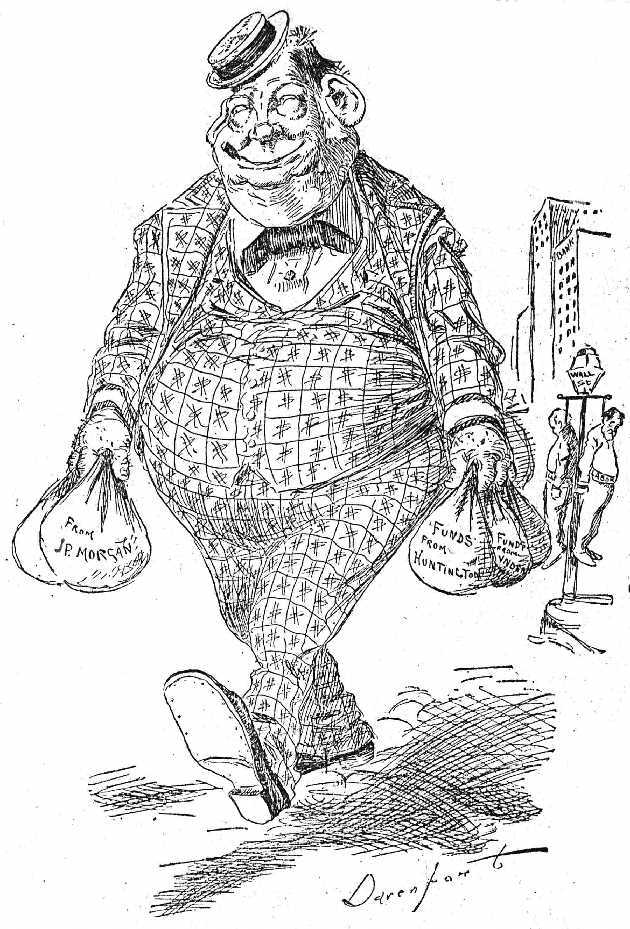
For a quarter-century or more, Rove has been telling friends that he would be the next Mark Hanna—the industrialist turned political boss who elected William McKinley president, only to see his successor, Teddy Roosevelt, become a reform crusader. Three years ago, an old friend of Rove’s told Ron Suskind of Esquire, “Some kids want to grow up to be president. Karl wanted to grow up to be Mark Hanna. We’d talk about it all the time. We’d say, ‘Jesus, Karl, what kind of kid wants to grow up to be Mark Hanna?’ “
When George W. Bush ran for president, Rove used his fancy for McKinley and Hanna to distract reporters from more obvious historical parallels—such as that Bush’s father was a failed, one-term president, or that the elder Bush would nickname his son “Quincy” in honor of two other failed, one-term presidents.
In Rove’s mind, McKinley was the first compassionate conservative. “He saw that the issues that had dominated American politics since the 1860s had sort of worn themselves out,” Rove told the Washington Postin 2000. “Neither party could successfully appeal upon the basis of their Civil War allegiances.” Bush and Rove weren’t in any rush to put the Civil War behind them, so compassionate conservatism was the next best thing: flying the Confederate flag, but at half mast.
The urge to elect another McKinley (and to be the next Hanna) was a strangely mediocre ambition. It’s hard to imagine the late Lloyd Bentsen winning a debate by declaring, “I knew Bill McKinley. Bill McKinley was a friend of mine. And governor, you’re no Bill McKinley.”
Nonetheless, Rove stayed loyal to the 1896 analogy. As James Traub noted last week in the New York Times, Rove gave a speech in 2002 about how much McKinley had done to draw new voting blocs to the Republican Party. Earlier this month, Rove’s eye wandered a bit, when he told the New Hampshire GOP that his favorite presidential quote was from Warren Harding. Yet Harding was in the McKinley-Hanna mold—all three were undistinguished Republicans who might have done more damage had they not died in office.
But as Jacob Weisberg foresaw last November in a piece called “Karl Rove’s Dying Dream,” you can’t party like it’s 1896 forever. Instead of the Republican realignment Rove had promised, Bush began dragging his party down with him. In effect, conservatives were telling Bush the cruelest words Rove had ever heard: “You’re no Bill McKinley.”
Bullies: This week, we have proof that Rove’s dream is as dead as McKinley. In fact, Rove wrote the obituary himself.
In a fawning Time essay that would make Mark Hanna roll over in his grave, Karl Rove finds a new hero—Hanna’s nemesis, Teddy Roosevelt, who left the Republican fold in 1912 to found the Bull Moose Party. Rove sounds as Bully as Marshall Wittmann: “Theodore Roosevelt is one of the most remarkable figures in America’s story. … He was among our most consequential Presidents.”
Rove tries hard to portray TR with the official White House talking points about Bush: character, leadership, animated by big ideas, “makes ardent friends and bitter enemies.” But as even Rove must realize, that moose won’t hunt. Roosevelt is consequential for all the reasons Bush is not: Unlike the current president, TR stood up for the common man, took on established interests, and showed a boundless energy for solving the nation’s problems.
Why, nearly a century after McKinley’s and Hanna’s deaths, would Karl Rove suddenly throw them over? Unlike Roosevelt, Rove never stopped any bullets, but he has been sweating plenty of them. Perhaps all those grand jury appearances made Rove see the light and realize that Hanna was wrong to worship what goes on behind closed doors.