Read all of Slate’s coverage about the Affordable Care Act.
At first glance, this morning’s 90-minute oral argument in the first of a three-day assessment of the constitutionality of the Affordable Care Act, looks something like the court coughing up a big old drama-killing hairball. For one thing, the issue is arcane and hypertechnical: Does a 19th-century statute—the Anti-Injunction Act—which provides that “no suit for the purpose of restraining the assessment or collection of any tax may be maintained in any court by any person”—bar the Supreme Court from even hearing the health care cases until someone has refused to purchase health insurance and paid a penalty for it? Since that won’t happen until 2014, the Anti-Injunction Act offered at least one federal appeals court the attractive option of making this whole case disappear for a few more years.
That now looks unlikely to happen. Because both the Obama administration and the opponents of the health care bill want the Supreme Court to decide the suit now, the court had to appoint an outside advocate—D.C. lawyer Robert Long—to argue that the court has no jurisdiction to hear the case. Forty minutes into his argument (which sounded more like a complex tax seminar than a fight over health care) Long didn’t appear to have too many buyers for the idea that these challenges should ripen on the shelf for a few more years. Everyone emerges from court this morning just a little glassy at having been pepper-sprayed by multinumbered tax-code references for well over an hour.
It’s kind of fantastic.
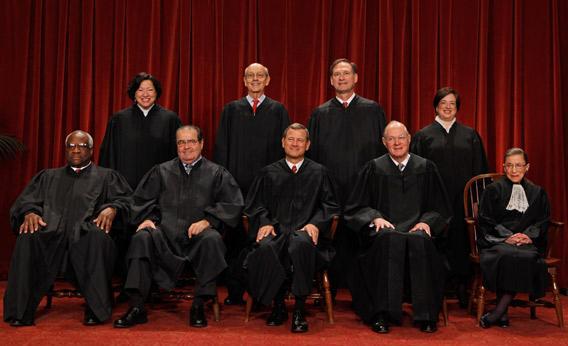
Long describes the Anti-Injunction Act as a “pay first, litigate later” rule that allows the collection of taxes to occur efficiently. (Justice Stephen Breyer will later describe taxes as “the life’s blood of the government.”) Long tries to persuade the court of the dangers of allowing the “taxpayer to go into court at any time,” but Justice Sonia Sotomayor seems dubious, asking him to lay out the “parade of horribles” that might happen if the tax law doesn’t apply here.
Long does a good job responding to what feels like sequential head-bonkings by one justice after another. But it’s plain that several justices were not going to be able to get past old case law, and others simply doubted whether the health care law is a jurisdictional statute. By mid-morning a general consensus has emerged, as Sotomayor puts it, “that Congress has accepted that in the extraordinary case we will hear the case.”
Justices Sotomayor and Antonin Scalia do a bit of philosophizing about whether there should ever be any jurisdictional rules at all, leading Long to respond that “not all people who litigate about federal taxes are necessarily rational.” Then Justice Stephen Breyer explains that while he is leaning toward Long on the jurisdiction issue, he has a different problem with deploying the tax law to squash this suit. As he puts it: “Now, here, Congress has nowhere used the word ‘tax.’ What it says is penalty.”
Long replies that “it’s part of the taxpayers’ annual income tax return. The amount of the liability and whether you owe the liability is based in part on your income. It’s assessed and collected by the IRS.” But Justice Scalia jumps in to add that the courts adhere to a principle that “unless it’s clear, courts are not deprived of jurisdiction, and I find it hard to think that this is clear. Whatever else it is, it’s easy to think that it’s not clear.”
The big textual hiccup here is that the provision requiring you to pay money if you fail to buy health insurance is called a “penalty” under the law and not a “tax.” That’s what Breyer keeps coming back to this morning. And it forces Solicitor General Donald B. Verrilli Jr. into taking the position that the Anti-Injunction Act doesn’t apply to the health care law because this just isn’t a tax.
Verrilli opens by cautioning, “This case presents issues of great moment, and the Anti-Injunction Act does not bar the court’s consideration of those issues.” He adds that this isn’t a tax “even though the minimum coverage provision of the Affordable Care Act is an exercise of Congress’ taxing power as well as its commerce power.” This is just too much for Justice Samuel Alito who breaks in to say: “General Verrilli, today you are arguing that the penalty is not a tax. Tomorrow you are going to be back and you will be arguing that the penalty is a tax. Has the court ever held that something that is a tax for purposes of the taxing power under the Constitution is not a tax under the Anti-Injunction Act?”
Verrilli replies that for purposes of tomorrow’s discussion it doesn’t matter whether Congress called it a tax. But for Anti-Injunction Act purposes the words tax versus penalty drive the whole outcome. He warns that it would be dangerous for the court to find that the Anti-Injunction Act is not a jurisdictional provision. He just wants the court to determine that it doesn’t apply here.
Ginsburg clarifies: “So if we agree with you about the correct interpretation of the statute, we need not decide the jurisdiction?” Verrilli agrees. Justice Anthony Kennedy gets the biggest laugh of the day when he retorts: “Don’t you want to know the answer?”
Verrilli then nails the understatement of the day when he replies: “Justice Kennedy, I think we all want to know the answer to a lot of things in this case.”
Justice Sotomayor probes what consequences Americans will face for the failure to buy health insurance, noting that some of the litigants contend that “there are other collateral consequences such as for people on probation who are disobeying the law, if they don’t buy health insurance they … could be subject to having their supervised release revoked.” Verrilli says that‘s wrong and that the only consequence for failing to buy insurance is that you must pay the penalty.
Justice Elena Kagan asks it this way: “Suppose a person does not purchase insurance … pays the penalty instead, and that person finds herself in a position where she is asked the question, ‘have you ever violated any federal law,’ would that person have violated a federal law?” Verrilli says no, “If they pay the tax, then they are in compliance with the law.”
At which point Justice Breyer has to finally ask: “Why do you keep saying tax?” and Verrilli quickly amends his own prior statement to read: “If they pay the tax penalty, they’re in compliance with the law.” He politely thanks Breyer for pointing this out. But I’m not sure he means it.
Both Breyer and Ginsburg question the notion that the purpose of the tax/penalty/tax-penalty provision is to raise revenues. Then Gregory G. Katsas, who represents the private parties challenging the law, gets 20 minutes to explain why the court needs to get on with it and hear the case. He spends a good proportion of that time volleying right up at the net with Sotomayor, and then tries to explain why the challenge here is to the mandate, not the penalty, so the Anti-Injunction Act isn’t an issue. Chief Justice Roberts is doubtful about that: “It’s a command. A mandate is a command. … What happens if you don’t file the mandate? And the answer is nothing. It seems very artificial to separate the punishment from the crime.”
It’s unlikely the court will simply boot this case down the road. (At the end of the morning’s argument, Chief Justice Roberts thanks Long for stepping in and says, “We will continue argument in this case tomorrow.” Translation: The show will go on. And now it’s for reals.) One question is why we went to all the trouble of briefing, arguing, and roping someone in to defend the Anti-Injunction Act, if the court had every intention of blowing off the first gate and hearing all three days worth of argument. That’s the wrong question. The court actually did what it does best this morning—reading complex old statutes (when Kennedy asked Long why the wording of the Anti-Injunction Act was so weird, Long basically replied that’s how people wrote back in 1867), asking practical questions, and reaching what looked to be nearly universal agreement that they’ll hear the case this year. While protestors outside were hollering about religion and freedom, the justices were boring those of us inside almost senseless with statutory construction. And sometimes, check that, most of the time, boring is what the justices do best.
* Tomorrow will be the big show. The court will tackle the individual mandate and the Commerce Clause. (Wednesday is for severability and the Medicaid expansion.) For those of you looking for laser tag instead of 19th-century statutory interpretation, tune in tomorrow.
Dahlia Lithwick will be chatting with readers on Facebook about this week’s Obamacare oral arguments at 11:00 a.m. EST on Thursday, March 29.
Watch Dahlia Lithwick Give Her First Impressions of Monday’s Opening Arguments
