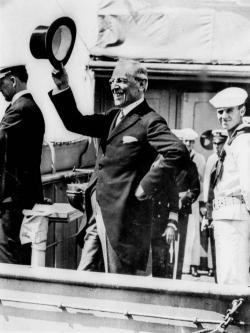
The first presidential press conference was a mistake. President Woodrow Wilson’s private secretary, Joseph Tumulty, advised newspapermen in Washington that at 12:45 p.m. on March 15, 1913, the governor—he still called Wilson by his former title—would “look them in the face and chat with them for a few minutes.” The new president expected to greet each man one-by-one to begin a personal relationship of the kind he had with reporters as governor of New Jersey. Up to that point, presidents had either ignored the press or fed them news in small, private, off-the-record meetings. Teddy Roosevelt spoke to reporters while his barber gave him his morning shave. But at the appointed hour, 125 newsmen appeared in Wilson’s office. He didn’t know what to do. They stood in their sack coats and vests in a semi-circle, four deep waiting for the new man to start pushing around some words.
“I did not realize there were so many of you,” said Wilson after an awkward pause. It wasn’t just that he was new to the job. At the time, the White House press room was barely bigger than the lavatory across the hall. “Your numbers force me to make a speech to you en masse instead of chatting with each of you, as I had hoped to do, and thus getting greater pleasure and personal acquaintance out of this meeting.”
The speech en masse became a regular feature of the Wilson administration and, 100 years later, the White House press conference has retained the shape of that first meeting—awkward, impersonal, and with little pleasure for the president. The moment legitimized the press corps and put the president and the press in an extended clutch—entwined and angling for advantage. The rocky launch of this new institution highlights a truth about the limits of the presidency. Wilson knew when he took office what his successors only learned through hard experience, and that President Obama is learning afresh this week as his poll numbers dip in the wake of the sequestration fight: A president shapes public opinion, but he is not a master of it.
Wilson had a lot in common with the current president. He was accused of being too professorial and aloof, and he loathed the news culture for its focus on the trivial and commercial. Experience would only harden this view, but on that first meeting, he was anxious to show that he liked newspapermen and they were even more anxious to be liked. The New York Times headline of the encounter reads “Wilson Wins Newspapermen,” and gushes from start to finish about how much the newspapermen loved Wilson and how Wilson seemed very much indeed to like them, too! “As he went on talking, the big hit he was making with the crowd became evident,” wrote the Times reporter. “There was something so unaffected and honest about his way of talking under this unexpected call on him that it won everybody.”
The Washington Post headline read, “Wilson, in friendly chat, says he likes reporters.” The Post correspondent went wobbly, concluding the first paragraph of his dispatch by describing Wilson this way: “Standing there, where he could take in all with a sweep of his kindly eyes and with a genial smile.” Though there were so many in the room, some clearly got a few turns on Wilson’s lap.
At that first meeting, Wilson didn’t do much more than blink those kindly eyes and tell the assembled men that he was fond of them and was sorry he hadn’t visited sooner but that he was trying to “get onto his job.” The White House usher didn’t even note the event in his official book.
A week later, on March 22, Wilson held his second press conference. This time it made the usher’s book and it was held in the East Room. The president came prepared. Apologizing for the raggedness of their first encounter, he said he wanted to build a working partnership with the 128 men who attended. “Please do not tell the country what Washington’s thinking, for that does not make any difference. Tell Washington what the country’s thinking.” He asked reporters to “lend me your assistance as nobody else can,” to bring “the freight of opinion into Washington … to try and make true gold here that will go out from Washington.”
The reporters were baffled. “Our function, at least as we saw it, leaving aside our duty, was to inform the country what Washington was doing,” wrote New York Times Washington bureau chief Richard Oulahan later. The president, he said, “had come to Washington with a distinct prejudice against the place and what he conceived to be its mental atmosphere.”
Wilson, the former political science professor, had a specific notion of how the president operated in a democratic system. He didn’t want the press to broadcast his views. As historian David Michael Ryfe explains, Wilson thought the president should be a conduit for public opinion. He would not follow the mob, but he also couldn’t lead the country where it didn’t want to go. “A nation is an organic thing,” wrote Wilson, “its will dwells with those who do the practical thinking and organize the best concert of action: those who hit upon opinions fit to be made prevalent, and have the capacity to make them so.”
As president, Wilson would curate public opinion and then work with Congress to enact its will. But in order to have a sense of public opinion and tweeze out those views “fit to be made prevalent,” he needed reporters to send out the fishing nets to collect as much information as possible.
This view is at odds with the modern conception of the action-hero president whose rhetoric—amplified through the media—can overcome the obstacles flung in his way. President Obama’s fans wish he could give a speech like the ones he gave during the campaign so that he could enact a true liberal agenda. Republicans, like Sen. Ron Johnson of Wisconsin, argue that the president should “lead” by speaking to the country about the dire state of the country’s finances so that the people will fall in line behind cutting the entitlement programs they love so much.
Wilson wasn’t the only president who thought public opinion could at best be molded but never controlled. Abraham Lincoln took walks that he called “public opinion baths,” to learn the public mood so that he could shape it into policy. He was relentlessly ridiculed for his ponderousness and reluctance to act, which was the result of his belief that the public could not be forced in a radical new direction. FDR agreed. He famously said, “I cannot go any faster than the people will let me.” Political scientists largely agree, too. “Presidential power is not the power to persuade,” writes professor George Edwards. “Presidents cannot reshape the contours of the political landscape to pave the way for change by establishing an agenda and persuading the public, Congress, and others to support their policies. Instead, successful presidents facilitate change by recognizing opportunities in their environments and fashioning strategies and tactics to exploit them.” If this is a basic truth about the presidency, it’s a hard one to put into practice. President Obama came into his second term saying he was “mindful” of previous presidents who had overreached after winning a second term, but then he overreached in the fight over sequestration. Ronald Reagan and Bill Clinton were great communicators but left office complaining that they wished they had been able to find the right message to move the public faster.
The problem all presidents learn is that it’s hard to know what public opinion is. The public doesn’t really know what it believes much of the time. Or, the public is misinformed. For an academic like Wilson though, more data was better than less, which is why he was so anxious to enlist reporters as fact-finders, not as his personal megaphone.
In setting up the White House press conferences, Wilson was asking for a trade. He would let reporters in, giving them access and standing, if they would play the role he wanted. The press didn’t oblige, but Wilson still tried to carry out the experiment. As W. Dale Nelson reports in his book on the history of the White House press secretary, Wilson relied on his private secretary Tumulty to report on the public mood. “I’m happy to have [Tumulty] a good deal away—to pick up opinion—which he does wonderfully well. Washington is no place to learn what the country is thinking about.”
The next few years would be bumpy for the official presidential press conference. In July 1913, Wilson threatened to stop them when the New York Sun published comments on Mexico that were supposed to be off the record. Afterward, all comments were considered off the record unless the White House said otherwise, which essentially recreated the arrangement that had existed before the first formal press conference. As war loomed in 1915, Wilson halted the press conferences for a year and his view of the press grew colder. At one point, in arguing for legal limits on press coverage, he said, “I do not think that the newspapers of the country have the right to embarrass their own country in the settlement of matters which have to be handled with delicacy and candor.”
Future presidents would continue the battle, but Wilson had ceded the enemy a crucial beachhead. “Every president after that felt compelled to hold press conferences,” says Senate historian Donald Ritchie who wrote a great history of the Washington press corps. “He treated them as professionals and gave them legitimacy.” Working reporters hadn’t even had their own room at the White House until Teddy Roosevelt. Now they had a right to ask the president questions as a part of the regular functioning of the office.
This access would ultimately doom Wilson’s view of reporters. If a reporter could ask questions on a regular basis, they could set the agenda and fit Wilson’s views into whatever they decided was important. Those decisions were informed by the very cynical and commercial interests Wilson had loathed. Wilson hated this idea and very soon invented a crucial new presidential tool: the public stonewall. Ryfe, the presidential historian, studied 630 of Wilson’s press conference answers and found that 67 percent of them were unresponsive, uninformative, or cursory. A reporter at the time said the object of Wilson’s press conferences was “to make responses which seemed to answer the questions, but which imparted little or nothing in the way of information.” Almost 20 years to the day after Wilson’s first press conference, FDR would give his first fireside chat, an attempt to regain the agenda by speaking directly to the American people without the press filter.
President Obama has tried all of the same tricks, from a Google Hangout to a Reddit “Ask Me Anything” to regular appearances on ESPN and late night talk shows. The only thing he hasn’t tried is inviting us all into his office for a chat. That’s probably wise. We’d probably break something, either news or an heirloom.
