“Is that him?”
“This is the Iron Dome guy? That’s him speaking?”
“I think that’s him!”
A hundred-odd “pro-Israel lobbyists,” as the official literature calls them, gather around a small stage in the AIPAC Village. There are several of these stages. It’s a large “village,” located at the bottom of the Walter E. Washington Convention Center, in a room that stretches underneath three city blocks. To get there, you walk past the ads that repurpose the old Uncle Sam recruitment photos with a new slogan: “I want YOU to be on time for your lobbying appointment.”
Six weeks ago, this was the site of the largest inaugural ball in modern history. The floor was bare concrete, and the hors d’oeuvres were Cheez-Its and pretzels served in ornate metal bowls. Today, for the annual American-Israeli Public Affairs Committee conference, the room is carpeted, and the kosher refreshments are served from ersatz “food trucks.” Higher-dollar donors head into pavilions at the north and south ends of the room, where they can kibitz with members of Congress and former diplomats. (AIPAC offers special recognitions for donations up to $2 million.) Lower-dollar donors can check out the technological “showcase,” products invented by Israelis and now ready for American soldiers, drivers, or households.
Case in point: a presentation by retired Brig. Gen. Danny Gold. In 2005, when he ran the Israeli Defense Force’s weapons and R&D shop, Gold advocated for a short-range defense system that could scan for missiles, predict their targets, and destroy them in flight. Within five years, Iron Dome was getting the funding it needed. In 2012, it knocked out 84 percent of the missiles shot from the Gaza strip. Gold tells the story in a thick accent, giving credit to Israeli’s scientists—and giving some credit to the Obama administration, which presided over $275 million of funding for Iron Dome.
Shoshana Marcus, a donor and Hebrew teacher who lives in Maryland, lifts her iPhone above the crowd. “I want to take a picture,” she says. “This is the man who saved my grandchildren! I’ve got grandchildren who live in Israel.”
If Gold saved her grandchildren, and the Obama administration bankrolled that rescue mission, who gets the kudos? That question will be asked and re-asked of the 12,000-plus AIPAC donors who’ve come to D.C. this weekend. Jewish panic about Barack Obama was the dog that never barked, not during the 2008 campaign, not even after the 2012 campaign. When Obama picked Chuck Hagel to lead the Pentagon, Republicans saw a test for AIPAC. Would America’s “pro-Israel lobby” throw its weight and conspicuous money against a man who’d accused “the Jewish lobby” of “intimidating a lot of people” into unwise votes?
No, it wouldn’t. AIPAC stayed out, pointing out that it never got involved in nomination spats. Hawkish pro-Israel groups, with infinitely less clout, tried and failed to pinch-hit. At a pre-AIPAC happy hour, on Saturday, some of the activists who’d manned the guns remained bitter. “They existed to stop something like the Hagel nomination,” one of them told me. “What vote’s going to come up that’s more important than Hagel? What’s more important than saying: No, you can’t do what Hagel’s done and expect to ever get a defense role?” The anger spilled out from AIPAC donors, and it was channeled in pro-Israel punditry. “Had the American Israel Public Affairs Committee opposed Hagel publicly,” wrote Washington Post blogger Jennifer Rubin in her 73rd and final post chronicling the nomination, “I do not think he would have been confirmed.”
But AIPAC rank and file have moved on. “I was not happy about Hagel, but a lot of people are saying that he’s going to be different than what he used to be,” says Shoshana Marcus.* “Israel produces a lot of technology. The United States gives the means to produce it. Someone like Hagel, he’s going to learn that aiding Israel is to the United States’ benefit. Is President Obama always pro-Israel? No. I don’t think so. But he does the right things.”
This, with a little less angst, was the Obama-Biden campaign’s 2012 pitch to wayward Jews. At his defensive 2012 speech to AIPAC, the president asked lobbyists to ignore his gaffes and look at the balance sheet. “The fact is, my administration’s commitment to Israel’s security has been unprecedented,” he said. “If during this political season you hear some questions regarding my administration’s support for Israel, remember that it’s not backed up by the facts.” The Obama campaign wanted Jewish voters to think about Iron Dome. One year later, Iron Dome was mentioned so often at AIPAC’s conference that Tablet put it at the top of its AIPAC Bingo card. Hagel was mentioned once, when Israeli Defense Minister Ehud Barak wished him “all the best.” (Barak was the first foreign counterpart to get a meeting with newly installed Secretary Hagel.)
“I trust President Obama,” said Joyce Wolf, an AIPAC donor from Michigan. “If Hagel really had a black heart, the president wouldn’t have nominated him.”
Any residual Hagel bitterness, if it existed, was kept behind closed and carefully guarded doors. Conference organizers restricted media access to most breakout sessions, including every session involving a current member of Congress. No reporter could watch the leaders of the House Foreign Relations Committee debrief on the year to come; none could watch Texas Sen. Ted Cruz, who spent the last month asking for records of old Hagel speeches, speak at a town hall about “how members of Congress experience Israel.”
No, Republicans had to be subtle with their Hagel-bashing. Texas Sen. John Cornyn, the Republican whip in the Senate—a man who deserves credit for the first, ultimately vain Hagel filibuster—never mentions the nominee. He just mentions that he, John Cornyn, “supported every single piece of pro-Israel legislation,” unlike some people. “I know some U.S. officials have called for greater engagement with Hamas,” says Cornyn. I scan the rows, the thousands of AIPAC lobbyists-for-a-week, and saw wry smiles. I see more of them when Sen. John McCain, steamrolling New York Sen. Kirsten Gillibrand in a short policy panel, says, “We need members of the national security team who are pro-Israel, not anti-Israel.”
It’s not like the “Israel lobby” disagrees with that. Its leaders simply decided that it wasn’t worth challenging a nominee for secretary of defense and losing. Did they want to make a statement, or did they want to keep the aid and research dollars flowing? At a “town hall” about the U.S.-Israel relationship, Union College Professor Stephen Berk reminds skeptics that “Richard Nixon said some hateful things about Jewish people” right before he re-armed Israel during the Yom Kippur War. Barack Obama said the wrong things, but they weren’t going to pressure him by undermining him.
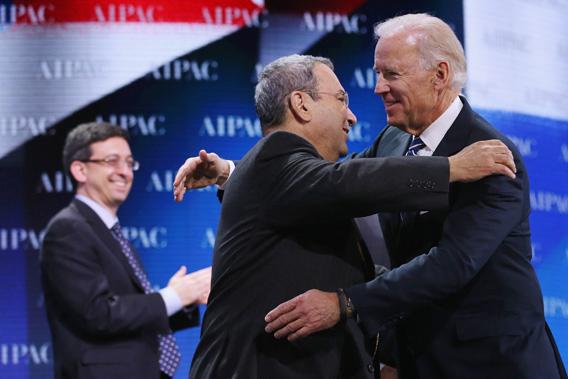
The president missed AIPAC this year—no great scandal, since he’s making his first in-office trip to Israel later this month. He dispatched Vice President Biden, a font of stories about the Israeli prime ministers he’s known, a pol who knows which words do and do not spook the lobby. Biden appears onstage to the strains of “Hail to the Chief,” and runs over to hug Ehud Barak, as outgoing AIPAC president Michael Kassen preps his introduction.
“Because of this administration’s dedication to Israel,” says Michael Kassen, “more than $400 million has been invested in Iron Dome.”
Biden talks for more than 30 minutes, acknowledging that “we’ve always disagreed on tactics,” but moving right on to the good stuff.
“I don’t have to explain [the Iron Dome] to anybody anymore,” he says. “Everybody saw, the world saw!”
Correction, March 5, 2013: This article originally attributed a quotation to Shoshana Gold. The quote was spoken by Shoshana Marcus, quoted earlier in the article. (Return to the corrected sentence.)
