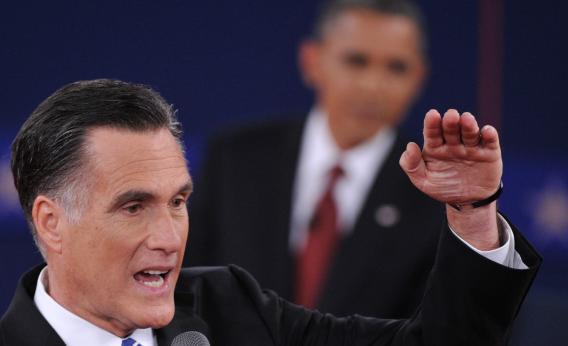
HEMPSTEAD, N.Y.—In unhappier days, when Mitt Romney spoke to Florida donors in view of a hidden camera, he reminisced about all the fun Ronald Reagan had when he ran against Jimmy Carter.
“The fact that we have hostages in Iran, I mean, that was all we talked about,” said Romney. “And we had the two helicopters crash in the desert, I mean that’s—that was—that was the focus, and so him solving that made all the difference in the world.” What sort of foreign policy crisis might break out in 2012? Whatever it was, “if something of that nature presents itself, I will work to find a way to take advantage of the opportunity.”
Romney got that opportunity on Sept. 11. Islamic militants attacked the American consulate in Benghazi, Libya, and killed four Americans, including Ambassador Chris Stevens. It was, as Republicans would quickly point out, the first murder of an ambassador since the Carter years. The Romney campaign bobbled its first response, putting out a statement that claimed the administration “sympathized” with the attackers—the American embassy in Egypt had condemned a remarkably dumb video satire of Mohammed, which protesters in that country cited as their pretext.
But in the weeks since, Romney and Republicans and the conservative media got more facts. Reporters revealed that the Benghazi consulate had asked for more security, that Stevens himself had said this on the day he died. The president’s surrogates held back on calling the attack “terrorism.” The story became “Benghazi-gate,” a tale of cover-ups and—in a phrase mimeographed by Romney spokesflacks like Dan Senor—“the unraveling of the Obama foreign policy.”
And then it came up in a debate—and Romney whiffed. Kerry Ladka, one of the undecided voters chosen for the town hall forum, said that his “brain trust” had come up with a question: “Who was it that denied enhanced security and why?” The president gave a pat answer that Republicans were ready for him to give: He had immediately scrambled to investigate the attack, and “we are going to find out who did this, and we are going to hunt them down.”
Romney rose and ambled slowly toward an answer. “I—I think the president just said correctly that—that the buck does stop at his desk,” he said, “and—and he takes responsibility for—for that—for that—the failure in providing those security resources, and those terrible things may well happen from time to time.” He didn’t point out, as he could have, that the commander-in-chief had just dodged Ladka’s question. He said that Obama’s decision to proceed with a Sept. 12 fundraiser had “symbolic significance, and perhaps even material significance.”
Obama was ready for this, too. “The day after the attack, Governor, I stood in the Rose Garden, and I told the American people and the world that we are going to find out exactly what happened, that this was an act of terror.”
Romney saw an opening to embarrass the president. He homed in on him. “You said in the Rose Garden the day after the attack it was an act of terror,” he said. “It was not a spontaneous demonstration.”
Obama and Romney coolly exchanged fire over whether the statement was true, whether Obama had said this in the Rose Garden. It wouldn’t be hard to check, really. But moderator Candy Crowley threw the flag. “He did call it an act of terror,” she said. Romney was ready to debate Libya, but not to debate, with a moderator, the wording of one sentence on Sept. 12. The exchange, as most viewers would see it, was lost.
Republicans were dumbfounded. When the debate ended, I found Rep. Jason Chaffetz, who was standing mostly alone in the spin room. His House Oversight and Government Reform committee had been demanding Libya documents, publishing what it got from whistle-blowers, and bringing diplomats in to testify about the administration’s failure. He held a copy of a Sept. 18 press conference transcript, in which Jay Carney failed to call the Benghazi killings “terrorism.” He’d marked it up in blue pen during the debate.
“For the president to suggest that he was talking about a terrorist attack in Benghazi is totally off base,” said Chaffetz. “He was talking about terror in general, not terror specific to Benghazi.”
Republican are right in this sense: The words “terrorist attack” didn’t appear in the Rose Garden remarks. They’re wrong in this sense: Obama referred to “an attack on our diplomatic post,” then promised that “no acts of terror will ever shake the resolve of this great nation.” It was unspecific, it was flowery, and it was forgotten. And that was the administration’s problem. The subsequent cannonades of questions and documents and witnesses and punditry and timelines had formed into a glowing radioactive gruel, “Benghazi-gate,” in which the administration was simply hapless and ignorant and unable to say that terrorism exists.
“The fact of the matter is that I think he used the word TERROR,” said former Secretary of Homeland Security Tom Ridge. “The fact of the matter is seven days later, on David Letterman, he was still attributing it to a spontaneous reaction to that ugly movie. Oh, by the way—check out his speech to the United Nations! That’s not on David Letterman, that’s not in the Rose Garden, that’s the international community. He talked about it being a spontaneous reaction to a movie.”
Again, this is almost right. At the United Nations, the president said, in a banal sort of way, that “there is no video that justifies an attack on an embassy.” But in the days after Sept. 11, there were more throngs outside embassies, using the video as a pretext. The Benghazi outpost was a consulate, not an embassy, and its attackers had, indeed, mentioned the video as a justification for the murder. At another point in the U.N. speech, the president said that “the attacks on the civilians in Benghazi were attacks on America.”
But Obama didn’t say “terrorism.” That was the nucleus of the Obama’s-weak-on-terror case—the president has struck words and phrases like “Jihadism” and “terrorism” and “global war on terror” from the lexicon, proof that he doesn’t take this stuff seriously. The Benghazi muddle had been the perfect vehicle for that argument. And now, there was a risk that voters would see the Sept. 12 Obama statement again and wonder whether the confusing post-attack reporters were all that contradictory.
Republicans tried to pre-empt this by re-litigating “acts of terror.” RNC Chairman Reince Priebus arrived in the spin room, conferred with Chaffetz and his marked-up paper, and insisted that Obama had been bailed out unfairly by Crowley.
“He didn’t call it a terrorist attack in the Rose Garden,” said Priebus. “He didn’t call it a terrorist attack in the Rose Garden. We’ve got the transcript of when Jay Carney, the president, time and again referred to this as a spontaneous attack.” There were six days left before the foreign policy debate, and this would haunt Obama. “If you point-blank lie to the American people on something that’s already a headache for you, it’s not going to get any better.”
They think the terror/terrorism difference—which Crowley admitted in post-debate interviews—is stark enough to make the headache worse. But it’s hard to re-muddle something once it’s been cleared up.
