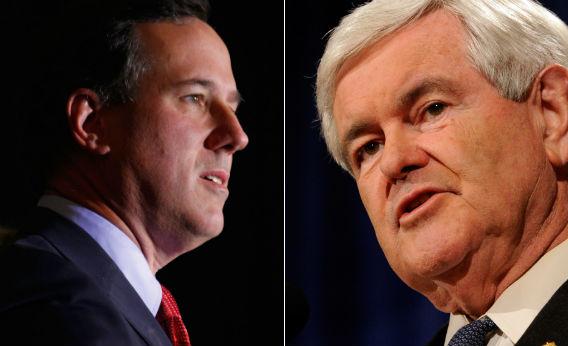
When they hand out the bunting, funny hats, and elephant pins at Republican Party headquarters, no one talks about the math test. For the next several weeks and perhaps months, GOP politics are going to center around a complex debate about delegates that will remind us all of those math problems you hated in grade school:
If Rick leaves Philadelphia headed for Tampa on a train powered by coal his grandfather mined and Mitt drives his Mustang to the same destination, how many attacks on the elite media will it take Newt to stop them?
All campaigns are spinning the delegate math to their advantage. Mitt Romney’s team is arguing that his opponents cannot win enough delegates to overtake Romney’s delegate lead. Rick Santorum and Newt Gingrich are arguing that they have a shot at accumulating enough delegates to surpass the weak front-runner and steal the nomination.
Both sides are spinning fantasies, but as might be expected, Romney’s fantasy is closer to reality. He is offering something closer to historical fiction whereas Rick Santorum and Newt Gingrich’s tales are more like science fiction.
To understand what’s going on, it’s best to think of two dramas, one that takes place in the primaries and caucuses to come and one that takes place at the Republican convention in Tampa, Fla.
First Drama: It’s almost impossible for Mitt Romney’s rivals to catch him
This is a hard truth for Santorum and Gingrich supporters, but independent Republican experts and delegate guru Josh Putnam of Davidson College say it’s so. That was the view before Santorum’s exciting showing on Super Tuesday and it’s even more true after.
Super Tuesday is a good example of the split dynamic that now rules in the Republican contests. One story on Super Tuesday centered on the dramatic moment in Ohio: Romney narrowly defeated Rick Santorum. He couldn’t win over the most conservative members of his party. Conclusion: The race is close! The other dynamic that night took place in Virginia: Romney won 63 delegates and his opponents won nothing. On Super Tuesday, Romney won six of 10 states. He won 65 percent of the delegates and hundreds of thousands of votes. Conclusion: The race is not close!
Unfortunately for Gingrich and Santorum, the delegate math is what matters in winning the nomination and Romney has a huge lead. Romney now has 396 delegates—748 away from the number needed to win. Santorum is in second with an estimated 146. Newt Gingrich has 97 and Ron Paul comes in last with 38. In order to reach the required 1,144, Romney needs to win about half of the remaining delegates, while Santorum would need to win two-thirds of them.
But what if the drama overtakes the math? What if Rick Santorum keeps winning? Romney can’t keep losing, can he? The answer is that Santorum won’t win every contest, no matter how much momentum he picks up after possible wins in Alabama and Mississippi next Tuesday. The states he does win won’t provide him with a big enough margin to overcome Romney’s existing delegate lead. It’s going to be a long slog that batters Romney, but the math is his life preserver. Here’s why:
Proportionality: Delegates are awarded proportionally in 31 of 35 future contests, which means winning a state doesn’t mean you get all its delegates and losing a state doesn’t mean you don’t get any delegates. Mitt Romney lost Tennessee but still picked up 14 delegates. Rick Santorum won 29, giving him only a net 15 in his race to close the more than 200 delegate gap.
Not all states are created equal: To catch the front-runner, Santorum or Gingrich will have to do well in winner-take-all states. There are just four of them and they’re all favorable to Romney: Utah (where there is a large Mormon population and Romney helped turn around the Olympics), New Jersey (Gov. Chris Christie has endorsed Romney and the electorate is made up of his kind of voter), Delaware (the electorate is also favorable), and Washington, D.C. (Santorum isn’t even on the ballot). Santorum also didn’t make the ballot in parts of Illinois, which deprives him a chance at 10 delegates. Other states like California, Connecticut, Rhode Island, and New York have electorates that are dominated by moderate voters with whom Romney does well.
Romney’s rivals are too weak: If they hope to overtake Romney, Santorum or Gingrich would not just have to win future contests, they’d have to dominate them in a way no candidate has dominated any contest so far in this election. They’d have to steal huge chunks out of the Romney coalition—converting people who like Romney a lot and think he’s most electable. There is no evidence in any of the races so far that Gingrich or Santorum could do that. Mitt Romney may be weak, but his opponents are weaker.
Drama 2: Mayhem in Tampa
Mitt Romney’s challengers know that they’re not going to catch him on the delegate count in advance of the convention—though they aren’t broadcasting that idea. Their battle plan rests on keeping him from winning the 1,144 he needs to get the nomination and then zooming ahead of him in Tampa.
To do this, Santorum or Gingrich have two tasks: win enough remaining races to get within striking distance of Romney and then sweet talk however many delegates they need to make up the difference between the ones they’ve won and the ones they need to get to 1,144.
Romney is still in a good position to capture the magic 1,144. For Gingrich or Santorum to draw close enough to him, one of them must emerge as the sole conservative alternative. That way, the last conservative standing can suck up all the possible anti-Romney votes (and delegates). It will also help them win states outright, which will matter when momentum and public perception become a part of the big sales pitch in Tampa.
When the feuding Republican Party arrives in Tampa, if Romney has not locked up 1,114 delegates, the candidate in second place will embark upon a charm offensive to convince unpledged delegates and party officials that he should be the nominee.
There are two main audiences that need convincing: The first are the unbound delegates, and the second is the Committee on Contests. Let’s start with the committee. This is the body that meets in Tampa a week before the convention to adjudicate disputes over the delegates that were awarded during the election season. Rick Santorum and Newt Gingrich are likely to focus on the states of Florida and Arizona. Romney believes all the delegates in those states go to him because they are winner-take-all states. His challengers argue that the delegates in those states should be awarded proportionally because those states lost their winner-take-all status when they jumped ahead in the Republican Party primary calendar and held their contests in January and February. “This idea that Mitt Romney is going to get 50 delegates out of Florida, that’s just simply false,” Santorum said on Friday. “All these delegate counts, they are shadows.”
If the Romney challenger convinces the committee, Romney will still get the majority of delegates in those states, but he’ll lose some depending on how his opponent performed.
The committee is not the biggest hunting ground for delegates. In Florida, a successful bid would give Gingrich 16 more delegates and shrink Romney’s total by 27 to 23. The other 11 delegates would be split among Rick Santorum and Ron Paul. But the committee is a place where lawyers can debate rules and the terms of debate are at least fixed by common language, culture, and custom. None of that is true in the other venue where Gingrich or Santorum will have to make his case: the 513 members of the unbound delegate pool.
When advisers to Newt Gingrich or Rick Santorum talk about the unbound delegate pool, they make it sound like it’s a huge group of swing voters ready to be persuaded by the best argument. That’s not quite right: Most are technically free to do as they please, but they are a Romney-leaning group. If you were to think of this group as an electorate, they are more like the voters of Florida or Michigan—predisposed to liking Romney and more susceptible to his arguments—than they are the voters of South Carolina.
Who are these people? Among the more than 500 unbound delegates, there are various subgroups. First are the Republican “superdelegates,” 117 party officials most of whom are free to vote their conscience. Then there are 130 unbound delegates from states like Colorado, where they can choose to be bound at their state conventions, which have yet to be held.
The remaining 266 or so are unbound, but that doesn’t mean they are ripe for the picking. Some of these delegates will be pro-Romney people picked at their party conventions. So, for example, when Iowa Republicans meet in the summer to pick the delegates to go to the national convention, the 12 that go to Romney (of the 25 total) will be die-hard Romney fans. When they get to Tampa, they’re going to be a hard bunch to convince to abandon their man.
The pool of persuadable delegates is not only smaller than Romney’s rivals would like to admit, but there’s also the matter of what arguments are going to persuade them. Despite Romney’s perceived weakness at the moment, he is beating Santorum by 11 points in the Gallup poll. He is consistently seen as the most electable in national and state polls by as much as 40 points over Santorum. He is also considered the candidate who can handle the issue of the economy better than anyone else. He will arrive at the convention having won more states, more delegates, and hundreds of thousands of more votes. He did none of this through trickery.
Santorum and Gingrich will have to make a case built on ideology and momentum. They will argue that Romney doesn’t represent the base of the party—the Tea Party stalwarts and those who identify themselves as “very conservative” in exit polls. But the base of the party is not the whole party. Unless Santorum or Gingrich can prove in the coming contests that they have appeal outside the one-third of the party that loves them, they are going to be making a case that the loudest part of the party is more important than the largest part.
If Mitt Romney doesn’t get to 1,144 delegates before the convention, his opponents have an opening with a contested convention. But pulling off a win would still be a long shot. In 1976, at the GOP convention, Gerald Ford went to Kansas City without the required number of delegates to secure the nomination. Ronald Reagan fought right up until the end and got pretty close—delegates even broke their pledges to back Reagan—but ultimately the Gipper lost. Neither of Romney’s opponents is likely to be that close by convention time. Also, neither of Romney’s opponents are as popular as Ronald Reagan (which is part of the problem with the entire field).
These underdog victory scenarios are implausible, but Romney’s challengers have good reason to keep to this unlikely course, because the rules for delegate allocation are confusing. Want another example? What if Gingrich wants to throw his delegates to Santorum or vice versa? Well, it depends on whether he ends or suspends his campaign and the particular rules of the state from which he was awarded the delegates.
All of this complexity means it’s hard for Romney to make an airtight case that the math is on his side unless every voter wants to sit for a 25-minute PowerPoint presentation. And, to be fair, this has been an unpredictable campaign in which things we thought we knew are no longer the case. (Unless, Nostradamus, you predicted the Missouri nonbinding straw poll would help Santorum skyrocket.)
The “rules” would seem to favor Romney, but what if 20,000 people surrounded the arena in Tampa shouting, “We want Rick!” That might encourage delegates to break ranks, make up new rules, or find some other way. “We are breaking all the rules and folks who like to play by the establishment rules, they just feel really nervous about us,” said Santorum on Friday. “That’s why everybody is trying to angle us and saying he can’t do this. … You know what? If I listened to what people said … it would be an act of God for Rick Santorum to be here in March back in December. Well here I am.”
In a party in which the establishment is fighting with its populist wing, it’s also dangerous for any party official to look like he is shutting out the most loyal, passionate, and vocal supporters.
If you’ve read this far, you deserve some kind of prize. For the party that hates the tax code so much, the Republican delegate apportionment process makes filling out your 1040 seem easy by comparison. If nothing else, like the tax code, the process makes a person feel like she’s being snookered out of something. If all of this is still being sorted out in Florida’s summer heat, delaying the chance for the party to take on the incumbent president, the Tampa Bay Times Forum will be the perfect location. The inaugural event for that venue was a circus.
