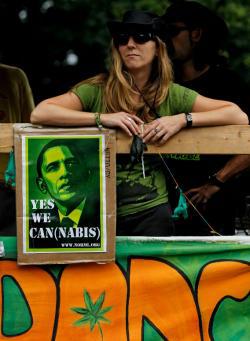
Potheads had high hopes for President Obama’s Google+ hangout on Monday. The Web superpower had invited citizens to submit questions for the president via YouTube, and it encouraged people to vote on the questions they’d like Obama to answer in a live video chat. The results: 18 of the 20 most popular questions were about marijuana policy.
The top vote-getter came from retired LAPD officer Stephen Downing, who said he’s come to see the country’s drug policies as “a failure and a complete waste of criminal justice resources.” Pointing to a recent Gallup poll that showed, for the first time, a majority of Americans in support of marijuana legalization, he asked Obama, “What do you say to this growing voter constituency that wants more changes to drug policy than you’ve delivered in your first term?”
Nothing, as it turned out. The question wasn’t among those selected by Google.
That’s a bummer for the weed lobby but par for the course in Washington, where legalization remains a nonstarter despite fast-growing public support. In 1969, 12 percent of Americans thought pot should be legal. That percentage grew to the mid-20s by the late 1970s, passed 30 percent in 2000, and hit 40 percent in 2009, according to Gallup. A surprising October poll showed support at 50 percent, with just 46 percent against.
While voters have mellowed out, their representatives in Congress haven’t. A legalization bill was introduced in Congress last year for the first time, but few expect it to even come up for a vote. Its sponsors are Barney Frank and Ron Paul, legislators who have built their reputations by taking unpopular stands. Those with something to lose—like, say, an election—still won’t touch the issue. When Obama did field a marijuana question in a YouTube chat last year, he laughed at it. “I don’t know what this says about the online audience,” he chortled. Why won’t the president, or anyone else in Washington, take marijuana policy seriously?
Pro-legalization types see it as a mere matter of time before the government catches up to the rest of the country. “The conventional wisdom for decades has been that this is a dangerous issue,” activist Tom Angell told me. “Behind the scenes people will say, ‘I agree, you’re totally right, we need to change these laws, but I’m afraid to say so.’ For some reason it’s still perceived as a political third rail.”
A primary reason for lawmakers’ reticence is that, for decades, the most visible advocates of looser weed laws have been, well, weed smokers—and what serious politician wants to be associated with a bunch of stoners, man? Earlier this decade, wealthy liberals like George Soros and Peter Lewis (once busted for pot-smoking himself) recognized that problem and shifted the debate to medical marijuana, giving the movement a more sympathetic public face: an ailing grandmother rather than a dreadlocked coach potato. Several states have since passed medical marijuana laws, but they don’t address the bigger issue at play here. It’s recreational users, not glaucoma patients, whose money fuels the illicit drug trade that finances criminal gangs.
That’s why Angell’s group, Law Enforcement Against Prohibition, has taken a different approach. It enlists cops and ex-cops to testify to the societal impacts of the failed drug war, pushing decriminalization and legalization as prudent policy solutions. It’s an appeal to reason, not compassion. Downing, the former LAPD cop who asked the YouTube question, is a LEAP board member. The support his video got, from the public if not from Google, testifies to his message’s broad appeal.
While the tactic seems to be working in some liberal states, it has yet to make pot legalization safe for lawmakers in Washington. Anti-drug leaders see that as evidence that Angell is wrong when he argues that it’s just a matter of time. Asa Hutchinson, the former Arkansas congressman who led the Drug Enforcement Administration under George W. Bush, told me he doesn’t see a big difference in how the debate is playing out in Washington today as compared to 10 years ago.
That may be partly a function of congressional demographics and partly a matter of incentives. Even if 50 percent of the public supports legalization, a pro-pot bill will never pass the Senate if those people are concentrated on the coasts. There’s also the fact that potheads tend to be less likely to vote than senior citizens, who came of age in the pre-hippie era and have never inhaled. If legalization opponents are willing to back up their conviction at the ballot box, there’s a lot of risk and little reward for a congressman to assume the marijuana mantle.
Hutchinson proposed a different explanation for the perceived disconnect between Washington and public opinion: There’s not actually a disconnect.
Asked by a pollster whether they support legalization, Hutchinson says, voters may shrug and say, “Why not?” But ask them just how legalized marijuana should be regulated, how it should be taxed, and whether it should be sold at the corner store in their neighborhood, and they’ll quickly change their tune. That seemed to happen even in liberal California, where a referendum on legalized marijuana failed in 2010 in part because voters worried about the mechanisms for ensuring proper oversight.
There may be something to that. It’s extremely rational to oppose the excesses of the drug war. Harsh sentences for marijuana possession are a big reason that U.S. prisons are teeming with poor, young blacks (who are far more likely to be arrested for marijuana use than middle-class whites). Decriminalizing possession, or at least lightening sentences, seems to be an idea whose time is coming.
But legalizing marijuana? That may still be further than the average American, upon reflection, wants to go. A 2010 study by the nonprofit RAND Corporation suggested that legalizing marijuana in California would send pot prices plummeting and consumption soaring. The impact on the state budget would likely be a net positive, but not enough to make a big dent in the Golden State’s financial crisis.
And for all the efforts of groups like LEAP, there’s still the Cheech and Chong factor. One of the RAND paper’s authors, psychologist and U.C.–Berkeley law professor Robert MacCoun, argued that pot’s place in pop culture makes it hard for even generally supportive people to take the issue seriously. (As a marijuana policy researcher, MacCoun says, he can’t grab a snack at a party without someone joking about the munchies.) That sets marijuana legalization apart from other socially liberal causes, such as gay marriage, with which an impassioned moral appeal can resonate deeply even with those inclined to oppose it.
All that said, it’s clear time is on the smokers’ side. The pre-baby boom generation—the country’s last to grow up believing that marijuana was more likely to cause rape, insanity, and suicide than it was to promote passing out on the couch—won’t be a political factor much longer. Today’s middle-aged voters came of age in the 1970s, when marijuana use was even more common than it is today. Some may harbor reservations about laws that allow their kids and grandkids to follow their lead as tokers, but they’re far less likely than their parents to lump weed in the same category as more destructive drugs like heroin and cocaine. It won’t happen today, and it won’t happen in the next four years. Eventually, though, we’ll have our first weed-legalization president.
