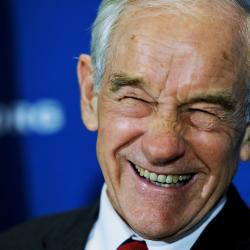
LAS VEGAS—The room seats 315 people, and Ron Paul’s speech is scheduled to start at 12:30 p.m. Wednesday. The room is full at 12:20. There are middle-aged people with Ron Paul gear—vintage 2008 stuff, homemade designs with Paul wearing a surgical mask—and students from the University of Nevada Las Vegas. They keep themselves amused.
“Socialism sucks!” yells one kid wearing a knit cap.
“Ron Paul 2012!” yells another student.
“Rand Paul 2016!” yells an older man cradling a tot.
The show starts on time. Paul’s wife Carol, a petite woman with big blonde hair, walks to a reserved seat and gets immediate cheers of recognition. Peter Tariche, a serious-looking computer programmer who directs Youth for Ron Paul in the Western states, rises for the introduction.
“Only one man has defended liberty and the Constitution,” says Tariche. “History will look back kindly on him, for our generation has the power, the will, and the courage to restore a free society. We, the youth of this campaign, will fuel this movement. We will fix the problems that now face this generation.”
That’s Paul’s cue. He strides onto the stage and begins with this: “A lot has happened the last couple of years.” Thus begins a 35-minute lecture about Austrian economics, Keynesian economics, Randolph Bourne (who coined the idea that “war is the health of the state”), the origins of the housing crisis, and the road to serfdom. He talks up his new plan to cut $1 trillion in 2013, and thereby balance the budget, by scrapping foreign aid and five Cabinet departments, and starting to scale back entitlements. But he’s really much more comfortable on the philosophy.
“The Austrian economists,” says Paul, “the free-market economists who predicted the downfall of the Bretton Woods agreement and the collapse of so much of what has happened over these years, they’ve also made this predictions about an interventionist planned economy of the Keynesian type—that it would eventually lead to this bankruptcy. It would lead to more government, not less. If it didn’t get stopped, it would lead to a fascist type of socialism. Guess what?”
That’s a rhetorical question. Talking to members of the crowd after the speech, I don’t find any voters still shopping around. These are Paul diehards who would chug hemlock before voting for someone else. The difference between them and, say, the Paul diehards who flood other states’ straw polls, or wave signs outside of debates, is that they’re in Nevada. This is a caucus state. This is a place where Ron Paul matters, where Ron Paul’s fans can rattle the GOP.
Four years ago, no one knew what would happen in Nevada’s caucuses. They were sort of an experiment, a way to make a diverse Western state matter. The final Nevada polls predicted that Mitt Romney would win the caucuses narrowly, with about 26 percent of the vote, and that Paul would pull single digits and come in sixth. That didn’t happen. Romney won 51 percent of the vote; Paul came in second.
When the state conventions came up—the caucus vote was non-binding—Paul’s supporters stayed solid, dragging out a floor fight, demanding their delegates. It was a legendary battle locally (I still have DVDs that the Paul fans pressed and distributed afterward), and it would presage what happened in 2009 and 2010, when outsider activists took over their Republican parties in state after state. In Nevada, the activist rebellion ended up producing U.S. Senate candidate Sharron Angle.
Paul’s movement isn’t a surprise anymore. It’s an excuse-in-the-making for Republicans who will end up losing to him. Three months before the caucuses, he has two campaign offices and six full-time staff here. Romney is working the state, too; Herman Cain and Rick Perry have some staff and endorsements. The other candidates don’t really have anything. Last week, Rick Santorum, Newt Gingrich, Michele Bachmann, and Jon Huntsman actually used the state’s decision to move up the caucuses to announce that they’d skip the caucuses. Paul’s fans love, love, love watching the forfeits.
“Come on, who was gonna vote for Huntsman?” scoffs one UNLV senior who’s studying economics. “Oh, ‘I’m not going to compete in Nevada because they moved up the vote.’ That’s like me saying I could play in the NBA, but I don’t want to. Nope. I’m not in the NBA because I’m 5-foot-7-inches.”
The NBA’s not the best metaphor for what’s happening to these caucuses. If it stays a contest of Romney and his Mormon base versus Paul’s merry libertarians, it’s a poker game that no one else can buy into. And Paul’s fans, not used to this feeling, like being on top. When the candidate’s speech ends—no Q&A—he moves back toward the hallway, past the ropeline, ready to sign books and shake hands. Deirdre Heydee, a fan who drove in from California, has brought $80 skateboards with Paul’s face drawn on them.
Paul doesn’t get to shake many hands. The media have rushed over to ask him questions, and a local TV reporter shoves a microphone in his face to grill him on entitlements. “What would you say to people in Nevada,” she asks, “who depend on the programs you’re talking about cutting?”
“Well, I talked about that,” says Paul. “I’m not going to repeat my speech.”
“What would you say, if they depend on those programs?”
“I gave my speech. I can’t repeat my speech.”
Paul avoids a pulsating blob of cameras and heads back to the hallway. A few fans snap at the reporter for asking the question. Carol Paul chastises her, saying she stopped her husband from meeting more of the people who wanted to see him. It’s ironic. Earlier in the day, the Paul campaign had sent out a fundraising e-mail blaming the press for not giving him more coverage. “The media continues their old tricks of propping up their preferred candidates with more airtime,” it says, “while ignoring those who challenge the status quo.”
But hey, maybe defending every little position in a scrum isn’t what Paul is talking about. The bet is that he doesn’t need to. He gives the same basic speech he’s been giving for 30 years; he keeps adding followers; he’s got the money to spread the message. And Nevada, bleak as it is right now, is fertile territory for the message. Unemployment in this state spiked to the mid-teens in 2009, and it’s stayed there. After the speech, I drive over to Paul’s new campaign office in the Vegas suburb of Henderson. It’s one of the only inhabited spaces in a stucco strip mall built for two dozen stores. I walk into the office at the same time that a new Paul supporter is stopping in for a lawn sign.
“People walk past the parking lot and they see the economy,” says Steve Bierfeldt, Paul’s Nevada executive director. “People in Nevada don’t need to be told that unemployment’s a problem, or foreclosures are a problem. They’re living that. He’s talking about it.” And so Paul’s campaign thinks Nevada is actually winnable? “Definitely.”
