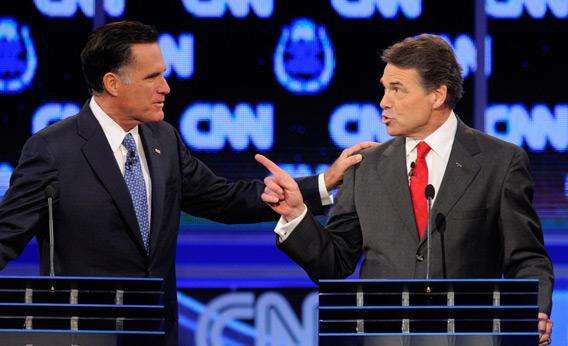
LAS VEGAS—In order to give the CNN Western Republican Presidential Debate a regional flair, the network created a horseshoe logo. The candidates went one better. They turned the debate into a Wild West bar fight. It started with a scuffle over Herman Cain’s 9-9-9 tax plan, then tipped over tables in a skirmish over Mitt Romney’s health care plan in Massachusetts. The candidates talked over each other, their voices escalating. They accused each other of lying. At one testy point, when Romney was lecturing Rick Perry about interrupting, he put his hand on the Texas governor’s shoulder. He was trying to provoke him. Watch it, Mitt—he could be packing.
But after the townsfolk came out from behind the water barrel and the children were allowed to walk the streets again, what had changed? Not much. This was the most entertaining debate of the eight so far. But the shoving and bickering—while a sign that the first contest is less than three months away—probably didn’t change the state of the race: an eventual Romney vs. Perry matchup being interrupted by a Cain interlude.
Cain was at the bottom of the first pile-on. Every candidate said his 9-9-9 plan was a bad idea. It would create a national sales tax, a value-added tax, and would hit the poor disproportionately. Cain said these were all “knee-jerk” reactions and encouraged people to read the plan on his website.
This wasn’t an answer but a dodge. He said the criticisms were a case of mixing apples and oranges. “We are replacing the current tax code with oranges,” he responded at one point. The whole thing threatened to turn into a fruit salad. (What, no pears?) Romney quipped that because the Cain national sales tax would be added to existing state sales taxes, “I’m going to be getting a bushel basket that has apples and oranges in it because I’ve got to pay both taxes.”
Cain’s answers about his plan should be graded on a curve of his own ambition. Maybe if he were offering a garden-variety economic plan, he could get away with answers no sharper than a throw pillow. But he is talking about a wholesale reform of one of the most contentious and complicated portions of the federal experience at a time when government has never been more sclerotic. He’s also promising to do it in 90 days, which is faster than Ronald Reagan passed his tax breaks in 1981. (Oh, he’s also going to balance the budget in a year.)
It’s great to be ambitious. But this is like turning around Godfather’s Pizza by promising the pies will make themselves. Cain says he’ll be able to pull all of this off because he’ll have the support of the people. But not everyone is convinced. The National Review, Newt Gingrich, and The Tax Policy Center aren’t nuts, at least not always. Sure, Cain can continue to push his plan. But if he can’t do a better job explaining and selling it, he might as well just give in to the notion of a fantasy campaign and promise he’ll ride a unicorn in his inaugural parade.
None of this may diminish Cain’s support, because intensity of support is not necessarily tied to strength of his answers. He didn’t do that well defending his plan at the last debate either, and yet his standing improved. He is the most likable of all the Republican candidates, according to a recent CNN poll. The Gallup poll shows that Republican voters have the most intensely positive view of him—and it’s growing. When Cain repeated that he thought the Occupy Wall Street protesters had only themselves to blame, the audience erupted. That sound bite probably did him as much good as his insufficient answers on his tax plan hurt him.
Cain also benefited from not being Romney, Rick Santorum, or Perry. Those three were contentious throughout the evening, trading personal attacks and crying foul. At first the attacks on Romney were a group affair. Several took a turn kicking his health care plan. Romney defended it as ably as he has all year. Gingrich gave him a partial assist by saying it was unfair to compare it to Obama’s health care plan, then went on to say that Romney had imposed a “bureaucratic, high-cost system” on his state. Romney shot back that his plan included an individual mandate that Gingrich had once supported.
Romney does his homework. He always had a negative fact to throw back at Perry when the Texas governor went after him. Attacked on his record creating jobs in Massachusetts, he charged that many of the new jobs created in Texas went to illegal immigrants. He also attacked in real time. When Perry interrupted him, Romney suggested that if he wanted to be president he’d need to allow others to talk. “This has been a tough couple of debates for Rick,” said Romney at another point. Perry’s jaw clenched so tight that if he’d had a piece of coal in there, it’d now be a diamond.
Perry had drunk his Red Bull. His first utterance was that he was not a “conservative of convenience,” which was a veiled shot at Romney. Romney “is a very slick guy,” said Perry’s communications director, Ray Sullivan. “That slickness includes the ability to change positions on a dime.” This is the same point Obama strategist David Axelrod has been making lately. The message was repeated in the press releases from the Perry campaign: “Romney Is a Fraud on Immigration,” read one.
Perry took just about every available opportunity to attack Romney on everything from his economic record as governor to immigration—sometimes both at the same time. He answered one question about health care in Texas by attacking Romney’s hiring of illegal aliens, which was a bit head-snapping. “It’s time for you to tell the truth,” said Perry about Romney’s use of a firm that hired illegal aliens. Going after Romney on immigration is a double win for Perry: It helps weaken Romney and helps clean up Perry’s problem with conservatives who don’t like his in-state-tuition-for-children-of-illegal-immigrants policy.
Perry wasn’t just attacking. As if taking a page out of Romney’s playbook, Perry avoided some chances to attack and used questions as opportunities to promote his record in Texas and his energy policies. He looked like a candidate who wanted the prize.
While Perry was competing for Most Improved, the award for Most Immature goes to Rick Santorum, who otherwise had some forceful moments defending the family unit, a winning position for conservatives. At one point Santorum nearly stomped his feet like a toddler in a sustained interruption of Romney. When Romney climbed out from under the fusillade, Santorum complained that Romney had run out of time—time that Santorum himself had taken up with his tantrum.
In the passion primary, the candidates’ contest to show voters that they care deeply about improving the economy, Perry flirted with being a bit overheated. The audience booed him when he continued to return to the issue of Romney’s hiring of illegal immigrants. Romney, meanwhile, gave it right back to his accusers, showing evidence of being an actual human being. That’s one way to see it. For others it might look like Romney was a little shrill and rattled as he lectured Perry.
How can you tell an experienced candidate? In the middle of the fracas over immigration, Romney stepped back to say that the reason everyone onstage was so passionate about illegal immigration was because they were passionate about legal immigration. Nevada’s voting population is 26 percent Latino, and Romney had his eye on that. In the one slip-up of his trademark technical precision, Romney said that he fired the lawn-mowing firm using illegal aliens. “You can’t have any illegals working on our property,” he said he’d told them. “I’m running for office, for Pete’s sake.” This won’t diminish the charge that he is more calculating than principled.
There have been eight debates. There will be 12 more. To invest each one with drama, the networks hosting them have to boast about how grave the stakes are. The hyperbole escalates to the point where it seems like the candidates might take a swing at each other. At moments during Tuesday’s debate, for the first time this year, the pre-debate hyperbole actually seemed plausible.
