Congratulations, libertarians! August 2010 was the month when you joined an exclusive club: people accused of shilling for amoral and scary billionaires.
It really shouldn’t have been a new or bracing experience for you. People have been mocking libertarians for years. This month, though, you got it from both barrels of what Andrew Breitbart likes to call the Democrat-Media Complex. On Aug. 9, President Obama spoke at a fundraiser in Texas and warned Democrats of “groups with harmless-sounding names like Americans for Prosperity” with shadowy funding sources and the power to distort elections. “You don’t know if it’s a foreign-controlled corporation,” said Obama. “You don’t know if it’s a big oil company, or a big bank.” Just two weeks later, The New Yorker published a 10,000 word profile of David and Charles Koch, the billionaires who have poured profits from their oil, chemical, and manufacturing companies into a network of libertarian think tanks and activist groups—such as, for example, Americans for Prosperity.
Again, nothing truly new there. But the reaction was angrier than a John Galt speech. AFP President Tim Phillips accused the president of “making shrill, desperate attacks on Americans for Prosperity and our 1,200,000 AFP grassroots activists across the nation.” Reason magazine, where I worked from 2006 to 2008 (and for which I am still a contributing editor), responded with multiple blog posts attacking the New Yorker profile. “The story is a masterpiece not of the tightly researched and argued journalism for which The New Yorker is revered,” writes Reason.com and Reason.tv Editor-in-Chief Nick Gillespie, “but of sly innuendo and revelations as lame as they are breathless.”
Gillespie does a fine job of picking apart the New Yorker article. It also includes this disclosure: “David Koch has been on the board of trustees of Reason Foundation, the publisher of this website, for decades, and his name appears in the masthead of Reason magazine; I have also taught at various programs for the Institute for Humane Studies, which the Kochs fund, and will speak at an Americans for Prosperity event later this week.” That’s exactly what the enemies of Koch want to hear—proof that the brothers are members of the illuminati, cackling as their influence spreads across the political landscape.
Libertarians had better get used to this. The Kochs are now in the pantheon of Evil Rich Benefactors, exposed for everything they fund and accused of funding everything their opponents don’t like. (FreedomWorks, which exists because it wanted to break away from Koch and AFP, is constantly and wrongly accused of taking Koch money.) And that means that the response so far—lots of shock and denial and dismissal and some griping about personal attacks—won’t really work. The Kochs’ defenders should look at other cases in which well-meaning billionaires became Emmanuel Goldsteins and adjust their strategies accordingly.
Exhibit A: Richard Mellon Scaife. In the early 1970s, the Pittsburgh tycoon and conservative activist realized that his aid to the Republican Party didn’t mean much if liberals controlled academia, the media, and Washington think tanks. He was merely the wealthiest of many donors who started pouring serious money into organizations like the Heritage Foundation. It wasn’t until 1986 that journalists fully realized the power of what Scaife was doing, and it wasn’t until the 1990s that Scaife himself was really demonized. The reason? He was putting millions of dollars into the American Spectator and other media outlets that obsessed over the sexual life of Bill Clinton.
The Democrats went to war, much more aggressively than Obama has so far against the Kochs, starting with an (in)famous document, brandished by then First Lady Hillary Clinton on The TodayShow in 1998, detailing the “vast right wing conspiracy.” Scaife didn’t handle it especially well. His media strategy was simple: say nothing. Reporters thus filled in the blanks around him. Neither he nor his beneficiaries liked what those blanks were filled with, and “Scaife money” became a byword for “part of a conservative conspiracy.”
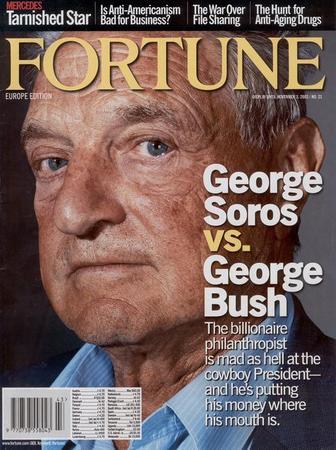
Exhibit B: George Soros. Until 2003, Soros was best-known as a well-meaning hedge-fund manager who funded democracy efforts in the former Soviet Union. Then he announced that defeating President George W. Bush was a “matter of life and death” and donated $18 million to such projects as MoveOn.org and the Center for American Progress—big liberal projects that had been launched to battle, ironically, the projects that Scaife had funded. In no time at all, he became a left-wing boogeyman, inspiring follow-the-bouncing-dollars investigations from conservatives and watching his biography get twisted into something resembling an Erich von Stroheim character. One sample from the biography posted at communist-turned-conservative David Horowitz’s “Discover the Networks” project: “While hundreds of thousands of Hungarian Jews were being transported to death camps, George Soros accompanied his make-believe godfather on his appointed rounds, confiscating property from the Jews.”
Soros took Scaife’s script and flipped it. Instead of hiding, he wrote a book and embarked on a speaking tour right before the 2004 election. That was just what conservatives hoped he’d do, because they’d spent a year calling him the “Daddy Warbucks of the Democratic Party” and because his voice bore a striking resemblance to Bela Lugosi’s. (Conveniently, in the Age of Drudge, close-ups of Soros made him look like a madman.) And so six years later, Soros remains so infamous that conservatives still use him in their attempts to discredit liberal projects regardless of whether he gave them any money.
What should the Kochs and their benefactors take from all this? Maybe they can split the difference between Scaife and Soros. While TheNew Yorker may have oversold how secretive the Kochs are, it also notes that “the Kochs and their political operatives declined requests for interviews.” It also doesn’t help that when the Kochs are referred to as sponsors of the Tea Party movement, their press shop pushes out denials. Koch’s beneficiaries deny that they have any strings and accuse Koch foes of distraction and personal destruction.
Sure, that’s what it is. And it’s going to keep happening because the Koch strategy is working. Toss a hunk of Rearden metal at a D.C. libertarian organization or scholar and you’ll hit something connected to the Kochs. The brothers fund successful internships and fellowships via the Koch Associate Program, and every summer, dozens of budding libertarians in Washington work for think tanks before coming home to a group house nicknamed “Kochwood.” Koch interns are placed (often, not always) at Reason, Cato, the Competitive Enterprise Institute, and other libertarian organizations while attending classes on media and economics. What’s so sinister about this? Nothing—at least until the Tea Party started winning, and then liberals started getting very annoyed.
So pre-empt the coming exposes. Libertarians: Embrace the Kochs! Kochs: Embrace the Tea Parties! You are, Kochs and libertarians alike, among the few activists who should feel no need whatsoever to apologize for wealth and success. AFP’s Tim Phillips put it well when I asked him about this on Friday, responding to the New Yorker article by praising Soros: “This is America!” said Phillips. “God bless him! He made his money, and let him go out and try and spend it to see his vision of America fulfilled.”
That’s the way to do it. It’s not about Astroturf. It’s about the free market.