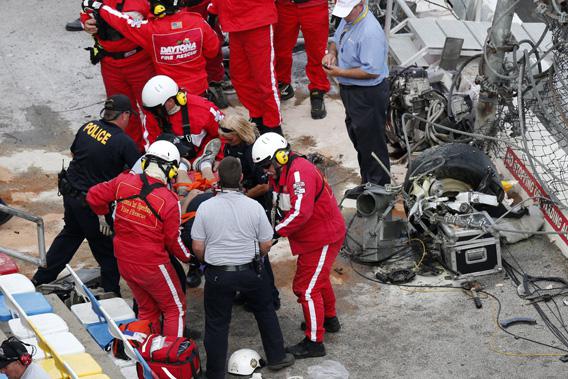
Baseballs, shattered bats, hockey pucks, basketballs, auto parts—there’s no end to the objects that can slam into hapless spectators at sporting events. A bunch of NASCAR fans found that out last week when they were hurt by flying debris at the Daytona International Speedway. Are such injuries a natural risk of fandom, or should the fans expect a big payoff?
That’s what Matt Morgan aims to find out. Morgan is the attorney for three of the gored spectators, one of whom suffered a shattered fibula. If he can’t settle the case, he’ll probably bring a lawsuit. In addition to NASCAR, defendants might include the owner of the speedway (described here as a “NASCAR sister company”) and the manufacturer of the safety fence that failed to ensure the fans’ safety.
So, would such a suit be successful? And should it be successful?
On first blush, it doesn’t look good for the plaintiffs. Much of the relevant law in the area of “spectators hit by flying stuff” owes a debt to baseball, where the unimaginatively named “baseball rule” generally prohibits fans struck by batted balls or errant bats from recovering damages against stadium owners and operators. Although there are variations on this rule, it’s been followed by many courts for years, and has been extended (often not by name) to some of the other flying objects mentioned above. And some states have even passed laws to make sure judges don’t change their minds.
There’s another problem for those injured. Sports tickets contain—often in absurdly tiny print—disclaimers against liability. They also state that, by entering the stadium, fans assume the risk of being hit by such objects. As the great common law judge Benjamin Cardozo once said, “The timorous may stay at home.” (Cardozo was talking about a case involving an amusement park ride, the Flopper, which flopped the plaintiff.)
These are high hurdles for potential litigants, but they can sometimes be cleared. First, the baseball rule isn’t always as firm as it first appears. Generally, the stadium must provide protective netting for the most dangerous places—behind home plate, for a start, where high-speed balls are likeliest to cause serious injury. Sometimes courts additionally state that the stadium must provide protective netting for as many fans as can reasonably be expected to want it. (If you have no idea how that question could be answered, you’re not alone.)
Second, even where the ball strikes someone far away from an area that’s “supposed” to be netted, victory for the defendants isn’t certain, at least in some states. A Colorado statute first protects stadium owners from these batted-ball claims, but then adds this exception: Owners can be liable for failing to take reasonable steps to “design, alter, and maintain the premises of the stadium in reasonably safe condition relative to the nature of the game of baseball.”
Although it’s hard to know, perhaps what the legislators had in mind here was a situation like that of the plaintiff in the recent case of Rountree v. Boise Baseball, LLC. There, the Idaho Supreme Court parted with its sister state courts in refusing to adopt the baseball rule.
While attending a Boise Hawks minor-league game, Bud Rountree stopped off at the Hawks Nest restaurant and then went to chat with a friend in the adjacent Executive Club lounge at the end of the third-base line. Rountree responded to the roar of the crowd by turning toward the field. His timing couldn’t have been worse—the ball that was causing all the commotion struck him, putting out one eye.
Like most paying customers at a sporting event, Rountree had been issued a ticket that informed him specifically of the risk of being struck by a batted ball. But in a unanimous decision, the Idaho Supreme Court refused to dismiss his claim. The justices said that without evidence as to the “prevalence of foul ball injuries in general” and “how varying stadium designs might prevent them,” it didn’t make sense to bar all claims through adopting a blanket rule.
The court thus showed how the exception in the Colorado rule might be applied, perhaps especially in cases where the injury occurs not in the stands but in the multipurpose areas that make up an increasingly important part of the spectator experience these days. Many a relieved parent can attest to the whine-preventing capabilities of newer stadiums’ playgrounds and food concourses. But the Idaho court saw that they’re also potential injury zones, with those inhabiting them paying scant attention to the nominal purpose of attendance—the actual ballgame.
There remained the assumption of risk defense, but the Idaho court rejected that, too. Idaho is in good company here, as many courts disfavor these kinds of disclaimers, finding them to be against public policy when they’re just written on the back of a ticket and not called to the customer’s attention. The law of Florida—which is where the NASCAR litigation would likely be conducted—isn’t entirely clear, but it seems that these boilerplate clauses (which appear to have been used on the tickets at Daytona) aren’t favored there, either.
Removing the assumption of risk argument would leave the Florida courts to decide whether some variation of the baseball rule should apply to auto racing. If so, the speedway could simply say: “Hey, we supplied a fence!” The problem, of course, is that the fence wasn’t effective at keeping the people behind it from injury. In fact, the presence of the fence could strengthen the plaintiffs’ cases: They can claim that they reasonably relied on the fences to keep them safe. And that same argument applies to the claim against the manufacturer of the fence: It wasn’t as safe as it needed to be.
Prospects may be improving for spectators injured by the flying tools of a sport’s trade. Hockey fans sometimes win when they’re injured by hurtling pucks, especially if they are seated in an area that’s unprotected by netting or Plexiglas. In cases involving spectators hit by balls at pro golf events, courts have found liability proper where the owners of the course (or tournament) didn’t take steps to minimize the risk. And now the baseball rule has struck out, at least in Idaho.
None of these protections for stadium owners make much sense anyway. Some state legislatures have found that the baseball rule is a way to support the “wholesome, family” activity of baseball, but that’s just an Orwellian way of saying the lawmakers want to insulate stadium owners from the costs their activities impose. I’m reminded of one of the great chestnuts from first-year torts class, the English case of Stone v. Bolton. Bessie Stone was struck and injured by a cricket ball flying out of the defendant’s stadium. Even though balls had left the stadium before, the House of Lords decided that the owners had not acted unreasonably, and therefore were not liable to poor Bessie. The ensuing outcry showed that the public understood what the court didn’t: The injury was a cost of doing business for which the stadium owners should have been accountable. (And, some added, the judges liked cricket too much.) Then the defendants did the right thing—they paid Bessie’s damages, anyway.
Daytona Speedway and baseball stadium owners should do likewise and pay the injured fans. Otherwise, these no-liability rules end up pinning the full cost of injury on the poor sap who got clocked. That’s both unfair and unnecessary. Better for the owners to spread the costs of harm by passing them along to all the paying customers, so each pays just a little. Only then will the price take into account what the sport really costs.
The owners of the Daytona International Speedway, then, shouldn’t be able to take refuge behind a no-liability fence. Settlement is the way to go here, with a lawsuit waiting for those stadium owners who don’t do the right thing.
