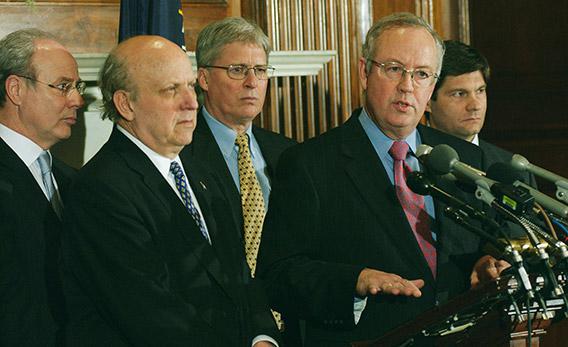
The conservative lawyer James Bopp Jr. has done as much as anyone to clear the way for the flood of money pouring into this year’s election. As James Bennet tells us in his excellent Atlantic piece, Bopp is the legal mind behind the Supreme Court’s Citizens United decision and another influential 2007 ruling, which together helped weaken disclosure requirements for political giving and ushered in the unlimited corporate and union donations of the Super PAC era.
Here’s a riff on Bopp that Bennet didn’t touch on: his unusual relationship with the James Madison Center for Free Speech, a nonprofit organization he co-founded in 1997. As a charity, the organization doesn’t really exist, outside of a few tax records in an IRS file cabinet. In reality, Bopp is the Madison Center, and vice versa, and for more than 15 years, the Indiana-based charity has helped fund Bopp’s influential litigation by channeling tax-exempt, mostly anonymous donations to his for-profit law firm.
The Madison Center shares characteristics with the ostensibly nonpolitical “social welfare” groups that are spending millions in undisclosed donations on ads in the 2012 election—which they’re free to do as a direct result of Bopp’s legal strategy. The man who has done the most to cloud disclosure laws is himself running an operation that’s partly in the shadows. The Center shares an address and telephone number with Bopp’s own law offices in Indiana, and has no paid staff or facilities of its own, according to the group’s public filings. Even the Center’s website is registered to the firm’s address. Officially, Bopp is just an employee at the Center, though he draws no salary, and his firm is classified on the group’s IRS records as an independent contractor. But he largely controls the Center’s activities, and virtually every dollar it collects, including hundreds of thousands from anonymous donors, is passed on to Bopp’s firm.
The arrangement stands out in the world of legal advocacy groups, tax experts told me, and raises questions about compliance with the IRS rules governing charitable organizations. “The relationship between this organization and Bopp’s law firm is such that there really is no charity,” said Marcus Owens, formerly a top official at the IRS responsible for overseeing tax-exempt groups. “I’ve never heard of this sort of captive charity/foundation funding of a particular law firm before.”
When I spoke with him in September, Bopp said he founded the Madison Center partly to serve as a right-leaning counterweight to the American Civil Liberties Union, the main group doing campaign finance work in the late 1990s. “I was trying to involve more people on the conservative side to be concerned about and fighting for campaign finance reform issues,” Bopp said. “At that point the ACLU was the most active in testifying and bringing lawsuits on campaign finance.” The Center, he said, has “accomplished its purpose.”
Like the ACLU or the NAACP, the Madison Center provides free legal services to under-funded clients to help advance a cause. But the center functions very differently from those other groups, and from most nonprofit organizations. Between 2005 and 2010, the only years for which records are publicly available, nearly 100 percent of the funds that flowed through the group, a total of $2.6 million, ultimately ended up in the coffers of Bopp’s own law firm. Of the slightly more than $185,000 the group collected from donors in 2010, for example, more than $183,000 went to Bopp’s firm.
While it’s not unusual for nonprofits to consistently work with one independent contractor, as Bopp’s firm is classified in the group’s tax filings, Owens and other experts said that it’s well outside the norm for all of a nonprofit’s funding to accrue to one company—and that the arrangement raises questions about IRS rules governing “private benefit.” Since it’s almost impossible to determine where the purportedly independent Madison Center ends and Bopp’s law firm begins, the extraordinary overlap might suggest that a primary purpose of Bopp’s organization is to fund Bopp’s private, for-profit law firm. Bopp denied this. “From my perspective,” he wrote in an email, “the Madison Center is the biggest beneficiary of our relationship, because of the millions of dollars of pro bono services that I have provided it.”
Beth Kingsley, a Washington attorney and nonprofit tax law expert with the firm Harmon, Curran, Spielberg and Eisenberg, explained that Bopp and his firm are a logical place to go for free speech defense, and it’s easy to see why the Center would hire him. But the IRS takes special note of nonprofit organizations that direct a large proportion of their funds to one business. “The IRS typically denies tax-exempt status to organizations that seem to exist solely for the purpose of funneling business to a single firm,” Kinsley said.
To understand the potential problem, it’s helpful to look at the Campaign Legal Center, which is linked to attorney Trevor Potter, whom Bennet describes as Bopp’s ideological rival. (Note: Both Potter and Marcus Owens work at the Washington, D.C., firm Caplin and Drysdale.) The Campaign Legal Center has the more familiar trappings of a typical nonprofit; it employs at least five paid staffers aside from Potter, maintains significant financial reserves year-to-year, and occupies offices distinct from Potter’s own. And while Potter litigates for the group and serves as its “general counsel,” the same position Bopp nominally holds with the Madison Center, tax records show Potter receiving a fixed salary from year to year. The sum paid to Bopp’s firm, by contrast, balloons and contracts in proportion to the revenue the Madison Center receives.
The professionals I spoke with said this pattern suggests the funds might simply be passed through as a matter of course. My review of the records of another analogous group, the conservative Center for Individual Rights, also shows independence in contractors and facilities, in sharp contrast to Bopp’s group.
Even more unusual is that Bopp appears to run the Center almost single-handedly, without significant oversight from a governing board. Since Bopp is an employee of the center, theoretically he shouldn’t direct the group on his own. But he told me that he himself manages daily operations and selects which cases are taken on for litigation. The board of directors doesn’t meet regularly; Bopp said he couldn’t remember the last time they did. And when I contacted Wanda Franz, listed on IRS records as the Center’s president every year between 2005 and 2010, the years with records available, she seemed surprised to be holding the position. “I’m a trustee,” she corrected. “I’m not the president. Where are you getting your information from?”
Kingsley said that while nonprofit governing boards don’t micromanage, the IRS does require them to guide major decisions. Since litigation is essentially the only activity the Center engages in, she found it surprising that the Board wouldn’t play an active role in selecting the cases it pursues. “I question whether there’s any real governance going on,” Kingsley said.
Bopp said the Madison Center’s board of directors had “delegated” management activities to him, because he has the most expertise in legal matters. He also said he’s free to pursue litigation on his own if the Center has the available funds. In an email to me, Bopp denied that the arrangement between his firm and the Center was out of the ordinary for small charities, and called the suggestion that his firm might be in violation of IRS rules “contrived.” While his firm performs a great deal of work for the Madison Center, handling “management, bookkeeping, filing IRS returns,” and legal services, Bopp said most of it is done at reduced rates or even for free. Bopp also pointed out that performing pro bono litigation is within the definition of a charitable activity.
The experts I spoke with said that even so, the Center could still be in violation of private benefit regulations. An individual can only receive an “incidental” benefit from a charitable organization; when all, or nearly all, of a group’s funds end up in one company’s coffers, it’s harder to argue the benefit is incidental. It’s a matter of degree, they said.
Bopp is by all accounts a talented lawyer, and as Richard Briffault, a professor at Columbia Law School, pointed out when we spoke, there’s no shortage of funding for attorneys looking to weaken campaign finance regulation. Without the Center’s help, Bopp likely wouldn’t have to go begging for finances; the arrangement just makes things easier. The center’s status as a 501(c)3 means that the group’s donors can deduct their contribution from their taxes, a benefit that could presumably convince benefactors to pry open their wallets. Nonprofit status also allows the Center to receive money from private foundations, which usually prohibit grant awards to entities not classified as charities by the IRS. According to the Foundation Center, a group that tracks charitable giving, at least three private foundations made grants to the Madison Center between 2003 and 2007, for a total of $125,000. Each of those foundations requires grant recipients to have 501(c)3 status.
And as Kingsley and all of the experts I spoke with pointed out, Bopp’s relationship with the Madison Center, convoluted as it is, might still pass muster under an IRS audit. Determining excessive private benefit can be a “squishy” endeavor, as Kingsley put it. And anyway, the IRS isn’t set up to go after what are ultimately small groups, even if they are violating the rules. Auditors are few and the potential payoff in fines and restitution doesn’t make nonprofits an attractive target.
In some ways the Madison Center operates like a public interest law firm, but there are important differences. Most public interest firms are for-profit ventures, and therefore can’t accept tax-deductible donations; they make their money from attorney fee awards when their cases are successful. About 60 percent of reported Madison Center funds, on average, do come from such awards. But it’s only recently that courts have embraced Bopp’s view of the law, and he ends up losing plenty of cases. Without the Madison Center underwriting those losses—through tax-deductible, mostly anonymous donations—Bopp’s firm might go broke litigating the losers.
OK, so it’s obvious, to anyone who looks under the hood, that there is little, if any, meaningful distinction between Bopp and the Madison Center, and that there’s something odd about the whole setup. But of course, these gray areas are Bopp’s bread and butter. If his relationship with the Center breaks the IRS rules at the moment, no one is more qualified to change that than Bopp himself.
