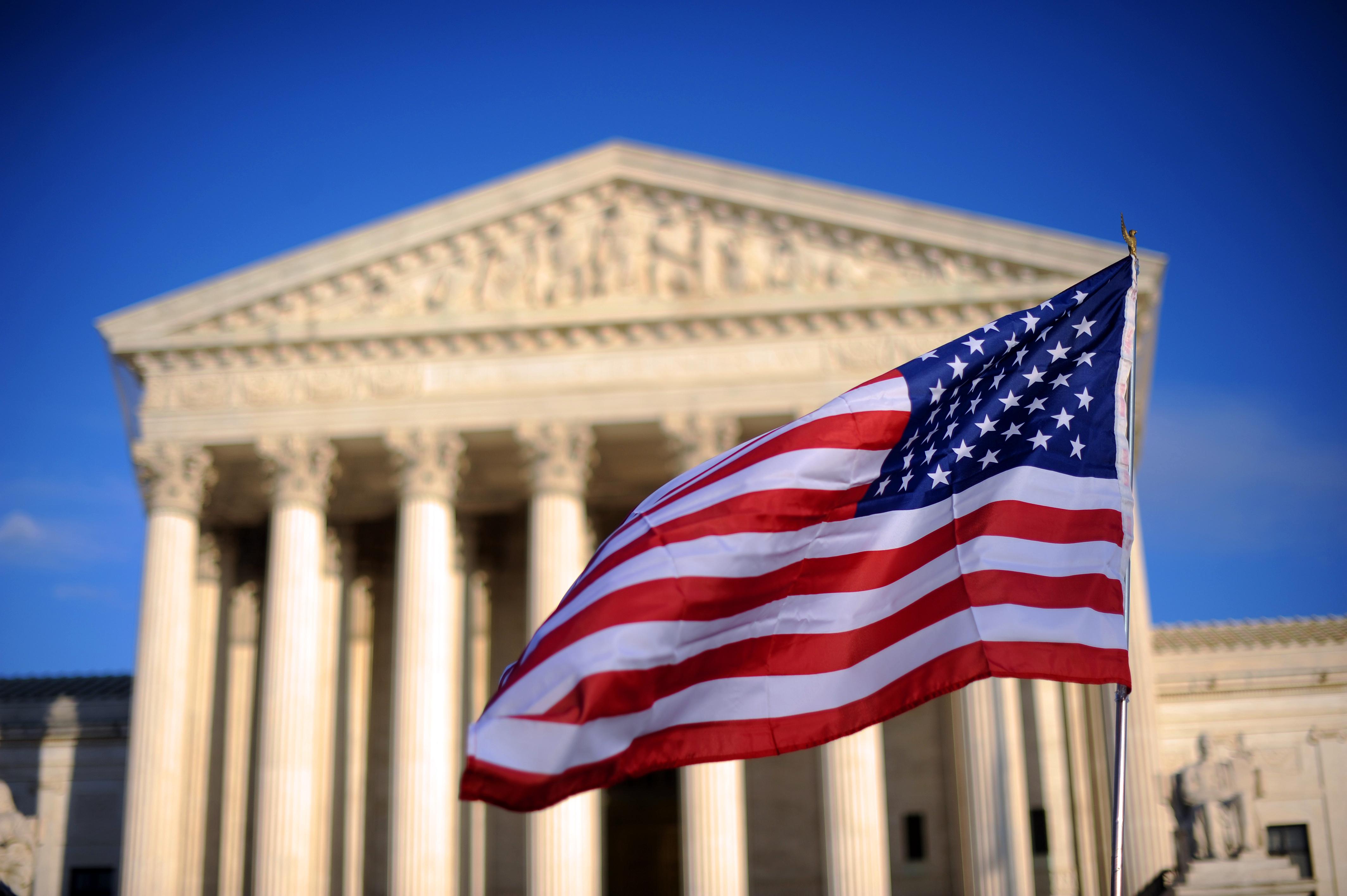
The Supreme Court agreed Monday to hear a challenge to the Affordable Care Act, which means a five-and-a-half-hour oral argument before the court this spring, with a ruling likely by the end of June. It’s hardly surprising that the court agreed to hear this case: There was a deep split of opinion between several federal appellate courts, 26 states say they hate this law, and the Obama administration wanted the court to hear it quickly. The surprise is which issues the court has asked each side to address, and for how long. By this measure, the court’s announcement is precisely 64 percent expected, 18 percent unexpected, and 18 percent astounding.
The health care law, signed by President Obama in March 2010, extended insurance coverage to more than 30 million Americans, in part by requiring citizens to purchase health insurance by 2014 or face a tax penalty. That “individual mandate” provision was the one that launched a thousand Tea Parties, and it’s the issue to which most constitutional scrutiny has been devoted: Can the government, under the Constitution’s Commerce Clause, regulate “inactivity” (i.e., the decision not to purchase health insurance), and by what principle can we limit such unspeakable powers (i.e., how far can it go in forcing citizens to eat broccoli)?
The court will hear arguments on that issue for two hours. It will also entertain 90 minutes of argument on the mandate’s “severability”—that is, whether the entire law collapses if the individual mandate provision is deemed unconstitutional. (The 11th Circuit Court of Appeals, even as it struck down the mandate, believed that the law itself would stand.)
So that’s three-and-a-half hours of debate. What are they going to argue about for the remaining two hours? That’s where it gets interesting.
The court asked the parties to brief and argue for an hour whether the lawsuit brought by the states challenging the insurance mandate is barred by the 19th century Anti-Injunction Act. That’s a law that precludes claimants from asking for a refund on a tax until the tax has been collected and paid. If the court were to determine that this law applies in this case, then the courts wouldn’t have jurisdiction to even consider the challenges until 2015, when the tax-penalty provision goes into effect. This argument was advanced in the 4th Circuit decision upholding the ACA and made with even more force by Judge Brett Kavanaugh in the District of Columbia Circuit Court of Appeals when it upheld the ACA last week. In a 65-page dissent, Kavanaugh writes: “For judges, there is a natural and understandable inclination to decide these weighty and historic constitutional questions. But in my respectful judgment, deciding the constitutional issues in this case at this time would contravene … the Anti- Injunction Act.”
Cautioning that courts of appeals should be wary of upholding such a dramatic law, Kavanaugh goes on to warn the courts against “prematurely or unnecessarily rejecting the Government’s Commerce Clause argument.” This is because striking down a major law should be done only rarely, he writes, and also because “we may be on the leading edge of a shift in how the Federal Government goes about furnishing a social safety net for those who are old, poor, sick, or disabled and need help.” He concludes: “Privatized social services combined with mandatory-purchase requirements of the kind employed in the individual mandate provision of the Affordable Care Act might become a blueprint used by the Federal Government over the next generation to partially privatize the social safety net and government assistance programs and move, at least to some degree, away from the tax-and-government-benefit model that is common now.” The fact that the court asked for extra briefing on the jurisdictional issue may signal that some of the court’s conservatives are contemplating Kavanaugh’s advice about leaving this matter to the political branches to resolve, or at least kicking it down the road until after the election.
That, in turn, could be good news for those who contend that Americans may learn to love health reform, or for those who contend that some justices would be swayed by opinion polls in the first instance. It may also be a good solution for a court that doesn’t really care to be Public Issue No. 1 in an election year.
That brings us to what was, even for observers who have closely tracked these lawsuits, the real surprise today. The court also agreed to hear a fourth issue, also for an hour: the claim of the 26 Republican state officials that the ACA’s expansion of Medicaid coverage should be struck down, on the ground that it unconstitutionally “coerces” state governments. Potentially, the court’s disposition of this issue could cripple the federal government’s capacity to promote national policy goals more gravely than even a decision to overturn the ACA individual mandate, and thereby limit congressional authority to regulate interstate commerce.
The ACA prescribes that, beginning in 2014, Medicaid (which is administered by the states with a combination of federal and state funds) will cover all adults with incomes up to 133 percent of the federal poverty line. Currently, state Medicaid programs are required only to cover children and their parents or caretakers, adults with disabilities, and poor individuals over 65. The ACA itself doesn’t force the states to accept this incremental financial and administrative responsibility: They retain the option, available since Medicaid was first enacted in 1965, of refusing participation in the program, the funds that go along with it, and the conditions that go along with the funds.
But this option, the 26 Republican governors and attorneys general claim, is a choice in name only—“more rhetoric than fact.” Medicaid ensures access to medical care for millions of their needy citizens, they argue—a vast political constituency that state governments cannot realistically abandon. On the other hand, because Medicaid accounts on average for 20 percent of state budgets, they claim that states could not replace the federal Medicaid contribution, which varies from 50 percent to 80 percent depending on income levels in individual states, without cutting into other vital state priorities.
That’s the argument, in a nutshell: The Medicaid expansion is too good a deal for the states to turn down.
Not one of the lower court judges who considered the Republican officials’ argument bought it. Three of these judges voted to overturn the individual mandate provision. Yet they all rejected the states’ Medicaid quandary as, in Judge Roger Vinson’s words, a “hard political choice” altogether voluntary in constitutional terms. Moreover, no federal court has ever upheld a state government’s claim that it was unconstitutionally coerced into accepting strings attached to federal funds.
That the Supreme Court agreed to review an argument that received such short shrift from all of the lower federal courts should not be as surprising as it may seem. The justices may simply have decided that the court owes the 26 complaining states the courtesy of hearing them out. On the other hand, there may be more behind the court’s grant of the petition to review the states’ Medicaid claim. For some time, there has been among legal conservatives—expressed on occasion by some members of the Supreme Court—an undercurrent of resentment that, in the words of libertarian scholar Lynn Baker, “The biggest threat to state autonomy is, and has long been, Congress’ spending power.” The “spending power,” conferred by the constitutional clause empowering Congress to “lay and collect … taxes to pay the debts and provide for the … General Welfare of the United States,” has long been construed to authorize congressional spending for any purpose that serves the nation’s “general welfare” and to impose conditions on recipients.
If a majority of the court now leans toward imposing new curbs on Congress’ spending (as opposed to the much-maligned Commerce Clause) power, that could portend changes far more radical than limits on Congress’ regulatory authority to impose the individual mandate. The states’ attack on the ACA’s Medicaid expansion provisions would cripple Medicaid as well as other state-administered programs that are federally funded and supervised. Also vulnerable could be antidiscrimination guarantees prescribed by conditional funding programs such as Title VI of the Civil Rights Act and Title IX of the Education Amendments of 1972, the Age Discrimination Act, the Rehabilitation Act (banning discrimination against people with disabilities) and the Individuals With Disabilities Education Act.
If the Medicaid expansion were to be called into doubt, major environmental programs that set federal standards but delegate implementation responsibility to the states could wobble as well. Legal challenges and intensified political and bureaucratic resistance to all such programs would become the norm if state governments could get into court to challenge federal conditional funding offers on the ground that they are politically constrained even if voluntary on paper.
So could myriad other requirements, not all of a progressive nature—such as the requirement, upheld in 2006 by a 9-0 Supreme Court decision, that universities receiving federal funds afford military recruiters access to school facilities equal to that provided to other recruiters. The Republican states’ “coercion” theory could make all such guarantees unenforceable.
While such possibilities need to be seriously addressed by the Obama administration and its allies, it is by no means clear that the Supreme Court’s conservative bloc is inclined to grant the Republican states’ Medicaid expansion argument. For one thing, the states’ claim of unbearable financial damage is weak on the facts. The ACA provides that the federal government will pick up, through 2016, 100 percent of the costs of covering the new beneficiaries for which it prescribes Medicaid protection, a percentage which is gradually lowered until 2020, after which it is set permanently at 90 percent. More broadly, there are strong reasons to doubt that Chief Justice John Roberts and his colleagues will be eager to drive the judiciary, and the rest of the government, into the political morass of deciding all the messy, intractable controversies that will inevitably follow a ruling in the Republican states’ favor.
But even if the court rejects the Republican states’ Medicaid claim, the Supreme Court’s decision in this case will likely make new law on the boundaries of federal financial leverage over states—and, potentially, private recipients of federal dollars. This is a conversation we have not been having in the national dispute over states’ rights and broccoli. The ripple effects could be as unforeseeable as they will be consequential.

