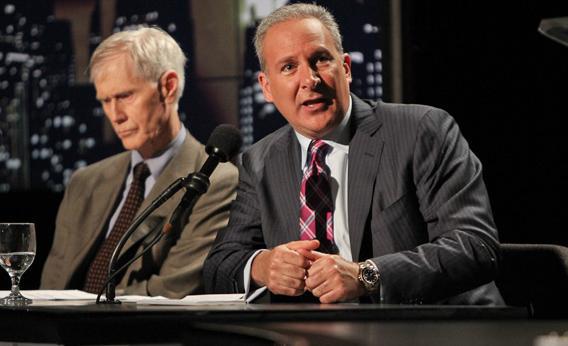
About three-fourths of the way through Tuesday’s Slate/Intelligence Squared Oxford-style debate on whether China does capitalism better than America, one audience member stood up to request a clarification of terms. How, she asked the panelists on stage, do you define capitalism?
She struck a nerve. People throughout the auditorium sat up a little straighter. Debater Peter Schiff took the question, hesitantly outlining a system that sounded alien to realities either here or China. “Where the means of production are controlled completely privately. Where the factors of production, land, labor and capital are allocated through a market. Where prices for all goods and services, wages and interest rates are set by the market,” he said.
Then, more confidently, Schiff moved on to a picture of not-capitalism: “The means of production are micromanaged by a centrally-planned authority. They’re making decisions based on politics—this should be produced; that should be produced; this should be favored; that should be favored. ”
Schiff’s aim was to critique the United States, which he believes unfairly nourishes certain industries with subsidies and tax breaks. Yet another debater, Minxin Pei, thought Schiff had rendered a pretty convincing portrait of China. As for the capitalism definition, Pei had just one thing to add: “The rule of law.”
Pei’s comment marked a turning point. Until then, dialogue had centered on which of the world’s two largest economies had a better form of capitalism: China, with its state-driven economy, or the United States, with its market-based economy. Ultimately, though, the crowd seemed to agree that capitalism itself couldn’t be disentangled from the rule of law, which meant a victory for Team USA when the final votes were cast.
The audience was polled both before and after the Oxford-style debate, and the side that changed more minds won. At the beginning of the night, 17 percent of the crowd at NYU’s Skirball Center voted for China’s state-based capitalism, 50 percent backed America’s market-based capitalism, and 33 percent were undecided. Two hours later, the pro-China ranks had dwindled to 9 percent, 85 percent favored the United States, and 6 percent were undecided. Defending the unsuccessful motion that “China does capitalism better than America” were Orville Schell, a journalist and director of the Asia Society’s Center on U.S.-China relations, and Peter Schiff, CEO of Euro Pacific Capital and former economic adviser to Ron Paul. Arguing against the motion were Eurasia Group president Ian Bremmer and Minxin Pei, a professor of government at Claremont McKenna college.
The debate was an at times gleeful race to the bottom as panelists tried to show not that one country did capitalism better, but that the other country did capitalism worse. For Schell, that meant highlighting the “madness” and “brokenness” of partisan Washington. China’s ability to marshal facts rationally, Schell claimed, would protect its economic fortunes; meanwhile, Americans were making a national strategy out of tuning out common sense. Any group as ideologically driven as the United States government could never do the work it needed to in the marketplace, he warned.
For his part, Schiff wanted to banish Uncle Sam from the economy altogether. He bemoaned U.S. government spending, high taxes, and corporate regulations. “We give capitalism a bad name,” he half-joked in his opening statement. In the same vein, he took multiple shots at Social Security, questioned the wisdom of employment rights for the disabled, and actually provoked hisses of disbelief by characterizing America’s welfare economy as fascist. Schiff waxed poetic about the 19th century laissez-faire United States, which he held up as a model of ideal monetary policies. “Americans were truly free in the sense that they got to keep the production, the fruits of their labor,” he said, citing that era’s lack of income taxes.
Bremmer, on the other hand, was at his best dismantling the philosophy behind centrally run capitalism. He spoke powerfully about the costs of an economic system that suppresses innovation by championing state-owned businesses. Without natural competition, he said, China will never be a “game-changer”: It’s no accident that the world’s Amazons, Googles, Facebooks, and Apples got their start in the United States. And speaking of Facebook: Bremmer scored one of the most decisive points of the debate when he used China’s blocking of the social networking site as a parable for authoritarianism trumping the profit motive.
The team challenging the motion owed some of its momentum to China’s poor record on human rights. Pei drew applause when he filleted the Middle Kingdom for its lack of transparency, cronyism, and rampant corruption. After Schiff complained that Americans were overly litigious, Pei observed dryly that at least U.S. business owners could count on legal protection. And he made sure to remind his colleagues, in between reels of damning statistics, that the numbers reported by the Communist Party were probably whitewashed.
A common theme was the greed and bloat of governments, especially compared to the frugality of working people. In Schiff’s mind, the Chinese system comes closer to capitalist freedom than the American one: It allows entrepreneurs to keep more of their profits and removes the red tape tamping down local business opportunities. Pei countered that the Communist Party vacuums up 35 percent of China’s wealth and offers no social services in return. At least when the American people surrender 30 percent of their income to government, they get welfare programs as compensation.
Schell replied that Chinese citizens do reap benefits from state spending. “Look at the highway system, look at the rails system!” he protested.
It was a moment of rare passion for Schell, who revealed backstage that he felt deeply ambivalent about his own position. “Honestly, I could have argued either side,” he said afterward.
But to Bremmer and Pei, China’s investments in infrastructure are unsustainable and misguided. Rather than pour state wealth into projects its people don’t need, they say, the country should look for ways to boost domestic consumption.
Bremmer blamed the Western “environment of fear”—a byproduct of the 2008 financial crisis—for fostering self-doubt in Americans. We see miracles in China where we should be noting weaknesses and liabilities, he said. For instance, the Chinese owe much of their extraordinary growth to cheap labor, a quickly vanishing resource.
The overall atmosphere of the evening was one of uncertainty and risk. At one point or another, every debater on stage alluded to the unknowability of the future, even as they doubled down on their best guesses. Bremmer, Schiff, and Schell in particular seemed to see both China and America as time bombs: Their task was to predict which economy would explode first. Schiff, who foretold of the collapse of the housing bubble in 2008, warned that the United States economy would crash as soon as the Chinese stopped funding our extravagant spending habits.
Yet many of the arguments also had a nostalgic slant. Schiff spoke of “[turning] back the clock to try to incorporate the system and the values that were enshrined in the Constitution by the framers.” Pei admonished Americans for their short memories. Schell even invoked Adam Smith, the “patron saint of capitalism,” to propose a more active regulatory role for the U.S. government: “When the security of the whole society is at stake, the natural liberty of a few individuals who might endanger that security ought to be restrained.”
And ultimately it was this fealty to traditional ideals that won the day for the pro-U.S. team. Whether or not authoritarian capitalism could do things democratic capitalism couldn’t, the audience was reluctant to link an economic system so enmeshed with the principles of liberty to China’s one-party regime.
Still, as Schell remarked in his closing statement, “Who would have thought, five or 10 years ago, that we would be sitting here tonight even having this debate? What China has accomplished, as counterintuitive as it was, is pretty extraordinary.”
