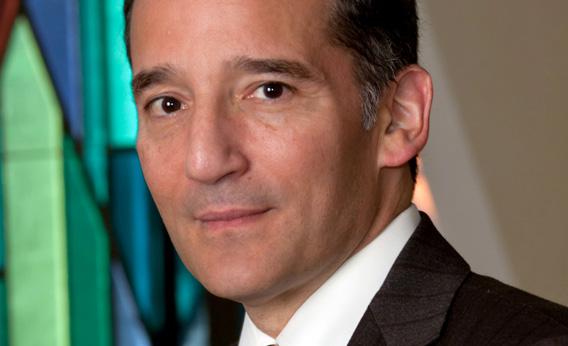
When Rabbi David Wolpe was 12 years old, he watched the Holocaust documentary Night and Fog, and stopped believing in a higher power. “Seeing radical evil convinced me that there was no God,” recalls Wolpe, the son of a rabbi and leader of Sinai Temple in Los Angeles. “But as I got older, I began to appreciate that religion wasn’t a weakness — that some of the smartest and strongest people I met were religious. [I realized] that reason wasn’t enough to build a life [on].”
That’s why the reformed atheist will battle against the motion, “The World Would Be Better Off Without Religion,” at the live Nov. 15 Slate/Intelligence Squared U.S. debate in New York. But he’ll fight with some sympathy for his nonbelieving opponents. “For many years, I used all the same arguments [against religion] that now I hear from the other side,” admits Wolpe, who remained an ardent atheist and Bertrand Russell devotee until his early 20s. “I understand them, because it makes sense to believe that this is all just an illusion that makes people feel better. But it’s not experienced that way from the inside.”
Recently, I caught up with Wolpe for a conversation about why he’ll face an uphill battle on Nov. 15, how faith relates to toothpaste, and what most people don’t understand about praying. Excerpts from the interview are below.
Slate: You’ve done similar debates on religion before. Some have gotten a little mean. Will the debate on Nov. 15 be different?
David Wolpe: I expect that this won’t be that vituperative. I may be wrong, but I don’t expect that you’re going to get a debate whose central thrust is ridicule — which you sometimes got in previous debates — as opposed to a sort of reasoned exploration of the historical and contemporary record of whether religion is good or bad for the world. [Also], the question is somewhat different [than past debates]. It’s not, “Does God exist?” or “Is there an afterlife?” but [rather] whether religion is good for the world. It’s less a theological question than a sociological and historical one.
Slate: So does that mean it will be easier for you to win?
DW: (Laughs). As opposed to the other times when it was hard to win?
Slate: I mean, since you can point to hard facts in historical evidence, rather than more elusive arguments.
DW: Let me put it this way. In one sense, there are no winners for such a debate because there’s so much evidence to go around. How you massage the facts depends on where you stand. If you judge by the votes, my sense is that the temper of the times among the people who come to such debates is that religion is a negative force. I think we’re fighting an uphill battle. I’ve sort of come to believe that people who are religious tend not to come to such debates, and that people who are opposed to religion come to see religion take a proper bashing. My guess is that in New York, we’re going start off at a disadvantage. Whether we’ll be able to make up some ground, I don’t know.
Slate: This idea that the world would be better off without religion seems pretty modern. Is it? Or has there simply been a wave of anti-religious sentiment recently?
DW: The idea is a modern. It’s one that shows a certain charming obliviousness and dangerous naiveté about human nature, as though it’s religion that makes people do bad things when in fact it’s being people that largely makes people do bad things. Religion is one of many different attempts to get them to be a little bit better than they would be if left to their own devices.
Slate: I recently spoke to your debate partner, Dinesh D’Souza, about the various societal factors that prompted this debate. He cited the rise of radical Islam and 9/11. What else got us here?
DW: I think that the possibility of comparative religion [contributed]. That’s when you see how many different religions are practiced, and you actually come to know something about them and live in proximity to them. To a certain cast of mind, it diminishes the plausibility of any of them.
Slate: Can you talk about that a little more?
DW: When I grew up, my parents used Crest toothpaste. My mother made it clear to us that it was [the only type that] any responsible and decent parent ought ever to use. When I used to go to my friends houses, they would use Colgate, or the really irresponsible ones [would use] Aquafresh. I would think, “What depraved and uniformed parents these kids must have if they don’t know that they should use Crest!” But when you get older and you start to realize [that there are many] people who are as smart, kind, and thoughtful as you, and use Pepsodent, it reduces the sense of authority that you grew up with. You start to think, “Maybe none of this is true. Maybe there is no hierarchy of toothpaste in the world.” Even though the example is trivial, I think something like that happens for everyone unless you live in a community of entirely likeminded people. People see lots of thoughtful, kind, decent people who practice other religions, and they begin to think, “What makes mine superior?”
Slate: How do most people react to that epiphany?
DW: There are three different reactions to that. [The first is when] people become defensive, brittle, and superior, diminishing the work of other religions. The [second] is people think, “Well, obviously none of this is true, it’s all nonsense.” And the third, which is my way of approaching it, is to believe that clearly, all of these people in their own way are searching to eliminate cavities. Which is a good thing. This is all a real search for something transcendent because that transcendence exists in the world. There are lots of ways of trying to approach it, but they’re all trying to approach it because it’s real.
Slate: Earlier this year, you wrote a story articulating the four reasons that atheists are angry in the Huffington Post. You also noted, “No one can seriously deny that religion has been guilty of wickedness in this world and has provided cover for wickedness. … While as a believer I think there is much more to be said about this topic, it is certainly reasonable for people to be angry at religion for its abuses, particularly people who have themselves been victims.” What more should be said about the topic?
DW: It’s true that people in the name of their religion sometimes do terrible things. And if religion is supposed to make people better, I understand why it doesn’t always have the best reputation in this world. It doesn’t always work the way it’s supposed to. The flip side of that is that the “supposed to” also comes from religion. Like, why would we expect that religion would make people better? Religion does have and promote standards. So when religious people do bad things, we’re disappointed in them because they’re religious people [and] they’re supposed to do better. In some ways, the condemnation of religion is a tribute to religion, otherwise you wouldn’t condemn it.
Slate: At a more micro-level, it seems like people often turn away from religion if something terrible happens to them or a loved one. You, too, have been through a lot as a cancer survivor. Why didn’t you denounce faith during those more trying times?
DW: A lot of people are the victims of bad theology. The bad theology is, “if I pray the right way, I’ll get the right result.” I don’t believe that. I never believed it. Sitting there in the cancer ward, I don’t think that God said, ”OK, Wolpe prayed, so I’ll take care of him. The guy in bed five I’ve heard nothing from, so that’s it for bed five.” But that’s what a lot of people believe. But if you believe that way, bad things are always going to be barriers between you and God. If you think that prayer is supposed to give you understanding, depth, strength and connection to others, then it’s different. Leona Medina, a [17th-century] rabbi, once said very beautifully, if you were standing on the shore of a lake watching a guy pull his boat to the shore, and you were confused about mechanics and motion, you might think that he was pulling the shore to the boat. People make the same mistake when they pray. Whatever they want, they’re going to move God to it. But real prayer is when you pull yourself towards God. If you see it that way, then it makes not getting the result that you want not a disproof, but an understanding that maybe that wasn’t for you.
Slate: What would a world without religion be like?
DW: I once kiddingly said if you want to know what a world that was run without genuine faith and only with goods [would look like], you don’t have to imagine it because there’s Hollywood. A world without religion would be Nietzsche’s world. It would be a world in which ultimately the only value is power. If there isn’t a transcendent value, then the strongest wins. The only thing that militates against power is the sense that there’s something higher. Without religion, I don’t know what the sense of that something higher could be. For me, it would be a very frightening world.
Slate: Can you give us a sneak peek of what you’ll argue on Nov. 15?
DW: The largest [international] aid organization in the world is a Christian evangelical organization out of Seattle. [But a lot] of the good that religion does in the world goes unreported—not because people are prejudiced against religion, but that’s just the nature of reporting the news. You don’t say, “Once again today, a religious aid worker saved someone’s life.” That just doesn’t make the paper. Religion is more complex and does much more good than people assume. Every single study in America shows that people who are part of religious communities participate in civic life more, give more money not only to religious charities but to secular charities, are more likely to help someone who’s homeless, and more likely to help someone who’s destitute. Religion does an enormous amount of good. Even though there are certainly egregious counterexamples, they are more flashy than persuasive.
