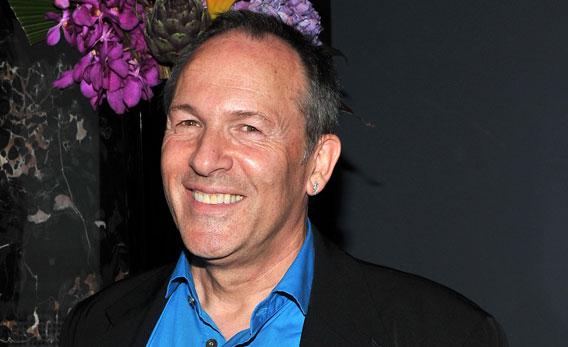
Matthew Chapman will argue for the motion “the world would be better off without religion” at the Nov. 15 Slate/Intelligence Squared U.S. debate in New York. Read more about the debate here. Find out why Chapman’s opponent, Dinesh D’Souza, thinks a world without religion would be miserable here.
People usually assume I’m an atheist because I’m Charles Darwin’s great-great-grandson. This is less than half the story. I was born into a family that went to church, and attended schools that mandated daily prayers. Sometimes a hymn or carol would move me, but mostly the whole thing left me cold—until I was 7 and had a transcendent religious experience. I describe it in my book Trials of the Monkey—An Accidental Memoir and am including an excerpt below. To give it some context: My parents’ marriage was in turmoil and they’d sent me to a prep school where small boys were caned (sometimes in public) and molested (always in private). Sometimes the two were combined: a light caning (usually just after prayers) followed by a supposedly comforting molestation. “Spare the rod and spoil the child,” as fundamentalists like to say, though in this case there was more than one rod in play and none were spared.
It was a confusing time. I had already embarked on what became a long period of delinquency or rebellion, depending on your viewpoint. But first there would be a respite for a religious phase. As I’m sure is often the case, several factors were involved.
At the age of seven, I started to pray every night. This began because our house was tall and dark and if I told my parents I wanted to pray, they’d come up with me when I went to bed. Once they were there, the longer I prayed, the longer they stayed.
Perhaps there was another reason too, of which I was not then aware. Christianity is perfectly designed to provide a replacement family—God, the father, Mary, the mother, Jesus, the brother—and at this time I feared my own family was about to self-destruct.
Although my mother and father had their doubts about this sudden religiosity, I was becoming such a wicked boy they wanted to encourage any urge toward goodness even if it might not be genuine, and so they dutifully trudged up the stairs to pray with me. Dredging about in newspapers and magazines, I located an endless and astonishing vein of human misery from which to mine the elements for my nightly pleas. I then became so moved by my descriptions of these sorrows that before long I began to think I’d like to offer my life in service to the poor wretches of whom I spoke. What had started out as fakery became authentic.
I had thought of becoming either a naturalist, a gigolo, or a sailor. Now I began to think I’d take a shot at sainthood. I dreamed constantly of being a missionary, not in an evangelical way but in the sense of being where I was needed, as a worker in a leper colony, say, or among the maimed and dying. Usually I was in Africa, sometimes India. I had no wife or children. God’s love (I saw it almost as a friendship) and the adoration of those for whom I’d given up my life, was more than enough. It was a glorious dream.
I still vividly remember the internal glow evoked by faith. I say it was a glorious dream—but it seemed real. How could I see these images of God—how could I talk to God—if he did not exist? What I saw when I closed my eyes was as real as what I saw when I opened them—and a lot less disturbing.
I thought I should begin my ascent to sainthood by reading the Bible cover to cover. I was a slow reader, but eventually I reached Leviticus, the third book of the Old Testament and of the Hebrew Bible. When I got to Chapter 20, Verse 13, I came across this: “If a man lieth with a man as he lieth with a woman, both of them have committed an abomination: they shall surely be put to death.” I was a little taken aback. At that time, the only truly civilized and loving couple I knew was my gay uncle and his partner. Yet here was God speaking directly to Moses and basically saying, “Kill them.” My uncles!? Why? It made no sense. I ploughed on through the Old Testament but with a growing suspicion that the God I was reading about was not just narcissistic, misogynistic, and genocidal, but completely and utterly insane.
By the time I was 9, I discovered that my uncle and his partner would face long prison sentences if their homosexuality was revealed. It was clear that this legalized homophobia came mainly from Leviticus 20:13 because the verse was often quoted by both politicians and the clergy. It’s still quoted by many Christian sects and violence is only its most obvious consequence. I will leave for another time an account of the ways in which the lives of my two uncles, for that is how I think of them, were restricted and diminished by this church-state cruelty. Or you can read my Uncle Ben Duncan’s illuminating and moving book, The Same Language, which is about life as a gay man in England at that time.
Moderate believers find excuses for Leviticus 20:13, but they can’t argue that the verse is “metaphorical” or “poetic.” It’s situated between specific and practical rules about how to kill and eat animals and when it’s appropriate to beat or stone your wife to death.
Reading the Bible shocked me out of Christianity. I often wonder how many avowed Christians have actually read it, because it is one of the most brutal, repetitive, and contradictory books in existence.
When I came to America in the ‘80s, I began hearing about creationist attacks on the teaching of evolution in schools. For the first time, being a Darwin descendent became relevant. In England and most of Europe, creationism—the idea that the Bible explains the development of life on Earth better than science—was taken about as seriously as alchemy. I watched the antics of creationists out of the corner of my eye, thinking this must be a minor aberrational phenomenon not worthy of attention. But eventually, the subject drew me in. My first book, Trials of the Monkey—An Accidental Memoir, was an account of the so-called Scopes Monkey Trial in 1925 and my trip to Dayton, Tenn., the small town where it took place.
A few years later, Harper’s Magazine asked me to cover the 2005 Kitzmiller v. Dover trial in Harrisburg, Pa. Eleven parents had sued their school district after fundamentalist Christians on the school board tried to get creationism (they later changed the word to intelligent design) taught alongside evolution in the ninth-grade science class. The plaintiffs argued this contravened the Establishment Clause of the First Amendment, the section that prohibits the teaching or presentation of religious ideas in public school science classes. (I later wrote a book about the trial called, for reasons you will understand only if you read it, 40 Days and 40 Nights—Darwin, Intelligent Design, OxyContin, and Other Oddities On Trial in Pennsylvania.)
During the six weeks of the Kitzmiller v. Dover trial, I met many of the leading intelligent design activists. Often described by its critics as “creationism in a lab coat,” intelligent design is almost demented in its denial of what is scientifically demonstrable. Its advocates spin elaborate “scientific” fantasies in defense of religious belief. By the end of the trial—a scientific and philosophical battle in a federal court—one of intelligent design’s most outspoken critics was Republican Judge John Jones. He ruled in favor of the plaintiffs, slamming the fundamentalists and their scientific supporters for their intellectual dishonesty.
After a fellow reporter at a Harrisburg newspaper revealed that I was a Darwin descendent, I became an object of curiosity and sometimes animosity. I was invited to homes and churches in the area to talk about my views, and on a couple of occasions to endure attempts at conversion. A preacher told me that Darwin was synonymous with Satan and that I was therefore damned myself. This was unusually extreme, but I often met people who, given a choice between evidence and faith, instantly chose faith no matter how good the contradictory evidence was. These conversations had a unique quality: I was talking to people whose way of thinking—or not thinking—had usually been ingrained in them as children. No amount of rational discourse would change their minds. They were hardwired to have blind faith and be suspicious of reason. Faith had made them stupid, angry, and, I would argue, dangerous.
Faith is why we don’t want Iran to get a nuclear bomb. It’s also why we are terrified of Islamic radicals taking over Pakistan, where nuclear weapons already exist. Faced with the potentially horrific consequences of ancient faith married to modern weaponry, we should be questioning the whole concept of religious faith, including our own. But, for obvious reasons, we aren’t. As I learned in Pennsylvania, that faith—a diseased appendix of the mind—is not so easily removed.
When I read the Bible as a child, my disenchantment with religion began. But ironically, it was in the state founded by William Penn to be a liberal and inclusive religious sanctuary that I saw so much angry and exclusionary faith. It was there that I discovered its universal potential for harm. I left Pennsylvania with my journey to atheism complete.
