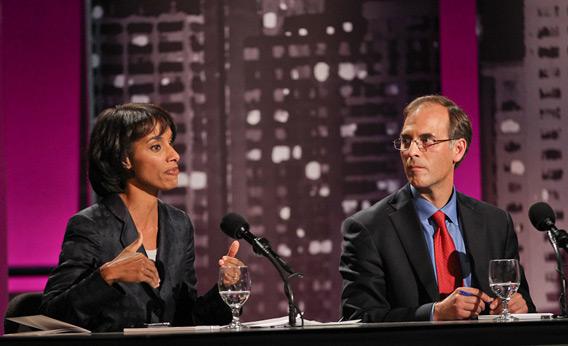
Earlier this week, President Obama, ardent lover of three-word mantras, introduced a new slogan for his American Jobs Act: “We can’t wait!” The president exhorted Congress to act on the jobs creation plan he introduced in September. The audience at last night’s Slate/Intelligence Squared U.S. live debate at NYU’s Skirball Center vehemently agreed with the president: After the conclusion of the debate, 69 percent voted for the motion “Congress should pass Obama’s jobs bill—piece by piece”; 22 percent voted against the motion; and 9 percent were undecided. The audience was also polled before the debate began. (The side that attracts the most new supporters post-debate wins.) Forty-five percent voted for the motion, 16 percent against, and 39 percent were undecided.
The audience’s overwhelming vote to pass the bill may have reflected its deep skepticism of the side opposing the motion. NYU law professor Richard Epstein and Cato Institute senior fellow Dan Mitchell endured hisses and boos, while chief economist of Moody’s Analytics Mark Zandi and Princeton University economics professor Cecilia Rouse won laughter and applause as they took the president’s side.
Zandi and Rouse argued that Obama’s jobs plan will ensure we don’t slide into a double-dip recession, and that passing pieces of the act should be the beginning, not the end, of our overall strategy to boost the stagnant economy. “We just can’t go into recession,” Zandi emphasized. “If we do, tax revenues will fall, government spending will automatically increase, and the $450 billion the president has proposed to pay will seem small in the context of the losses we’ll suffer.” After Congress passes the plan, Zandi said, we’ll need to focus on longer-term issues like deficit reductions, tax reforms, and pro-growth policies. But the long-term doesn’t matter if we don’t get our policy right in the short-term.
Epstein and Mitchell predicted a similarly dire economic future if Congress passes the plan. The jobs plan won’t work, they explained, because it’s just a copycat of historically ineffective stimulus bills. The American Jobs Act will kill jobs and cripple the economy, Mitchell said, because it relies on the inefficient public sector to do private sector jobs. And it’s bogged down by faulty economic theories. The plan introduces more bureaucratic red tape—like a clause forbidding discrimination against hiring the unemployed—that will shackle markets and hamper job growth. Even the president’s proposed one-year payroll tax holiday, Epstein and Mitchell asserted, won’t spur hiring because companies don’t make long-term decisions based on short-term policies. “You must create lower tax rates that last for a longer period of time if this is going to be able to succeed, ” Epstein explained. “Any kind of short-term fix at this particular point is doomed to failure.”
Mitchell and Epstein began the debate strongly, especially when Mitchell engaged the audience in a clever “quiz” to show that the American Jobs Plan is simply a repeat of failed economic policy. “Let’s divide this room in half,” he began. “Let’s borrow all the money out of the pockets of the people on this side of the room and give it to the people on this side of the room. Now here’s the quiz. Raise your hand if you think there’s more money in the room.” The audience chuckled. This stimulus, he explained, is simply a redistribution of national income. “Our goal should be not to redistribute national income; we want to increase national income,” Mitchell said. “We want a bigger pie so everyone can get a bigger slice; that’s what economic growth is all about.”
But soon, Mitchell and Epstein seemed to fall from grace.
Epstein drew the first rebuke by asserting that in taxing the top 1 percent of the population to pay for President Obama’s Jobs Plan, “it turns out that you’re taking money from the hands of people who know how to use it …”
Boos and hisses.
“… and to put it into the hands of a government which simply does not.”
Not true, countered Rouse. “If you look at experience over time, there’s not a great relationship between high marginal tax rate and economic growth,” she fired back. Reagan, she explained, lowered tax rates for high income individuals while Clinton increased them. Clinton’s presidency saw more growth than Reagan’s.
A little later, Epstein’s remarks sparked another round of booing. ABC News correspondent and debate moderator John Donvan asked him to explain the downsides of infrastructure investment, a central part of the president’s plan.
“If you look at this particular statute and the elaborate hoops that you have to go through, it is not a bill which is designed to promote infrastructure,” Epstein said. “It is a bill which is designed to make sure that the president’s supporters, strong union members, get jobs which will allow them to contribute to the campaign to win.”
Epstein’s prolix tendencies didn’t help either. “Do you know that when you speak, there’s only commas at the end of everything you say?” Donvan quipped at one point. “I was looking for the period to break in, and there were semicolons and dashes and commas.”
Mitchell, too, elicited a number of angry audience outbursts, especially after he contended that “people get jobs quicker when unemployment insurance runs out.” He even egged on the disgruntled crowd: “Yes, hiss me! Hiss me!”
After the debate, Donvan reflected on Mitchell’s debate strategy. “Dan Mitchell’s willingness to play the ogre, as he put it, read fun and bold, but I think it didn’t help sell the side,” he said. He even thought Mitchell and Epstein “presented a more comprehensive argument” than the other team. But it “was also the view from 30,000 feet, and less satisfying for an audience asking for a jobs solution right now.”
Just as Zandi and Rouse argued that Congress can “walk and chew gum at the same time” in reference to a simultaneous focus on long-term and short-term economic policy, the pair was also able to employ two killer debate strategies at once: They nailed the urgency rhetoric while conceding some of the other side’s rational points.
“I do think some of the policy steps have created uncertainty for businesses and for the banking system,” Zandi said. “And that’s impaired the ability and willingness of businesses to step up and hire and for banks to lend. But that does not preclude the fact that we need to reduce some of the fiscal restraint that’s dead ahead of us. If we don’t make some policy steps here, taxes are going to rise on everybody. Unemployment insurance for many hard-pressed households [is] going to expire. And that’s the prescription for a recession.”
When I asked Mitchell why he lost after the debate, he told me it was because he was forced to play the villain. “The challenge of defending free markets and limited government is that you’re telling people there’s no Santa Claus,” Mitchell said. “Everyone likes to think that there’s some magic wand the government can wave, and especially if you’re in a position where you can be pigeonholed as somehow defending the interest of the wealthy, it makes it even harder.”
Why did Zandi win? “I thought I was funny,” laughed Zandi, who also won an Intelligence Squared debate a few years ago. “I thought that made a big difference, actually.”
