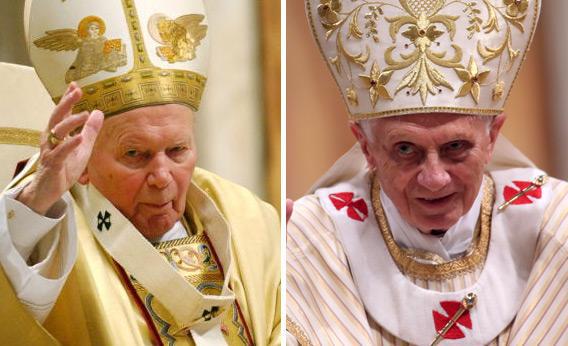
Eight years ago, when Pope John Paul II passed away, the United States Conference of Catholic Bishops praised him for staying on the job to the bitter end. “The elderly and infirm have been inspired by his indefatigable perseverance as his own physical limitations mounted,” said the bishops’ president.
Today, the bishops are praising John Paul’s successor, Pope Benedict XVI, for quitting. “His resignation is but another sign of his great care for the Church,” said the bishops’ new president.
The bishops aren’t alone. A chorus of Catholics is singing a new tune. When John Paul died, his biographer, George Weigel, lauded him for sticking it out:
His last years were full of pain and suffering. Yet he never tried to hide his deteriorating physical capacities; he seemed unembarrassed by frailty; and by continuing his papal service until the very end, he fulfilled the pledge he believed he had made to the Church, and to the Church’s Lord, at his election on October 16, 1978—the pledge to spend out his life in strengthening his Christian brothers and sisters in their faith.
Now Weigel has adjusted his perspective. “It’s a great statement about the humility of Joseph Ratzinger,” he said of Benedict’s abdication. “In a strange way, this is his last great service to the Church. He wants the Church to have the kind of strong leadership that it needs.”
When John Paul died, Peggy Noonan glorified his decision “to work to the very end” despite near-total incapacitation. “He held on to life as if to show us what he had for so long told us—life is precious, love it, use it, pour yourself out. Spend yourself.” In this way, Noonan wrote, John Paul “reminds us it is crucial to see the beauty in the old, the infirm, the imperfect. … He showed us this truth by presenting himself to the world each day as he was. … Repeatedly pressed to retire, to give himself some rest after his mighty labors, he refused. ‘Christ didn’t come down from the cross,’ he said.”
Now that Benedict is retiring, Noonan takes a different view:
Benedict is old, 86, and for 24 years, as John Paul’s Prefect of the Sacred Congregation for the Doctrine of the Faith, he was one of the few to see, up close and day by day, the price the Vatican as an institution paid for the otherworldly courage of John Paul, whose last few years were one long goodbye, and whose ability to administrate was diminished as he became physically disabled. …And he is older than John Paul was when he died at 84. Perhaps in Benedict’s decision we are seeing not a witness to suffering but an act of self-sacrifice and humility that in its own way too is other-worldly.
In Noonan’s retelling, Benedict’s exit is almost Christlike, shouldering and purging the sins of others: “The scandals that grew under John Paul … had to be faced and addressed by Benedict. Maybe he hopes he took the burden on his back and, as he leaves, can bear it away.”
Across the Catholic blogosphere, writers are struggling to rationalize Benedict’s decision. “He refused to let his bodily weakness be a vehicle for damage to the Church,” says one commentator. Through an “all too rare” surrender of power, says another, he “has given an example to the world of how to step aside gracefully and beautifully.” A third writer sees the two popes as complementary: “Pope John Paul II soldiered on to help show the world that disability was no disgrace. However, Pope Benedict XVI must have felt that since that example was already shown to us, he would chart a different path.”
It’s obvious what’s going on here. These are people of faith. They’ve put their faith in a church and the men who lead it. They’re determined to find virtue and wisdom in these men, even when two consecutive popes choose completely different courses.
But Catholics, like people of other religions, differ in personality and belief. And that’s what makes their reactions to Benedict’s abdication interesting. Some, apparently steeped in papal infallibility, insist that both popes must be right, because there can be “no doubt that Benedict’s decision,” like John Paul’s, “was guided by the Holy Spirit.” As one writer says of Benedict: “If he thought this was the best for the Church then who am I to disagree?”
Others are more critical. John Paul, “who suffered and bent under the burden of the Petrine office as illness consumed him,” was “a powerful witness to the dignity of human life,” concedes Thomas McDonald. But the pope’s decline, McDonald adds, “also affected the way he managed the church, and as the abuse scandal exploded, that was something we could ill afford.” Pat Archbold draws a similar conclusion:
While we all witnessed an enfeebled holy man suffer great infirmity in love and patience, Cardinal Ratzinger must have seen much more. He must have seen how during those years of decline the Vatican bureaucracy becomes de facto pope and how that de facto Pope can thwart and subvert the will of the legitimate Pope.
That’s a pretty sharp critique of what John Paul did. But there’s a case to be made against Benedict’s choice, too. Ross Douthat acknowledges that Benedict, like John Paul, faced years of decay. Nevertheless, Douthat argues, the pope should die in office for three reasons: First, he’s “a spiritual father more than a chief executive.” Second, he serves God, and “if God wants a new pope, He’ll get one.” Third, “the church is still supposed to be the church even when its human leadership isn’t at fighting trim.” Far from accepting infallibility, says Douthat, Catholicism must frankly endure “leaders who are wrongheaded, incompetent, senile or corrupt.”
This is a debate well worth having. On one side, those who think, on reflection, that Benedict was right to step down and that John Paul, for the same reasons, was wrong to hang on. On the other side, those who believe that John Paul was right and that Benedict, for the same reasons, is wrong to quit. A clash between these two schools won’t be as tidy as a chorus of gymnastic apologists bent on defending both popes. But it will be more fruitful and more honest.
William Saletan’s latest short takes on the news, via Twitter:
